
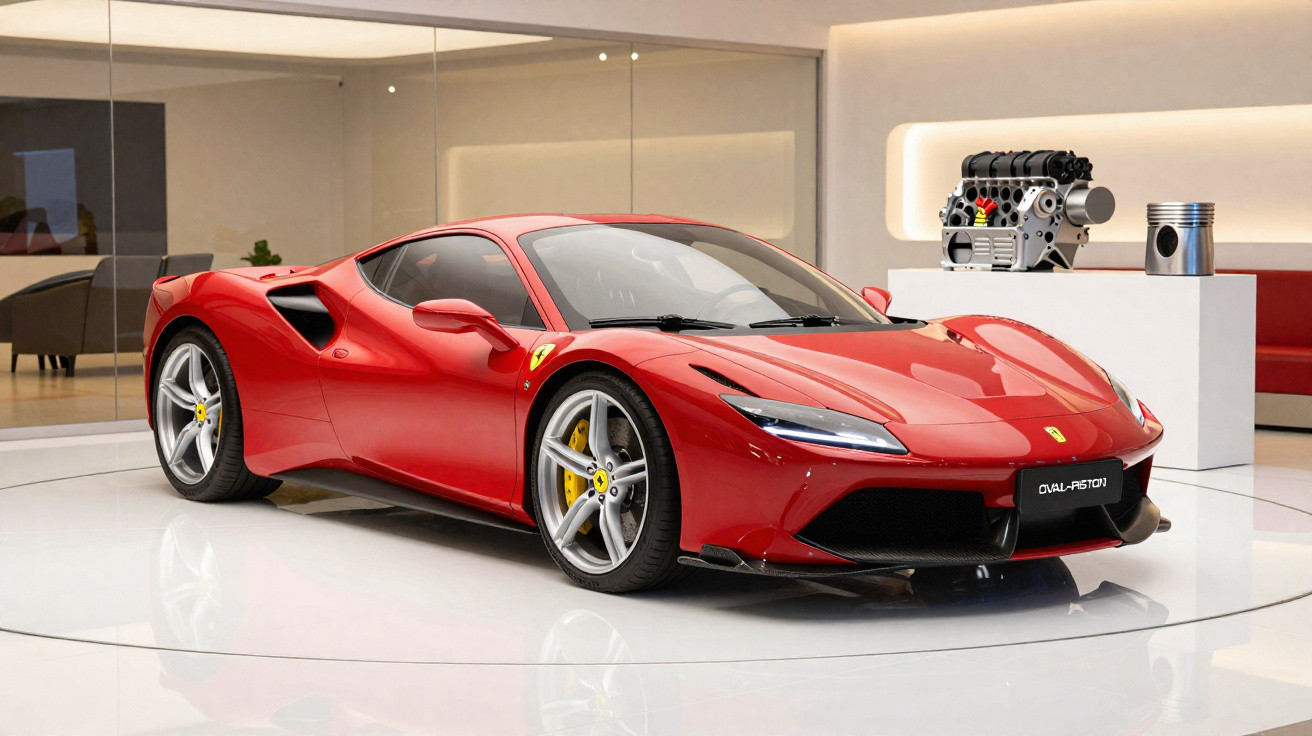
The room was almost silent: only the soft rattle of laptop keys, the thin hum of fluorescent tubes, and that familiar Maranello blend of carbon fibre and espresso in the air. A slide lit up with a piston-except it looked off. Longer. Flatter. Nearly oval. A couple of journalists edged closer; the engineers didn’t even flinch. They’d lived with that outline for years. For everyone else, it was like watching someone quietly redraw a circle.
Off to one side, beneath a clear acrylic cover, sat a metal component that resembled a precision capsule more than a conventional piston. People keep waiting for Ferrari to reveal another V12, another soundtrack, another headline number on a spec sheet. Instead, they’ve slipped in a change of geometry-something that could unsettle a lot of what we assume about how engines must work.
One engineer dropped his voice, as though the part itself might be listening. “This,” he said, “is where it starts to get weird.”
A strange piston that could change everything
Seeing Ferrari’s new oblong piston for the first time triggers an almost automatic rejection: pistons are meant to be round-end of discussion. This one is stretched sideways, with a longer major axis and a tighter radius, as if a standard piston had been gently compressed in a vice. On a projector it seems like a nuance; in the metal it feels oddly provocative, as though the engine block had to learn a different grammar.
Inside Ferrari, the formal label is “advanced oblong piston architecture”. Out in the workshop, it’s already collecting nicknames: the lozenge, the capsule, the “espresso pill”. The humour covers a more serious undercurrent. If the concept delivers what’s implied, it points to more power from the same displacement, cleaner combustion, and a fresh way to think about friction and thermal behaviour-changes that don’t leave many old assumptions intact.
The on-track impression is even more unusual. One test driver, speaking off the record, said the prototype engine “pulls like a turbo with no turbo”. The torque arrives as a smooth, linear surge that doesn’t quite align with what your ears expect, because the sound character shifts in surprising parts of the rev range. You lean into the throttle anticipating the familiar climb, and instead the car simply keeps biting-like someone has quietly extended the useful rev band.
Fragmentary internal figures shared by Ferrari suggest double‑digit efficiency improvements in certain load windows, plus a measurable drop in cylinder wall wear over long-duration running. Gains of that scale are normally associated with control software, hybrid assistance, or fuel and calibration tricks-not with a single piece of metal moving up and down. Here, the headline change is buried in the silhouette: longer combustion-chamber exposure, tighter influence over flame travel, and a more sympathetic relationship with airflow.
Strip away the theatre and the principle is straightforward. By stepping away from a perfect circle, Ferrari can subtly reprofile the combustion chamber. That opens up finer control over where the fuel–air charge sits, how it is compressed, and how the flame front propagates. It’s less about merely containing an explosion and more about shaping the route it takes. At the same time, that longer axis spreads forces over a slightly broader area, easing peak loading on the cylinder wall and the wrist pin.
The compromise is obvious: more demanding machining, narrower tolerances, and an approach that’s hostile to high-volume production. A circle is forgiving. An oblong form isn’t. But this is Ferrari’s natural territory-where geometry, metallurgy and software overlap, and where chasing 1% improvements can justify huge investment. The real surprise is that this isn’t necessarily limited to racing applications; the consequences could reach everyday engines in ways we’re only beginning to understand.
How the oblong piston might escape the racetrack
If you use anything powered by an engine, there’s a practical angle here. The oblong piston isn’t primarily about giving wealthy buyers a marginally faster supercar. The larger story is what happens if the idea migrates into smaller powertrains-city cars, lorries, hybrid systems, perhaps even stationary generators. Imagine reduced vibration on the school run, an engine that wears more gently, or a compact hybrid extracting 5–10% more useful work from each drop of fuel.
Reduce it to one main outcome: more controlled combustion. With added horizontal length, Ferrari can influence where peak temperatures occur and how long the charge remains in the most effective pressure window. The result is that more chemical energy becomes motion, and less disappears as wasted heat or knock. For an everyday driver, that can translate into similar performance at slightly lower revs, or the same pace with less throttle. It’s not as dramatic as a lap-time headline, but it changes how an engine behaves at 2,000 rpm in traffic.
Picture a modest turbocharged four-cylinder in a family SUV using a toned-down interpretation of this approach. The oblong piston could help keep combustion cleaner at low load, reduce micro‑knock, and allow less aggressive enrichment when you accelerate hard. The net effect is an engine that feels calmer in stop–start driving, a fuel gauge that falls a touch more slowly, and emissions targets met without strangling response. You may never see the words “oblong piston” in the brochure, but you might notice how unbothered the engine feels on a cold Monday morning.
Ferrari engineers also suggest the geometry is well suited to alternative fuels and higher e‑fuel blends. Broader ignition authority, improved swirl behaviour, and steadier flame travel across different octane levels all get a mention. That’s the quieter shift: building an engine core with enough flexibility to cope with whatever odd fuel mixtures the next couple of decades bring. When regulation and supply realities tug in different directions, a combustion chamber that can be re-optimised in software-rather than remade in metal-starts to look like a genuine advantage.
Mechanically, the oblong concept forces a re-write of familiar rules. A subtly different side-loading pattern alters oil-film behaviour, affects how rings bed in, and changes the routes by which heat leaves the bore. Ferrari reportedly had to develop fresh simulation tools simply to forecast long-term wear. This isn’t a superficial tweak; it’s a fundamental intervention in how each stroke plays out.
The barriers are real: manufacturing expense, quality assurance, patent disputes, and an industry instinctively loyal to the circle. But there’s a sharper point too. As electrification keeps raising expectations, combustion engines can’t simply be “good enough”. They either become substantially better, or they get pushed aside. This oblong piston is Ferrari’s way of planting a marker and saying: the era of fire isn’t finished.
What this means if you’re not an engineer
You don’t need CFD running on a laptop to grasp what’s in play. Treat the oblong piston as a rare glimpse of how manufacturers are trying to wring unexpected life out of combustion. Whether you’re shopping for a sports car, choosing a daily driver, or you simply enjoy engines, a few simple habits can help you see past marketing gloss.
Start by noticing how brands discuss combustion chamber design rather than quoting only horsepower. Phrases such as “asymmetric piston”, “advanced squish zones”, and “optimized flame propagation” may sound like jargon, but they often signal that a company is reworking the hardware-not just adjusting maps. When Ferrari is willing to go oblong, it nudges others to revisit their own geometry, even if they do it more quietly.
When you test drive cars in a few years’ time, pay attention to the details. Does the engine pull cleanly from low revs without shuddering or a hesitant lull? Is it strangely willing yet composed between 1,500–3,000 rpm-the band most people inhabit most of the time? That’s exactly where something like an oblong piston can deliver benefits without fanfare. On a long motorway run you might notice less droning, fewer downshifts, and a sense that the engine “breathes” more freely. That isn’t magic; it’s geometry earning its keep.
And, realistically, nobody reads a 120‑page technical white paper before buying a car. Most of us skim a few reviews, watch two YouTube videos, and then choose with our gut and our budget. That’s human. So treat exotic innovations as a gentle lens, not a shopping checklist. If a manufacturer boasts about radical piston technology, ask what it means for warranty coverage, durability, and long-term servicing. A beautiful CAD rendering is worthless if the part can’t tolerate poor fuel and real-world neglect.
Ferrari’s own team understands the constraint. One senior engineer told me quietly:
We can’t afford genius that breaks on Tuesday. Whatever shape we choose has to survive the way people really drive, not the way we wish they did.
That one line points to a simple truth: technology only counts once it survives everyday mess. A winter cold start on cheap fuel, with tired oil, driven by someone late for work. A sustained high-speed run where the throttle stays pinned longer than the lawyers would prefer. The moment you misjudge a merge and suddenly need every available kilowatt.
- Look for engineering that improves real-world drivability, not only peak figures.
- Ask how unconventional designs are validated for long-term wear.
- Notice how the engine behaves in the first 10 minutes after start-up.
- Be sceptical of buzzwords that don’t come with a clear everyday benefit.
- Remember that quiet changes in geometry can outweigh loud slogans.
A new chapter in the story of combustion
Most of us have heard some version of: “the future is electric, end of story”. Part of you agrees; another part misses the smell, the sound, the mechanical pulse of an engine. Ferrari’s oblong piston isn’t an argument against electrification. It’s simply a refusal to let the combustion era close with complacency.
This oddly shaped piece of metal asks a bigger question: how much invention is still hiding inside things we treat as settled? The wheel, the piston, the four-stroke cycle-so familiar we assume they’re finished. Then someone stretches a diameter, reshapes a curve, redirects a flame front, and the old mechanism finds a new capability. Changes like that rarely stay in one corner; they tend to spill into other industries and other problems.
There’s also a certain elegance in Ferrari choosing not to innovate through more cylinders, more revs or more theatre, but through a discreet twist of geometry. No fireworks-just a strange capsule sliding up and down in a steel bore. Yet that small act of rebellion could produce engines that waste less, last longer, and cope better with uncertain fuels and shifting rules. An unexpected form moving in the most familiar rhythm-up, down, up, down-that could transform what happens in between.
| Key point | Detail | Why it matters to the reader |
|---|---|---|
| Oblong piston geometry | A longer, flattened piston that reshapes the combustion chamber and redistributes load | Clarifies why this is a fundamental rethink rather than a cosmetic tweak |
| Real-world impact | Potential for smoother torque, improved efficiency, and cleaner combustion at everyday revs | Links exotic Ferrari engineering to what your next car may actually feel like |
| Future flexibility | Designed to cope with evolving fuels and tighter regulations | Explains how combustion can remain relevant as electrification accelerates |
FAQ:
- Is Ferrari really going to use oblong pistons in production cars? Ferrari hasn’t named a specific model yet, but engineers describe the tech as “industrialisation-ready”, which usually suggests limited-series cars or high-end engines will come first.
- How is an oblong piston different from older oval racing pistons? Earlier oval ideas were often extreme and fragile; Ferrari’s version appears to prioritise a subtle, manageable shape compatible with modern materials, coatings and precise electronic control.
- Will this technology make engines louder or quieter? It’s less about outright volume and more about character: expect smoother torque delivery and a slightly different “texture” to the sound as combustion becomes more tightly controlled.
- Can this design reduce fuel consumption in normal driving? That’s one of the core aims. By lifting combustion efficiency at low and medium loads, it could lower consumption without blunting performance.
- Does this innovation delay the move to electric cars? It won’t stop electrification, but it could extend the useful lifespan of advanced combustion engines-particularly in performance cars and hybrid powertrains.






Comments
No comments yet. Be the first to comment!
Leave a Comment