
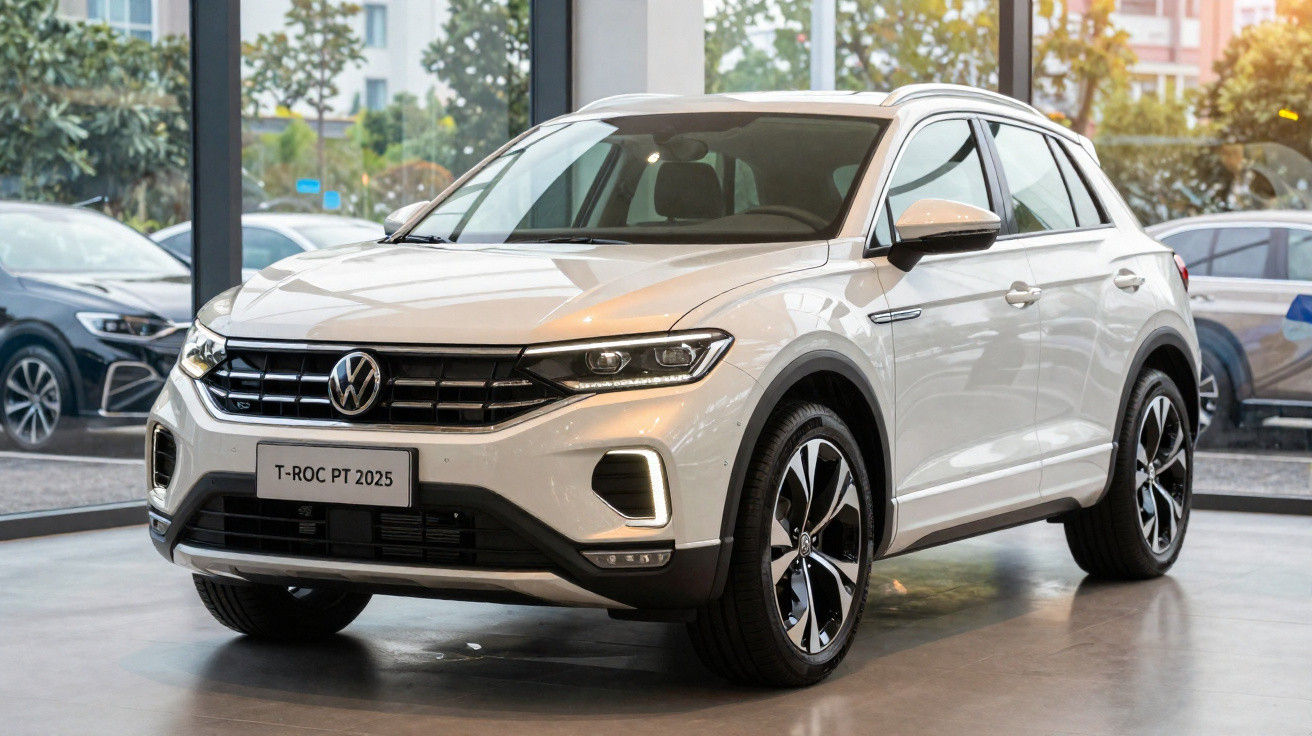
Portugal-built, locally penalised: that is how the Volkswagen T-Roc’s commercial story is set to play out in Portugal. The model runs head-on into Portuguese car taxation, where the ISV calculation places 60% of the burden on the engine capacity of combustion units.
Volkswagen T-Roc engines: the end of the 1.0 TSI and the arrival of the 1.5 eTSI
This second-generation T-Roc - a model that, since 2017, has already sold more than two million units in Europe - is no longer offered with the familiar 1.0 TSI 116 hp engine that previously served as the range’s entry point.
In its place comes a new version of the 1.5 TSI with the same power output but improved efficiency, and it also adds a 48 V mild-hybrid system. In practical terms, that means CO₂ emissions of 125 g/km, which is 6 g/km lower than the outgoing 1.0 TSI (131 g/km), now discontinued.
Leaving the factory, the price gap between the two engines is not especially large. However, once Portuguese taxation is added to the model’s base price, the picture changes. The higher tax burden on the entry-level T-Roc translates into a price increase of roughly €2,500.
If you then factor in the removal of the manual gearbox - increasingly unwanted in the main European markets - with the dual-clutch transmission naturally costing more, plus the addition of a mild-hybrid system, Volkswagen representatives say the total rise for the new Volkswagen T-Roc could reach €4,000.
Autoeuropa and the importer find a solution
According to Volkswagen Portugal officials, speaking during the Portuguese press presentation of the new T-Roc, the importer (SIVA / PHS) and the factory (Autoeuropa) worked together in an effort to absorb part of this price increase.
As a result, the second generation of the German SUV, in entry-level Trend trim with the 1.5 eTSI 116 hp engine, is available from €33 592. See all prices:
The fourth victim in just a few months
Portuguese taxation does not distinguish by nationality or segment. With smaller engines disappearing and being replaced by more efficient hybrid units that also have larger displacements, it is the Portuguese state’s coffers that benefit.
Alongside Volkswagen, Toyota, Dacia and Renault are also feeling the effects of Portuguese car taxation, whose most recent update took place 18 years ago, in 2007.
The new Toyota Aygo X will also lose its 1.0-litre three-cylinder and move to a 1.5-litre hybrid engine. That will push the price of Toyota’s cheapest model to close to the €20,000 mark.
A similar path awaits new Renault and Dacia models, whose hybrid engines will increase from 1.6 litres to 1.8 litres in capacity.
Why lower consumption and emissions can still mean higher prices in Portugal
All of these models have lower fuel consumption and reduced emissions in common, yet because Portuguese taxation is heavily based on engine capacity, in Portugal the most efficient cars are more expensive than the more polluting ones.

Comments
No comments yet. Be the first to comment!
Leave a Comment