
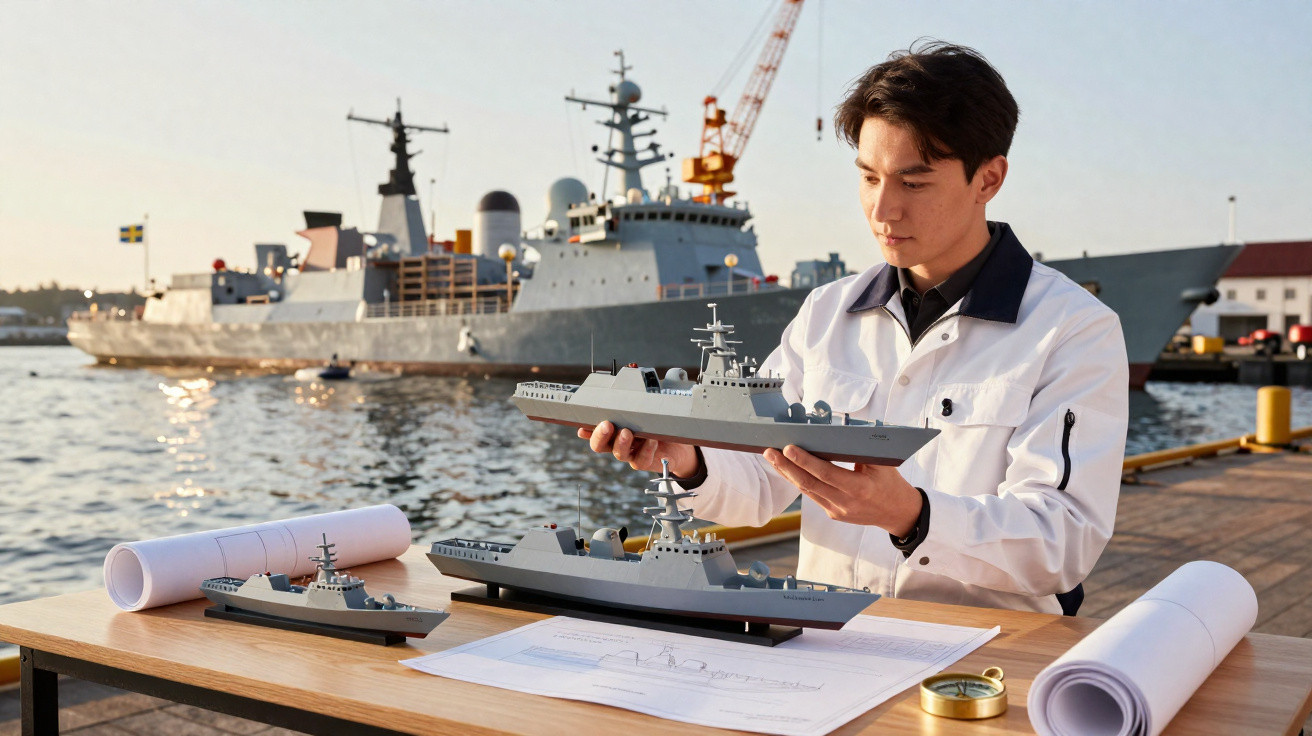
Sweden’s naval planners, meeting out of the public eye in Stockholm, are now weighing a pivotal option: strengthen maritime cooperation with France’s Naval Group, or support a new team-up between national prime Saab and the UK’s Babcock centred on the Arrowhead 120 frigate.
Franco-Swedish defence ties put to the test
Over the last decade, France and Sweden have steadily tightened their military relationship. The two armed forces already rely on several shared systems, including NH90 helicopters, BvS10 all-terrain vehicles and the AT4 family of anti-tank weapons.
Swedish special forces have also served alongside French troops in the Sahel as part of Operation Takuba. Beyond deployments, Paris and Stockholm have carried out demanding joint exercises and even swapped kit, notably with Swedish CB90 fast boats temporarily loaned to the French Navy.
At the high-end capability level, the links extend to anti-tank efforts such as Akeron MP and NLAW, as well as the European long-range strike initiative known as ELSA.
France has quietly built a dense web of defence cooperation with Sweden, setting the stage for a naval pitch that is anything but routine.
The relationship took another step forward at the end of 2023, when France’s procurement agency, the DGA, confirmed it had ordered two Saab GlobalEye airborne early-warning aircraft, with options for two more. In French defence circles, the purchase was widely viewed as a potential political lever.
The assumption in Paris is straightforward: if France is buying Swedish top-tier sensors, it should be easier for Sweden to pick a French-designed frigate for its future surface combatant programme.
The 5‑billion-euro Luleå frigate programme
Sweden’s “new generation surface combatant” project-often dubbed the Luleå programme-seeks four large frigates for around €5 billion. Once delivered, the ships are intended to underpin Royal Swedish Navy operations in the Baltic and Arctic for decades.
Stockholm is looking for platforms able to counter air threats, track and engage submarines in challenging waters, and sustain lengthy deployments in tough northern climates.
Early on, Swedish decision-makers leaned towards building much of the programme domestically, with Saab and national shipyards playing substantial roles-consistent with Sweden’s long-standing aim of keeping a capable naval industrial base at home.
From “local build” to “turnkey” ships
That stance changed in 2023, when the Swedish Defence Materiel Administration (FMV) started a process to procure four “turnkey” ships. Put simply, Sweden would choose an existing design and receive complete vessels, rather than managing a predominantly domestic design-and-build effort.
The revised approach broadened access for foreign bidders, notably France’s Naval Group, Spain’s Navantia and the UK’s Babcock.
- Initial intent: heavy local industry role, Saab as prime partner
- Policy change: move to four turnkey frigates from foreign designers
- Result: intensified competition between Naval Group, Navantia and Babcock
Naval Group’s FDI: France brings its showpiece to Gothenburg
Naval Group has been positioning its Defence and Intervention Frigate (FDI) as a close fit for Swedish requirements. Its lead ship, Amiral Ronarc’h, recently made a highly visible visit to Gothenburg during an extended deployment ahead of entering active service.
French messaging around the port call was deliberate: this is an operational vessel already sailing, not a concept on paper. Officials in Paris argue the FDI is genuinely multirole and engineered with northern operating conditions in mind.
Naval Group promotes the FDI as a fully equipped, already sailing frigate, tailored for demanding northern seas.
France’s armed forces minister Catherine Vautrin has said publicly that Naval Group could provide Sweden with a first FDI “fully equipped” and ready to operate. She also raised the prospect of an industrial partnership with Sweden, explicitly identifying Saab as the essential counterpart.
The offer hinted at a broader trade-off: Swedish firms would receive workshare and access to technology within an FDI-based approach, while Sweden would bind its naval future more closely to France and to other FDI users, including Greece.
Saab’s unexpected move: an alliance with Babcock
A central complication for the French proposal is that Saab does not want to sit in a subordinate role beneath Naval Group. Instead, the Swedish defence company has reinforced an alternative route by deepening its existing collaboration with Babcock.
Saab has now confirmed that it and Babcock will put forward the Arrowhead 120 frigate to the Swedish Navy. Under this arrangement, Saab will front the effort in Stockholm and engage directly with the FMV.
Saab intends to lead, not follow, in Sweden’s future frigate programme - and sees Babcock’s Arrowhead design as the right vehicle.
In past international bids-including the competition that led to the Royal Navy’s Type 31 frigates-Babcock promoted the larger Arrowhead 140. For Sweden, however, the British group has adapted the concept into a smaller variant: the 120-metre Arrowhead 120, shaped specifically around Baltic and Arctic operations.
What is the Arrowhead 120?
Babcock says the Arrowhead 120 would displace about 4,000 tonnes and have a length of 120 metres. It is presented as a modular frigate designed for lengthy deployments and high endurance.
Saab and Babcock highlight robust air-defence performance and sophisticated anti-submarine warfare systems as defining qualities-capabilities that sit at the core of Sweden’s stated operational needs.
| Feature | Arrowhead 120 (proposed) |
|---|---|
| Length | 120 metres |
| Displacement | Approx. 4,000 tonnes |
| Primary roles | Air defence, anti-submarine warfare |
| Air assets | NH90 or MH-60 Seahawk helicopter, plus aerial drones |
| Design approach | Modular, long-endurance deployments |
Lars Brännström, deputy head of Saab Kockums, has said the Arrowhead 120 is well matched to missions in the Baltic Sea, the North Sea and the Arctic. He points to range and autonomy for extended operations, as well as resilience in cold water and in crowded, shallow areas.
Why Saab–Babcock changes the balance
From Sweden’s perspective, Saab’s decision to align with Babcock creates a blended proposition: a hull concept with international credibility combined with a powerful domestic prime contractor.
Such a structure could help meet several political and industrial goals simultaneously. Saab would stay central to adapting the design, integrating Swedish combat systems and providing long-term support. In parallel, Stockholm could draw on Babcock’s experience from the UK’s Type 31 programme and wider export work.
The Saab–Babcock tie‑up offers Sweden foreign shipbuilding know‑how without sidelining its own defence champion.
For Naval Group, the development is an obvious blow. France had expected Saab to lend local weight to an FDI-led bid, reducing anxieties about reliance on overseas suppliers. Instead, Saab is now competing head-to-head in the very tender where Paris anticipated an accommodating industrial partner.
Navantia remains in contention, but Swedish reporting and commentary increasingly cast the choice as a two-way contest between the FDI and the Arrowhead family, with Saab’s domestic influence adding momentum to the UK–Swedish offer.
Strategic stakes for Sweden and its allies
This is more than a technical procurement. The frigate choice will influence how Sweden connects into NATO and EU maritime structures for the next 30 years.
Selecting the FDI would further strengthen ties with France and could place Sweden alongside Greece and other future FDI operators for training, logistics and upgrade pathways.
Choosing the Arrowhead 120 would pull Stockholm closer to the UK and to other navies fielding Arrowhead-derived designs, while also cementing Saab’s position at the centre of Sweden’s naval architecture.
- FDI: closer alignment with France and Mediterranean partners
- Arrowhead: stronger ties with the UK and existing Type 31 users
- Either choice: long‑term commitments to supply chains and upgrades
What “modular” really means for frigates
“Modular” is a term used frequently in this debate. In practical terms, it means the ship is engineered so that weapons, sensors and mission equipment can be replaced or modernised with less invasive structural work.
For Sweden’s navy, that flexibility has clear value. The Baltic threat picture evolves quickly, spanning Russian submarines, long-range missiles and drones. With a modular frigate, Sweden could introduce new radar fits, missile launchers or unmanned systems without having to undertake a major redesign every decade.
It also enables a wider range of missions. Depending on what is installed, the same hull might carry an anti-submarine suite in one period and a heavier air-defence configuration in another.
Scenarios Sweden is likely weighing
In Stockholm, analysts commonly describe several informal scenarios when discussing the decision:
- High integration with France: Sweden selects the FDI, gains quicker access to a fully proven design and piggybacks on French R&D, but accepts more foreign control over the platform.
- Industrial sovereignty focus: Sweden picks Arrowhead 120 under Saab’s lead, retaining more influence over design evolution and ensuring local work, while leaning on Babcock for hull expertise.
- Cost and speed driven: Whichever team can offer predictable costs and on‑time delivery in a tense security context gets the nod, even if that means trade‑offs on industrial ambitions.
Whatever Stockholm decides, the outcome will reveal how Sweden intends to balance alliance politics, defence-industrial priorities and the practical demands of patrolling some of Europe’s most sensitive waters.
Officials are expected to decide by the end of the first half of this year, with France, Saab and Babcock awaiting a verdict that could reshape naval partnerships across northern Europe.
Comments
No comments yet. Be the first to comment!
Leave a Comment