
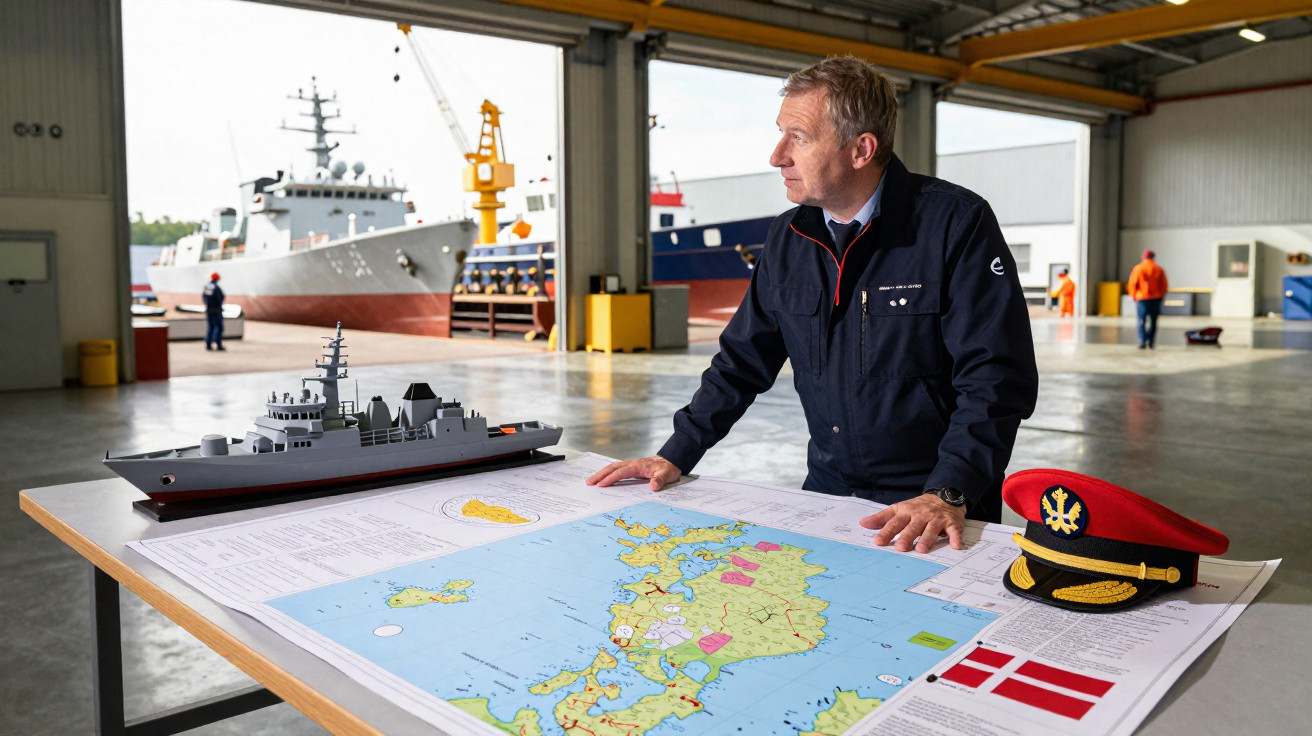
Denmark’s government in Copenhagen has settled on a new method for delivering a fleet of Arctic patrol vessels: build major sections around the country, then complete final assembly at a single northern hub. The approach links defence investment with Arctic priorities and an effort to restore Danish naval shipbuilding at home.
New Arctic vessels at the heart of Denmark’s naval reset
This choice sits within the country’s “Naval Plan”, a long-range programme unveiled in 2025 to reinforce the Danish Navy. One of its central aims is to re-establish Denmark’s capacity to design, manufacture and sustain its own naval vessels.
The immediate focus is five new Arctic patrol vessels, intended to strengthen surveillance and day-to-day presence in the Arctic and around Greenland. They will operate alongside the existing “Knud Rasmussen”-class patrol vessels, which currently underpin Denmark’s surface patrol capability in polar waters.
Five new Arctic patrol vessels will supplement three existing ships, signalling a clear expansion of Denmark’s northern presence.
These ships are meant to do more than patrol: they are also a clear statement of intent. They reflect increasing strategic competition in the Arctic, while also addressing practical requirements such as search and rescue, fisheries control, environmental oversight and support for Greenlandic communities.
Distributed construction: a ship built in many places
At the centre of the industrial plan is a “distributed construction strategy”. Instead of commissioning a single yard to build each ship from start to finish, Denmark will allocate production across several facilities nationwide.
Once completed, the main blocks and modules will be transported to a final assembly site in Frederikshavn, in northern Jutland-a location with deep maritime roots.
Ship sections will be built at multiple Danish facilities and then joined at a government-owned assembly yard in Frederikshavn.
Why the government wants to own the assembly facility
In a departure from many previous shipbuilding efforts, the Danish state plans to own the primary assembly yard outright. The site is being designed not only to deliver these five patrol vessels, but also with future programmes in mind, including the potential construction of larger naval platforms.
This decision is intended to achieve several goals simultaneously:
- Securing a national location capable of assembling sophisticated warships
- Cutting reliance on foreign yards for crucial defence infrastructure
- Establishing a durable industrial centre connected to later naval projects
- Giving the state tighter oversight of security of supply and build timelines
By sizing the facility for larger hulls, Denmark retains flexibility for future frigates, support ships or other major vessels that could be added in later stages of the “Naval Plan”.
Deloitte analysis steers strategy choice
The Ministry of Defence did not select this model purely on preference. Its decision was informed by an assessment produced by consultancy Deloitte, which weighed alternative industrial approaches.
Deloitte’s analysis judged that a distributed model rooted in Danish production offered the best value. The logic was that spreading work among domestic yards makes use of a wider industrial base, supports employment in more places, and leverages existing infrastructure rather than concentrating activity in one facility or moving it overseas.
| Option assessed | Key feature | Main drawback |
|---|---|---|
| Single-yard national build | All work completed at one Danish yard | Less use of the wider Danish industrial base; capacity pinch points |
| Foreign construction | Build overseas, support domestically | Erodes the national shipbuilding base; increased supply vulnerability |
| Distributed Danish construction | Several yards feeding a central assembly line | Greater coordination burden across sites |
Defence Minister Troels Lund Poulsen presented the move in strategic and economic terms, arguing that Denmark’s maritime heritage should be matched by modern industrial strength-and by more assured access to warships, maintenance and spare parts.
Arctic security: more than ice and symbolism
The Arctic is becoming increasingly prominent in Danish defence planning, not least because climate change is reshaping the region. As sea ice declines and fresh routes become viable, waters around Greenland are seeing more commercial movement alongside greater military attention.
Denmark-responsible for defence matters for both Greenland and the Faroe Islands-faces rising expectations that it can monitor and manage an enormous maritime area.
The new ships are designed for persistent presence in harsh, remote waters rather than high-intensity naval combat.
To underpin that sustained presence, Copenhagen has already purchased MQ-9B SkyGuardian long-range drones and has received US approval to acquire P-8A Poseidon maritime patrol aircraft. Those systems will deliver broad-area sensing, while the new patrol vessels will provide visible presence and the capacity to respond when sensors identify activity of concern.
Capabilities still on the drawing board
The Arctic patrol vessels’ final design has yet to be set. The Ministry of Defence has stated that the next major milestone is to define the required capabilities and technical specifications.
That work will determine key points, including:
- The degree of ice strengthening for the hulls
- The sensors and radar suite to be fitted
- Whether the ships should carry heavier weapons or concentrate on constabulary tasks
- Crew size requirements and the space available for embarked teams
- Expected autonomy and endurance when operating far from support
Once these needs are agreed, industry contracts covering hull construction, systems integration and equipment procurement can progress. The government has not yet published a timetable for when building will begin or when the first vessel is expected to enter service.
What these patrol vessels are likely to do
Even in the absence of final specifications, their intended employment is largely understood. Arctic patrol vessels typically remain deployed for extended periods, operate far from immediate assistance, and must cope with ice-prone waters and severe weather.
Anticipated tasks for the Danish ships include:
- Observing fishing activity and enforcing relevant rules
- Assisting ships in trouble and supporting search-and-rescue missions
- Showing the flag near Greenlandic and other Arctic communities
- Collecting environmental information and supporting scientific activity
- Escorting or tracking foreign naval and research vessels
That blend of missions points towards sturdy hulls, dependable propulsion, strong seakeeping and generous capacity for small craft, helicopters or drones. Firepower is usually less decisive than stamina, reliability and adaptability.
Strategic and economic ripple effects for Denmark
The distributed construction approach is also intended to deliver domestic economic benefits. By involving multiple shipyards and maritime firms, the government aims to maintain highly skilled employment across several regions rather than concentrating work within a single industrial centre.
This can help steady smaller yards that might otherwise depend on irregular commercial orders. It also reinforces a broader supply chain, spanning steelwork and propulsion through to combat systems and digital integration.
Over time, the state-owned assembly site in Frederikshavn could become the natural base for upgrades and mid-life modernisations-not only for the new Arctic patrol vessels, but potentially for other Danish naval assets. That would keep expertise and industrial learning within Denmark, instead of exporting it.
A quick guide to some key terms
The term “security of supply” appears repeatedly in Danish defence policy. In practice, it refers to maintaining access to equipment, spares and maintenance even during crises, sanctions, or disruptions to supply chains.
Domestic shipbuilding generally improves that resilience: components can be produced or repaired at home, and sensitive technologies are less exposed to decisions made abroad.
A second concept worth understanding is “distributed construction”. In naval programmes, this normally means that hull sections, blocks or modules are produced at several sites and then transported to a final yard for assembly. The model is used in countries including the UK, Italy and Australia. It spreads industrial benefit and can reduce overall timelines, but it also requires disciplined project management and careful planning for transport and interfaces.
What happens if timelines slip
Although no formal schedule has been released, major naval procurements frequently run late. Should delays arise, Denmark would probably rely more heavily on the current “Knud Rasmussen” vessels, as well as air assets such as the P-8A and MQ-9B, to mitigate any gaps in surveillance.
A realistic possibility is that the first ship effectively serves as a prototype, with practical lessons then incorporated into later builds. This can slow initial delivery, but it may accelerate the broader programme once early design and production issues are resolved. Having a permanent assembly facility should also make that learning process easier to sustain, because teams, tooling and workflows can remain in place for subsequent ships and future projects.






Comments
No comments yet. Be the first to comment!
Leave a Comment