
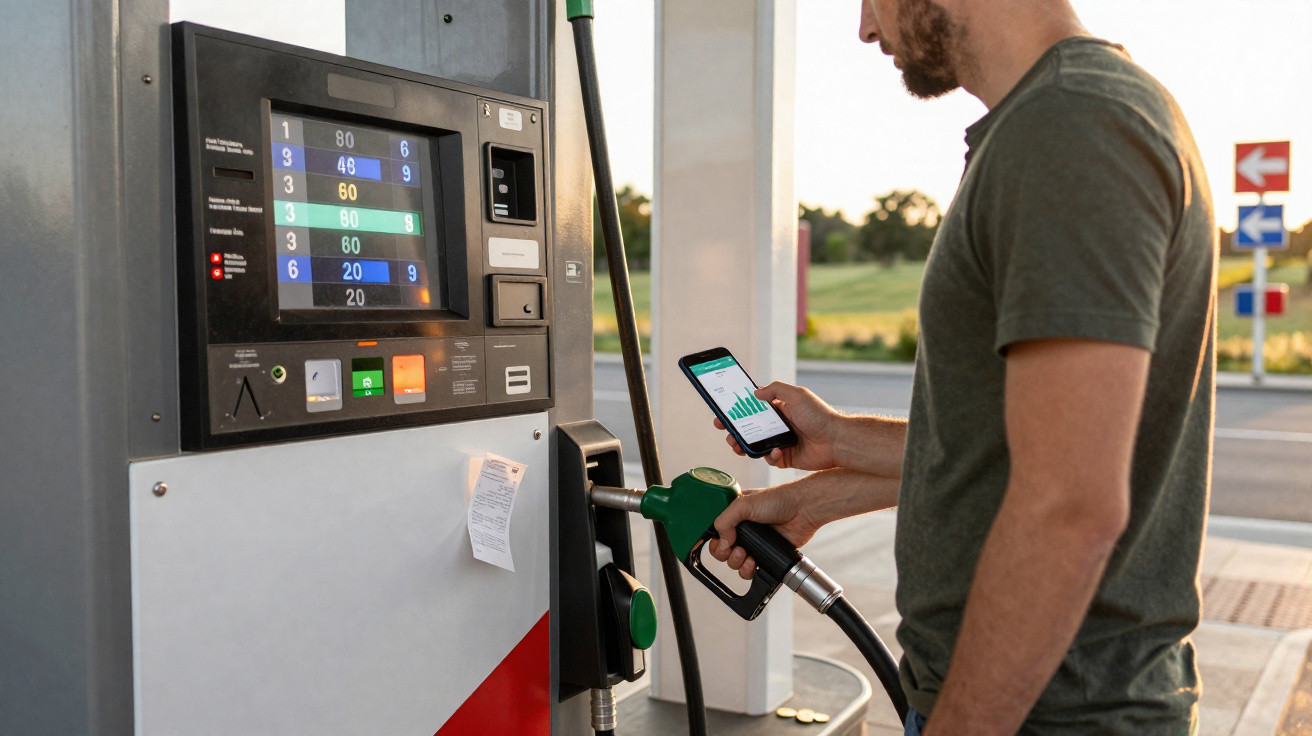
On a dull grey Monday morning at the forecourt, your gaze flicks between the glowing digits on the roadside totem and the numbers rolling across the pump: 1,89 €, 1,92 €, sometimes higher. You exhale, you pay, you drive off - and you still can’t really say who is taking what from every litre you pour into your tank.
That haze is meant to clear from February 12.
In France, filling stations will be required to show their real margin per liter directly on the pump. A short extra line - a few cents - that suddenly claims to put a figure on a charge that puts everyone on edge.
Some people call it overdue transparency. Others hear it as a clever bit of messaging.
Somewhere between frustration at the till and curiosity about what you are truly paying for, a fresh dispute is playing out right there beside the nozzle.
From February 12, a new line on the pump that changes everything… or nothing
In principle, it’s straightforward: alongside the price per litre, every filling station in France will have to display the profit it actually makes on the fuel you buy. Not the tax portion. Not the crude oil cost. Only the station’s own margin.
We are talking about just a handful of cents per litre - numbers that are supposed to clarify who earns what in a price system that feels endless. Like finally lifting the bonnet on a car you’ve been driving blind for years.
And that is exactly why the country is already split. Some will cheer; others will roll their eyes, sure it won’t change anything in day-to-day life.
Consider Claire, 42, a community nurse in the Lille area. She clocks up 120 kilometres a day and knows the diesel price better than her own electricity tariff. The last time she filled up, it came to 96 euros. She gives a weary shrug: “Anyway, I pay and that’s it.”
From February 12, when she pulls in to refuel, she may see something like “Station margin: 0,18 €/L” printed in small type. With a 50-litre tank, that tells her the station makes roughly 9 euros on her stop. The rest is absorbed by oil companies, distributors, and the State through taxes and VAT.
Will that make the hit feel any softer when her account balance alerts her at month end? She doubts it. But she concedes one point: “At least I’ll have a number to get angry at.”
This new obligation is also a distinctly political gamble. After months of sharp price rises and mounting anger among drivers, the government is under pressure. By compelling stations to publish their margin, it moves the spotlight: who is the “bad guy” - the retailer, the oil major, or the State itself?
Transparency sounds nice, but it’s also a way of pointing the finger, very precisely.
In practice, the picture is messy. Many independent stations survive on wafer-thin margins while trying to compete with supermarket giants. Some already sell fuel close to cost simply to draw people into a small shop. For them, making the number public is both reassurance and danger: reassurance because they can show they are not rolling in it; danger because customers may read a few cents without understanding what sits behind them.
How this new display might change your habits at the pump
So what, exactly, will you see from February 12? Every pump and sign will have to show the station’s gross margin per litre - in euros and cents. Not a percentage, not a vague indicator: a number you can read and compare.
In theory, you could decide it is worth driving a few extra kilometres to switch from a station taking 0,25 €/L to one keeping 0,12 €/L - in the same way some shoppers compare supermarkets product by product.
The new habit could be this: not only checking “SP95: 1,89 €”, but also scanning “Margin: 0,16 €”. Small figure, big effect on the mind.
But there is an obvious pitfall. You arrive at a supermarket forecourt: the pump price is ultra-competitive, a few cents below the station in the village; the margin shown is tiny too. You think: “They’re the good guys.”
Except that the site can afford to squeeze fuel margins because it makes money when you do the rest of your shopping inside. Or because, out of sight, a major oil group balances profits across several activities.
Meanwhile, across town, the independent station that knows you by name might display a slightly higher margin - not out of greed, but because fuel is its only meaningful revenue stream. Same rule, totally different reality.
That is where irritation can creep in quickly if the figure is read without the story attached.
Even so, that extra line forces people to look up. Until now, fuel pricing felt like one solid, opaque block. From now on, at least one piece of the jigsaw will be visible. Some drivers will use it to boycott certain stations; others will ignore it and concentrate on the total on the screen.
Let’s be frank: hardly anyone analyses fuel margins every day.
But on social media, photos of those numbers will spread. Comparisons will flare up between regions, brands, urban versus rural areas. Big groups will advertise their “reduced margins”. Smaller operators will complain they are being thrown under the bus.
And underneath the noise, one question will get louder: if the station only keeps 10 or 15 cents, who is really winning in a system where you pay close to 2 euros per litre?
How to read this new information without being fooled
There is a sensible way to approach the new display without getting tangled up. First, separate the feeling from the figure. When you read “Margin: 0,18 €/L”, translate it into something concrete. For 40 litres, that is 7,20 €. For 60 litres, it becomes 10,80 €.
From there, a quick calculation gives a monthly view. If you fill up twice a month with 50 litres, the station’s profit on your fuel is about 18 € per month. The rest of your 200, 250, or 300 € fuel spend goes elsewhere.
That won’t make the bill smaller - but it may stop you taking it out on the wrong person behind the counter.
The second trap is turning that margin line into a moral scorecard: high margin equals villain; low margin equals hero. Real life rarely fits that neatly. A motorway service-area station has higher operating costs. A rural station sells lower volumes. A large supermarket forecourt can slash prices, then recover profits by pulling you into the weekly shop.
If you compare, compare like with like: city versus city, supermarket versus supermarket, independent versus independent. That is where the strategic differences become clearer.
And yes, you are entitled to decide: “I’d rather give my business to the local station than a multinational, even if the margin is 2 cents higher.” Spending is also a choice about who you want to support.
This debate is already surfacing in cafés and at family tables. Some see the measure as yet another distraction designed to avoid talking about taxes, which account for a heavy share of the pump price. Others appreciate having at least one figure that used to be invisible.
“Showing our margin doesn’t scare me,” confides Marc, owner of a small station in Corrèze. “People think we’re taking 50 cents per liter. When they see it’s more like 12 or 15 cents, maybe they’ll understand why I also sell bread and lottery tickets to survive.”
Three very practical responses are already taking shape around this change:
- Drivers who will use the margin line to search for the “fairest” stations locally.
- Filling stations that will promote low margins as a marketing message, worn like a badge.
- Angry voices insisting the real issue is the tax share and global oil profits, not the corner forecourt.
A small number on the pump, a big mirror on our choices
What arrives on February 12 is not merely an extra line of text on a grubby plastic panel. It acts as a mirror held up to a sensitive relationship - the one we have with cars, money, and those who profit from both. Some will call this “transparency” manipulative, a way to steer attention away from the biggest beneficiaries. Others will seize the chance to understand a charge that has haunted their month end for years.
The reality is probably somewhere between the two. This rule will not make prices fall by magic. It will not remove dependence on cars, fix the lack of public transport in certain areas, or change the global market for oil barrels. Still, it does push one hidden part of the story into the open - even if that is uncomfortable.
What will we do with that clarity: compare, complain, change our habits, or simply doomscroll through angry screenshots? In the space between a few cents, a more personal question surfaces: at the pump, who do you actually want to pay - and what sort of world are you fuelling?
| Key point | Detail | Value for the reader |
|---|---|---|
| New obligation from February 12 | Gas stations must display their margin per liter directly at the pump | Better understanding of who earns what on each fill-up |
| Limits of transparency | Margin varies by station type, location, and business model | Avoid misjudging small stations or overvaluing low margins |
| Practical use | Compare similar stations, translate cents per liter into monthly amounts | Adjust choices and spending with clearer, more concrete data |
FAQ:
- Will this new margin display lower fuel prices?
Not directly. The measure doesn’t cap prices, it only reveals the station’s profit per liter. Prices will still depend on crude oil, taxes, and each brand’s strategy.- Are all gas stations obliged to show their margin?
Yes, all stations open to the public must comply with the new rule, whether they are supermarkets, independent stations, or highway sites.- Is the displayed margin the only profit on my fuel?
No. It’s the gross margin for the station itself. Oil companies, distributors, and the State (through taxes and VAT) also take a significant share.- Can I really compare stations using this number?
Yes, but ideally between stations of the same type and in the same area. A rural station and a big urban supermarket don’t have the same constraints or volumes.- What if a station doesn’t display its margin on February 12?
In that case, it is not complying with the regulation and risks checks and penalties from the authorities. As a customer, you can report the situation to the relevant consumer services.




Comments
No comments yet. Be the first to comment!
Leave a Comment