
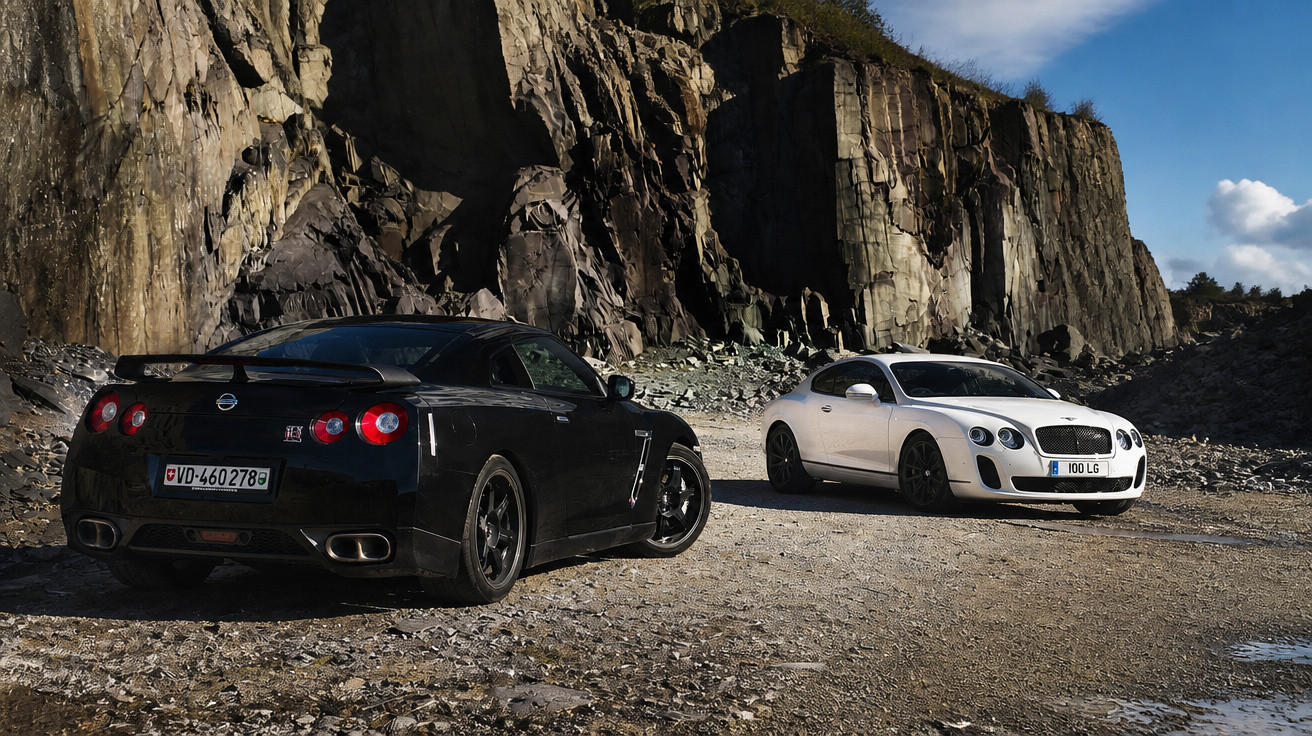
These, then, are the heavyweight “diet” specials. The Bentley Continental Supersports and the Nissan GT-R Spec V are pared-back, more ruthless versions of mainstream cars that are, let’s be honest, hardly unfamiliar with their nearest pie shop.
It’s not as if either looks especially tubby. Set against the grey rock of a slate quarry high in the Welsh mountains, our two contenders have about as much subtlety as bare-knuckle fighters. The quarry itself is a key backdrop in the remake of Clash Of The Titans that’s just landed in cinemas, and the atmosphere feels suitably mythic-even if the weather, oddly, is behaving itself.
[Inline image gallery]
This feature was first published in Issue 203 of Top Gear magazine (2010)
Photography: Lee Brimble
Before anything else, the headline figures: the Bentley Continental Supersports drops 110kg from the titanically heavy, near-2.4-tonne standard Conti GT. The GT-R Spec V, meanwhile, finds an even slimmer saving-just 60kg-compared with its already-established 1,740kg kerb weight.
Both cars arrive wrapped in near-absurd exclusivity and built in tiny volumes, reinforcing the idea that-even in leaner times-manufacturers can still extract serious money from customers who don’t need much persuading. With the Bentley priced at £163,000 and the Nissan at an eye-watering £124,950, you’re essentially handing over more cash to receive less car. Forget the balance sheet, though: if they’re sensational on the road, does any of that matter?
Snowdonia as the proving ground
Snowdonia National Park-raw, dramatic, and properly beautiful-is a perfect place to find out. You get fast, open stretches mixed with viciously tight, hard-to-read sections that can make even an Ariel Atom feel a bit cumbersome. If you want to give two expensive hopefuls a thorough thrashing, there are few better places in Britain.
It also helps that the GT-R is currently parked outside my house, and my house is roughly 250 miles (about 400km) south of Snowdonia. Which means the “test” for the rock-hard, rock-star Nissan begins immediately-and, if I’m honest, the thought of four or five hours across several slabs of British motorway in this thing isn’t exactly floating my boat.
And yet… It’s a GT-R. And it’s on my driveway. The day that fact fails to produce at least a small jolt of excitement is the day I go and get a proper job. All fast cars come with a story attached, but the GT-R is the guv’nor-not least because it resembles a piece of architecture more than a vehicle. That’s not criticism: it’s brilliantly executed, all harsh-edged menace and big, clean surfaces. The aerodynamics are strong, too. I’m smitten.
Nissan GT-R Spec V: details, cabin, and road manners
Only dedicated GT-R spotters will notice the Spec V’s exterior tweaks. The paint-Ultimate Opal Black-is exclusive to this model, and in the right light it reads as more purple than black. There’s a titanium exhaust with reshaped outlets. Under the front chin spoiler, the moulding gains a pair of additional ducts for brake cooling. Up front, the grille is carbon fibre, and the rear wing is carbon fibre too.
The lightweight alloy wheels come from Nissan’s formidable Nismo motorsport and tuning division. Look closely and you’ll catch the carbon-ceramic discs and silver Brembo calipers behind them-said to represent about 35 grand’s worth of stopping power.
A GT-R is the sort of machine that encourages a proper pre-flight routine. The front seats-Recaros with carbon-fibre backs-are superb, and the rear seats have been removed entirely. The driving position is about as close to ideal as you’ll find this side of a race car. The multi-function steering wheel, however, isn’t (and on this particular test car it’s on the wrong side). Then there’s the 19-screen display perched on the dash, offering g graphs, braking and acceleration traces, and yaw data. Presumably there’s a page somewhere that logs the impact from the crash you’ll have while you’re gawping at it…
Press the starter and the GT-R doesn’t deliver much theatre at idle. There’s a twin-turbocharged, six-cylinder V6 under the bonnet, but it chatters and whirs like a very high-grade industrial device rather than a hand-finished combustion engine boasting plasma-sprayed 0.15mm cylinder liner bores.
Slot the lever into ‘D’ and it engages with a sort of engineered belligerence. The rear transaxle gives a clonk. The first miles follow the same theme. At low speed the car is frankly horrible: it fusses over every flaw in the tarmac and tramlines more than anything I’ve driven since the previous-generation Porsche 911 GT2, which seemed genuinely allergic to travelling straight. The suspension uses bespoke Bilstein dampers set to a fixed rate rather than variable, and it doesn’t feel like there’s much actual damping happening. In short, the Spec V is yelling ‘get me to a circuit, now!’
Nissan GT-R Spec V: motorway brutality and overboost
Sadly, that’s not the plan. The rendezvous is in Snowdonia with the Bentley. The run north is never less than loud, and the ride stays tooth-rattlingly bleak, but it remains-undeniably-a GT-R. Put your foot down in any gear and it lunges forward with sci-fi force, stretching the meaning of “boost” as it goes.
There’s even an ‘overboost’ function, handing you an extra 14lb ft (about 19Nm) of torque in the mid-range-torque being something the standard GT-R isn’t exactly short of. Slightly strangely, the switch that activates it is shared with the cruise control. Still: overboost. A car with an overboost button. I try it once on the M6, then don’t bother again. It’s hardly lacking. And the police aren’t likely to accept overboost as a defence. ‘honestly officer, my thumb just slipped...’
By the Welsh border my ears are ringing and my fingers are aching from aggressive paddle work. I also feel as though I’ve spent three hours headbutting Keith Flint inside an amplifier at a Prodigy gig. The power is both intoxicating and vaguely terrifying.
At least the roads are dry. With its sticky Dunlop Sport semi-slicks properly up to temperature, the Spec V hurls itself into and out of corners at speeds that seem barely plausible. Much like the Bugatti Veyron, the Nissan GT-R begins to make you question what you thought cars were capable of. It’s less “driving” and more like operating a piece of high-tech military ordnance. It’s twitchier, edgier, and less forgiving than the standard GT-R-but if you’re up to the job, it offers an almost absurd level of closeness and feedback. The thing it still can’t quite supply is that old mate: soul.
Bentley Continental Supersports: a far deeper transformation
Which is surely where the Bentley steps in. A confession: although the Supersports is 110kg lighter than the regular car, the whole “fat fighter” framing is slightly misleading. The Supersports overhaul goes well beyond trimming weight, and it’s among the smartest reworks of an existing model I’ve come across in years.
Around 42,000 Continentals have been sold since 2003, which means the original’s ability to shock has largely worn off. The Supersports brings that sense of menace back-and then some.
For one thing, it looks superb. Over-blinged Bentleys are everywhere, and most of them are dreadful. The Supersports does the opposite: it turns down the jewellery and turns up the threat. White paint, anthracite wheels, and black detailing work brilliantly together, while the wider rear track and revised front end visually remove bulk from the car.
Inside, the changes are even more appealing. You get carbon seats with quilted inserts that look properly lean. The steering wheel is unattractive to the eye, but thanks to its suede rim it feels fantastic in your hands. There’s no wood trim. And, just as with the Spec V, the rear seats have been binned. A menacing chassis brace spanning the rear compartment hints at serious additional reinforcement. This isn’t a half-hearted special.
Bentley Continental Supersports: pace, torque, and handling
You understand that by about the third apex on one of Wales’s best stretches of road. The Continental Supersports manages its mass so effectively it’s almost eerie. Yes, it still has 2,240kg to shift, but with 630bhp it’s hardly short of firepower-and, like the GT-R, it doesn’t so much accelerate as relocate matter. Sixty-two takes 3.9 seconds. Top speed is 204mph (about 328km/h).
The eye-opener, though, is the sheer shove-and the almost casual manner in which it keeps building speed from 60mph (about 97km/h) all the way towards its maximum. There’s 590lb ft (about 801Nm) of torque available from just 1,700rpm, and releasing it makes the Supersports rumble and snort with something properly elemental. The W12 sounds less like a conventional engine and more like a satanic mill on prole-bashing overtime.
It also turns out to be astonishingly capable through corners. A torque-sensing differential shifts the balance towards a more rear-driven feel, while adaptive damping expands the car’s athletic range compared with the standard model. With its huge front tyres, the Supersports somehow overcomes the enormous heft of its 6.0-litre engine and delivers the kind of sharpness and turn-in you’d expect from something smaller and lighter. That’s the trick: it may only be 110kg lighter, but it behaves as if it’s shed 1,000.
Ceramic brakes, shifting opinions, and choosing the car
Then there are the brakes. In truth, braking tends to be handling and acceleration’s ugly step-sister in the pages of TG. Slowing down doesn’t sound as thrilling, does it? In these two cars, it absolutely is-and it has to be, because stopping this kind of weight is serious business. The feel and reassurance generated by both set-ups suggests ceramic brakes have finally reached maturity. I’m not sure I’ve ever used anything better. Up a Welsh mountain, that’s exactly the sort of revelation you want.
I arrived at this test sceptical of both the Bentley and the GT-R Spec V. Nothing changes the fact they’re staggeringly pricey evolutions of what are, by any sensible standard, already highly desirable mainstream cars. Yet as storm clouds gather over the hills, I find myself genuinely stuck for which one I’d rather take on the long trip back.
The Bentley takes the award for the most convincing makeover, not least because it had more distance to travel to become this formidable beast. The Spec V is more difficult to love: it’s so relentless, and the regular GT-R still stands as a genuine milestone. Together they underline how thrilling properly executed automotive engineering can still be.
But it’s the Nissan I want to go to war with again. Maybe it’ll rough me up. Maybe it won’t. The enjoyment lies in not knowing which way it’ll go…

Comments
No comments yet. Be the first to comment!
Leave a Comment