
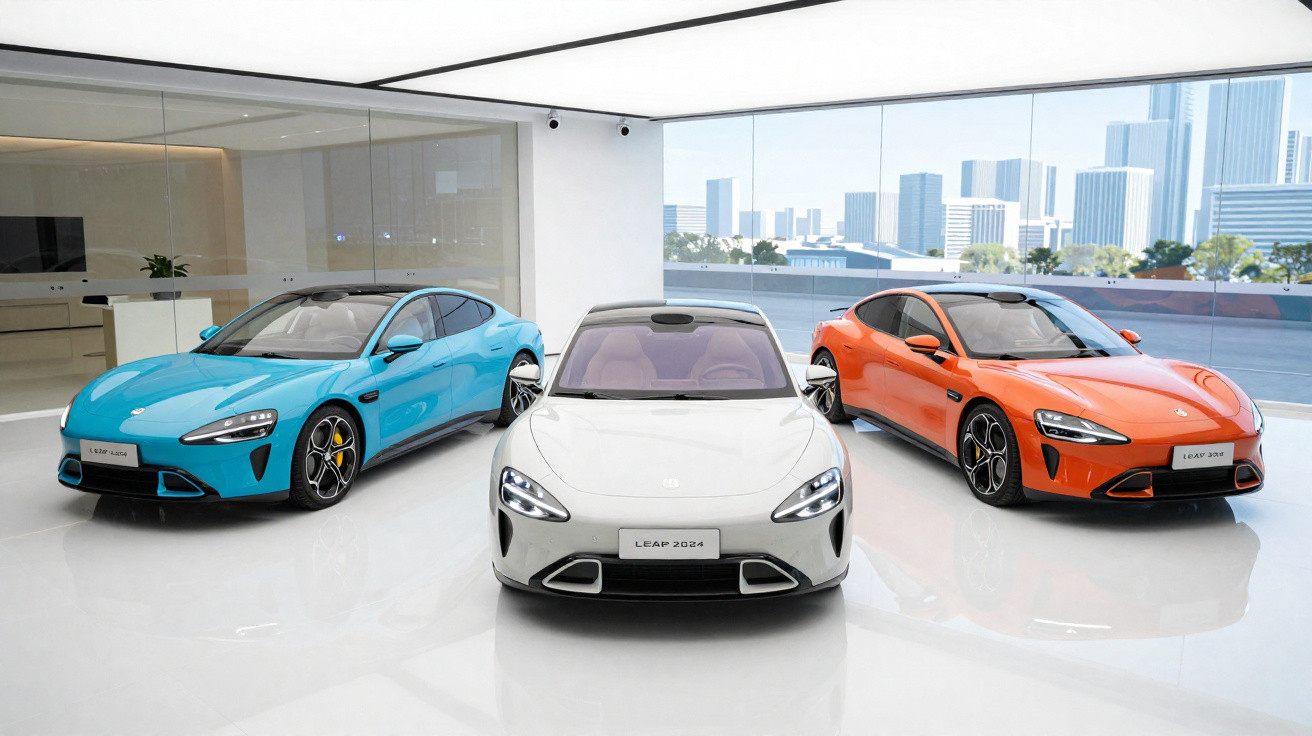
Leapmotor arrived in Europe only recently, yet it is already making its presence felt. It is currently the fourth best-selling Chinese brand here, despite having just three models on sale. The company registered more than 33,000 units in 2025 and, in the first two months of 2026 alone, it has already logged more than 12,000 vehicles - a jump of 642% versus the same period a year earlier. Leapmotor has no intention of stopping there.
Leapmotor’s momentum in Europe
To keep this fast pace of growth, Leapmotor has announced three new arrivals by the end of 2026, effectively doubling its current line-up. All three will be 100% electric, although the brand has not ruled out introducing EREV (range-extender electric) variants at a later stage - as it already does with the B10 and the larger C10.
Stellantis partnership, European production and EU tariffs
Its partnership with Stellantis is set to speed up the rollout. Leapmotor gains preferred access to the group’s extensive retail network and is also due to begin building cars on European soil soon, at one of Stellantis’ plants. That is the most effective way to sidestep the European Union’s steep duties on electric vehicles made in China - 20.7% for the brand, on top of the existing 10%. What many Chinese manufacturers are still trying to secure, Leapmotor already has.
Three new Leapmotor models to accelerate growth
Leapmotor B05 (Q2 2026)
The first model due to arrive is the Leapmotor B05, expected from the second quarter. This one is not an SUV. It is a car with sporty, dynamic styling aimed at the same segment as the Volkswagen ID.3 and Renault Megane, as well as the new Kia EV4.
It is based on the same Leap 3.5 platform as the B10 SUV and should share that car’s 160 kW (218 bhp) rear motor and battery options. However, with more favourable aerodynamics, it should be able to go further than the SUV’s 434 km (WLTP combined) figure.
Leapmotor B03X (Q3 2026)
Next up, the Leapmotor B03X is slated for a third-quarter debut and will enter the most hotly contested corner of the European market: the B-SUV segment. This is where you’ll find cars such as the Peugeot E-2008 and the new Kia EV2, and it is also where fresh would-be leaders are arriving this year, including the Volkswagen ID. Cross and the Skoda Epiq.
European specifications have not yet been confirmed, but they are unlikely to differ much from the Chinese version, where the B03X (called the A10 in China) is about to go on sale. It uses an electric motor with either 70 kW (95 bhp) or 90 kW (122 bhp), paired with two battery packs rated at 39.8 kWh and 53 kWh. A maximum range of up to 505 km is claimed - on the Chinese CLTC test cycle. It also stands out for its technology offering, including advanced driver-assistance systems, an AI-enabled cockpit, and over-the-air updates.
Leapmotor B03 (Q4 2026)
Finally, the Leapmotor B03 is planned for launch in the last quarter of the year. This will be a car positioned between the T03 city car and the more family-oriented B05. It will not be short of rivals, from the Renault 5 to the forthcoming Volkswagen ID. Polo. Of the three new models Leapmotor has promised for Europe in 2026, this is the one we know the least about, but everything suggests it will share the B03X’s technical base, motor options and batteries.
With this trio of launches, Leapmotor is aiming to make the most of the sales peak seen at the start of 2026 and translate it into much stronger growth across Europe. Now the question is simply how far it can go. One outcome that already looks likely is the positive impact Leapmotor’s (electric) success could have on Stellantis’ CO₂ emissions calculations.
Leapmotor wants to ride the 2026 wave - and these three new models - to expand far more in Europe. The open question is the ceiling for that growth. Along the way, there is another side effect: helping Stellantis meet its emissions targets.

Comments
No comments yet. Be the first to comment!
Leave a Comment