
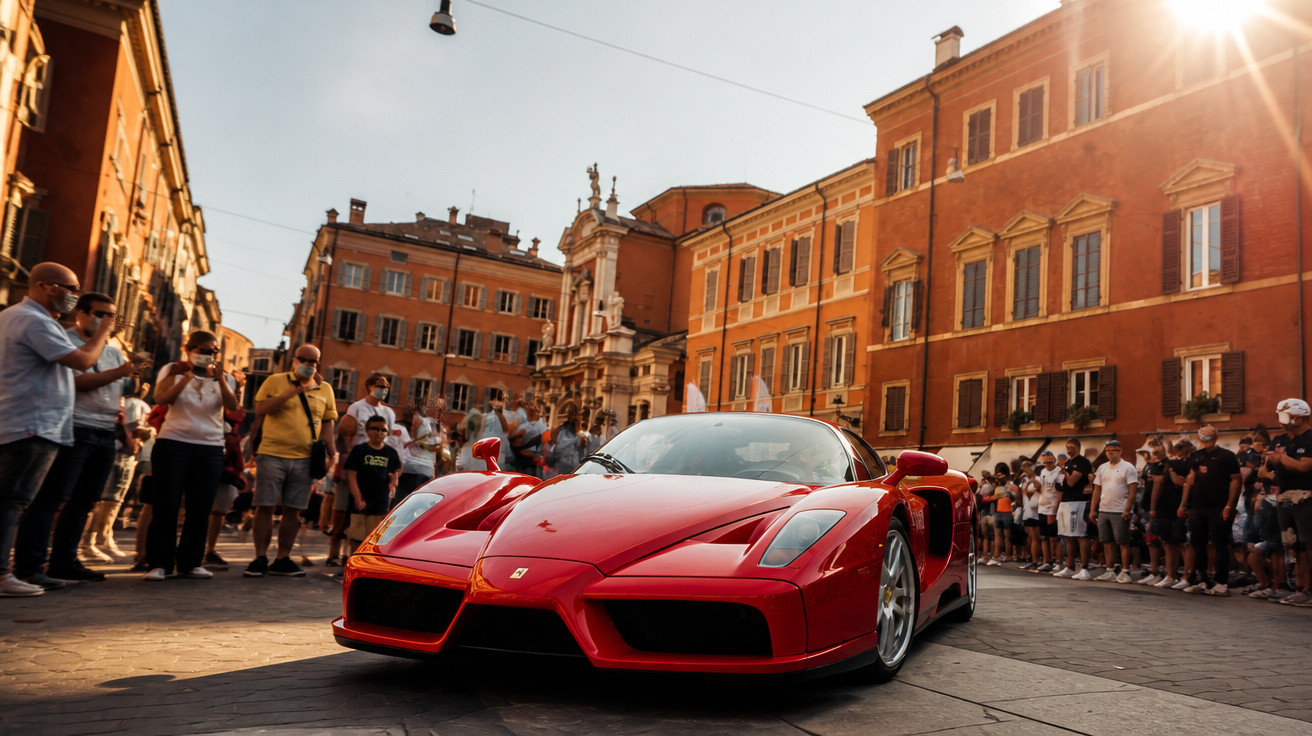
Modena is widely seen as the world capital of Italy’s peerless motor industry. It is the birthplace of the brilliant, legendary Enzo Ferrari and a standout gem within the wider Emilia-Romagna region - an area that counts Ferrari alongside Lamborghini, Maserati, Ducati, Dallara, Energica and Pagani. That is quite a lineage. For that reason, each year Motor Valley Fest unites the ingredients that make this territory exceptional, turning them into a yearly, motorsport-and-design-focused celebration. It is a striking salute to the region’s recognisable commitment to style, performance, luxury and speed.
For any true petrolhead, Motor Valley Fest belongs on the bucket list: an occasion every car lover should experience at least once. Reporting exclusively from this year’s summer edition, four icons from the region explain what makes it so special.
[Image placeholder: big read image, left-themed, delta:0]
Horacio Pagani, the legendary founder of his eponymous Pagani Automobili
What are the geographical borders of the Motor Valley?
There aren’t any. It isn’t defined by geography; it is a cultural inheritance - a set of values. Over a century ago, a visionary called Alfieri Maserati, who lived in Bologna, chose to move to Modena to set up his car factory. Why Modena? Because Modena was home to outstanding coachbuilders: first for horse-drawn carriages and, later, for motor vehicles - meaning the craftsmanship he required already existed here. Then, 70 years ago, Ferrari followed. Together they created the myth. Ferruccio Lamborghini arrived afterwards. And those figures shared the same passion as many smaller, lesser-known firms who, in their own way, also helped form this vast legacy.
So, it’s not just something special in the water of Modena?
Haha - no.
Your company’s legacy is rooted in high performance mechanical engineering. How can you preserve that legacy when electrification and sustainability seems like it will ultimately prevail?
I believe Leonardo Da Vinci left us a message: he said that art and science can walk hand in hand. So, if you want to create something truly beautiful, it must also work perfectly - which is why we invest in engineering as well as artistic training. Ultimately, these cars are objects that should provoke emotion. In the years ahead, the challenge will be to make cars that still stir emotions, even without 12-cylinder engines.
So mechanical engineering will be replaced by hi-tech?
Most likely, it will be a combination of the two. Look… even though my cars have set most track records, I have never had a client ask how quickly they accelerate, or what the top speed is - which, incidentally, we cap at 350 km/h. Our customers purchase sartorial works of art. Today, I was involved in handing over a car to an American customer who flew in from the US to collect it and, 20 minutes later, flew back on his private jet. That tells you the level of responsibility we carry towards our clients.
[Image placeholder: big read image, left-themed, delta:2]
You are an active member of the Motor Valley. What convinced you to take part in the event and how would you like to see it develop in the future?
Let’s put it this way: although we are newcomers - our company is only 21 years old - we are among the founding members, and the first meetings were held at my home and in my office. Today we share a clear belief: we must back the university so it can educate the talent of tomorrow, and we must help promote this event - and, as you can see, we are all here: Ferrari, Lamborghini, Maserati, Ducati, Dallara and ourselves.
But while Pagani and all the others are global, the Motor Valley Fest is still a wonderful local event. Are you looking forward to seeing more visitors from abroad?
Yes - and I think it will happen. We began in 2019, and it was ruined by rain. In 2020, because of the Covid emergency, it moved online. But as you can see, this 2021 edition is large, full of promise, and it is already bringing people like you from across the world.
Also - there’s no doubt that Pagani and all the other brands are very attractive together?
Yes, beyond doubt. I strongly support aggregation. Then each company must design, engineer and build with its own distinctive personality. Ferrari is myth; Lamborghini is magic; Maserati is tradition; and Ducati and Dallara are each special in their own way. Together, we have to play our part in carrying forward the values we hold in common… the values we share. The values we inherited are what brought us to where we are today.
[Image placeholder: big read image, right-themed, delta:0]
Stephan Winkelmann, CEO of Lamborghini
What are the territorial boundaries of the Motor Valley? Where does it start and where does it end?
It sits between Bologna and Modena, although there are businesses - such as Dallara - headquartered in Parma that still belong to the core of Motor Valley. You could also describe it as an industrial district with an exceptional concentration of expertise. It is something the world envies, and it helps make “made in Italy” genuinely unique. Worldwide.
And what is the single most important distinctive characteristic that is common to all of the Motor Valley Fest?
Performance, of course.
Apart from the people who work in the factories of Lamborghini and the other brands, how do the local communities relate to the legacy of the six iconic Motor Valley brands?
I can tell you that most enthusiasts of these brands will never own a supercar - yet they remain fans because the brands mean something to them. They represent the very best of what Italy can offer, and this corner of the automotive world is a niche within a niche. It stands out because we still strive to excel in areas where others have given up and stopped.
What is it that makes this region capable of accommodating so many different brands within such a small territory? Is it infrastructure or is it something more intangible?
There has to be an initial spark, and then you see emulators. With emulation comes education - mechatronic technicians who can make our customers’ dreams real. So there is an ignition point - a first brand or first idea - and then emulation follows because a specific type of expertise exists only here, built over decades. That is what enables multiple companies and, ultimately, this extraordinary district we call Motor Valley.
[Image placeholder: big read image, left-themed, delta:4]
Your brand’s legacy, and the legacy of so many other brands here at the Motor Valley, is forged on mechanical excellence. In the future, when the combustion engine becomes part of the past and the electrification accelerates, how will your company keep in touch with its legacy?
A new dimension will take centre stage: sustainability - a conditio sine qua non - especially for younger people, those around 30 or even younger, who treat it as a conditio sine qua non. We are fully aware of that. When we wake up, we already think 10 years ahead, because you need four years of development and then six to eight years for a car’s lifecycle. In a complex industry like automotive - and particularly for super sports cars - you must stay ahead of today’s mindset.
These brands sell mainly abroad, so as one of the founding members of the association that organizes this event, what is that you like the most about the Motor Valley Fest? And most of all, how would you like to see the Motor Valley Fest develop in the future?
What I value most is that everyone is genuinely pleased to be involved; no one is holding back and saying, “this is not for me, I want to be on my own”. These brands are so strong that they understand one another and recognise how much they share. So even if they are not “friends”, they are good comrades. Looking ahead, I would like this event - and Motor Valley more broadly - to create more synergies and to focus on what the future holds for these cars. That means shared understanding on technology, development, start-ups, and new ideas as they emerge. It’s about alliances. None of us can claim that brands like ours can do everything in-house!
[Image placeholder: big read image, left-themed, delta:1]
Francesco Tonon, Head of Global Product Planning, Maserati
Where does the Motor Valley start and where does it end?
In Modena, we are right at the heart of Motor Valley. As you know, Maserati was founded in Bologna in 1914 and then relocated to Modena in 1939. That means we have been manufacturing cars in the centre of Motor Valley for more than 80 years. We speak the same language as this extraordinary, one-of-a-kind place. Passion, innovation and audacity are in our DNA - and they are also defining traits of the other Motor Valley brands. Across Emilia-Romagna, it is essentially the same language being spoken: passion.
With different local accents?
Yes, absolutely. This region is famous for its local accents, but everyone is talking about passion, audacity and innovation. Those three qualities together are the added value that makes Maserati - and the other Motor Valley brands - so distinctive. Again: passion, audacity and innovation.
Besides the people that actually work for the luxury auto brands, how does the local community relate to the legacy of the luxury auto brands of the Motor Valley?
It begins in childhood. Here, people talk about motorbikes, cars, engines and racing from an early age. You can genuinely breathe automotive passion in Motor Valley. It has become part of the DNA of those who live here.
Your brand’s legacy is forged in high performance cars. In the future, as the combustion engines are phased out and electrification takes over, how will your brand keep in touch with its roots?
Our brand stands on three pillars: luxury, performance and innovation. Customers expect a modern take on luxury, a pure expression of performance, and a contemporary, beautiful design - and, in that respect, electrification is not a barrier. On the contrary, it gives our engineers and designers greater freedom. Without betraying our core values, we can build on this by introducing technologies developed within the Maserati Innovation Lab in Modena, creating outstanding models with unique design, rich technological content and high performance - and that are enjoyable to drive.
Is there a risk that electric drive trains become inherently less characteristic and, more importantly, will customers embrace the paradigm change?
Even today, when we talk about acceleration, some brands can already deliver remarkable figures - anyone can do that. Tomorrow’s challenge will be about more than acceleration. Acceleration is one thing; how you manage performance through handling is another - completely different - matter. In that sense, the know-how and passion found here in Motor Valley, whether a car is on a racetrack or a mountain road, is unique. That is where the smile comes from, not simply straight-line acceleration.
[Image placeholder: big read image, left-themed, delta:3]
What do you like most about the Motor Valley Fest and, as a partner of the association that runs the show, how would you like to see it developing in years to come?
For me, the most important aspect of Motor Valley Fest is bringing together all the magnificent brands in this area, with a shared aim: to create a bright future for the women and men working in factories, in R&D centres, for suppliers and partners, and, ultimately, for local institutions too. Today, we are building that future together. We are meeting new challenges with the same passion and dedication we apply in our daily work. We are ready to open a new chapter for this part of Italy, and Motor Valley Fest will be crucial in showcasing the work we are doing.
[Image placeholder: big read image, right-themed, delta:1]
Claudio Domenicali, CEO of Ducati
Ducati is an established global brand, so why is the Motor Valley territorial identity so important?
I believe the more global you become, the more you need roots - something to anchor the brand and keep it solid. Although we are a truly global brand and sell 90% of our bikes outside Italy, every motorcycle that leaves our factory in Borgo Panigale carries a small Italian flag. That matters a great deal, because being an Italian motorcycle manufacturer gives us powerful brand attributes that we protect and proudly take abroad.
The Ducati brand is more than just another Italian brand, it’s a Motor Valley brand. What are the geographical boundaries of the Motor Valley?
For me, Motor Valley is a geographical area of roughly 100 kilometres around Bologna, Modena and Reggio Emilia, home to six extraordinary international brands - Ferrari, Lamborghini, Maserati and Pagani and Dallara. It creates an atmosphere - a connection. It is an ecosystem.
Can you elaborate on the idea of an ecosystem?
It goes beyond the famous brands. It also includes universities, supply chains and institutions - and it has become stronger recently with the creation of the MUNER consortium: the Motor Vehicle University of Emilia-Romagna. It offers seven master’s degrees with automotive specialisms; the most recent addition focuses on electric cars. The relationship between the brands, the territory, the university and the institutions is what makes Motor Valley such a distinctive and exceptional place, in Italy and beyond.
What is the single most distinctive characteristic that these six iconic brands share?
Paradoxically, the strongest common trait is not engines! I think it is passion - a shared passion for design, performance and technology.
Is it correct to assume that passion for design, performance and technology all come together to make the product distinctive?
Yes - and design is not merely about making a product; it is about going further so the product is distinctive in its own right. Even when it is simply parked, it should stand out and turn heads. So design matters enormously. Performance is the second major strength, because everyone is focused on creating products that deliver emotion not only when you look at them, but also when you experience how they perform. The third strength is technology, because the brands here are not nostalgic - and, despite our heritage, we are actually very progressive.
And how do local communities, besides the people that work in the factories relate to these brands?
I think, above all, they feel proud. They appreciate how strongly the region is represented; in the end, these brands are part of the region’s legacy. It all comes down to people: those who live here, those who move here, those who study here at our university. They find an area that is fertile - a place where they can develop their passion and find work. Then their children can grow up with a future. So the more the brands shine as they grow, the more opportunities they create for new jobs - highly qualifying jobs - and that makes people proud and supportive.
[Image placeholder: big read image, left-themed, delta:5]
And what is it that makes this region able to accommodate so many unique and distinctive manufacturers in such a small area?
I think it comes from the passion people have for design and performance. We have Ferrari, racing in Formula One from the very start; and Ducati competing in MotoGP. Formula 1 and MotoGP are the most competitive arenas, and these brands win races and championships. We all have a strong history, but we don’t live in the past - we are not nostalgic. It’s contemporary. I mention racing because I am talking about the present. When I walk around, I meet many Ducati fans; they recognise me and congratulate me on the races. There is a great deal of support for the brand, and that makes me very happy.
As your brand’s legacy has been forged in the legacy of mechanical excellence, in the future, as the combustion engine is phased out and electrification takes over, how will your brand and, in general, all the iconic Motor Valley brands keep in touch with these roots?
That is a very interesting question. If you look at what I said makes the brand special, I didn’t mention mechanical competence - I mentioned design, emotion and performance. So we need to look ahead. Over the past 10 years at Ducati, we have evolved so many characteristics; as you know very well, we moved on from the V2 and have been successful with the V4, both in racing and in the market. So I don’t think we should be afraid of change. Of course, there are passionate customers worldwide who love engines, and perhaps engines will still exist in the future, because we can develop e-fuels and hydrogen engines in the meantime. The engine is not completely finished. But electric vehicles can also be thrilling. The real question is whether they are designed properly, whether they are light enough, and how exciting they are to drive. I don’t see electrification as a threat to Motor Valley and its brands.
Find out more about next year’s Motor Valley Fest 2022 and book tickets.
Pictures: Andrea Casano / courtesy of the Emilia-Romagna region
The 2021 Motor Valley Fest took place thanks to the Made in Italy project (www.madeinitaly.gov.it). An initiative that aims to promote the best businesses in the country as part of an agreement between the Italian Ministry of Foreign Affairs and International Cooperation, the Italian Trade Agency – the government agency for the promotion and the globalisation of the Italian companies abroad – and the Emilia-Romagna Region.
Comments
No comments yet. Be the first to comment!
Leave a Comment