
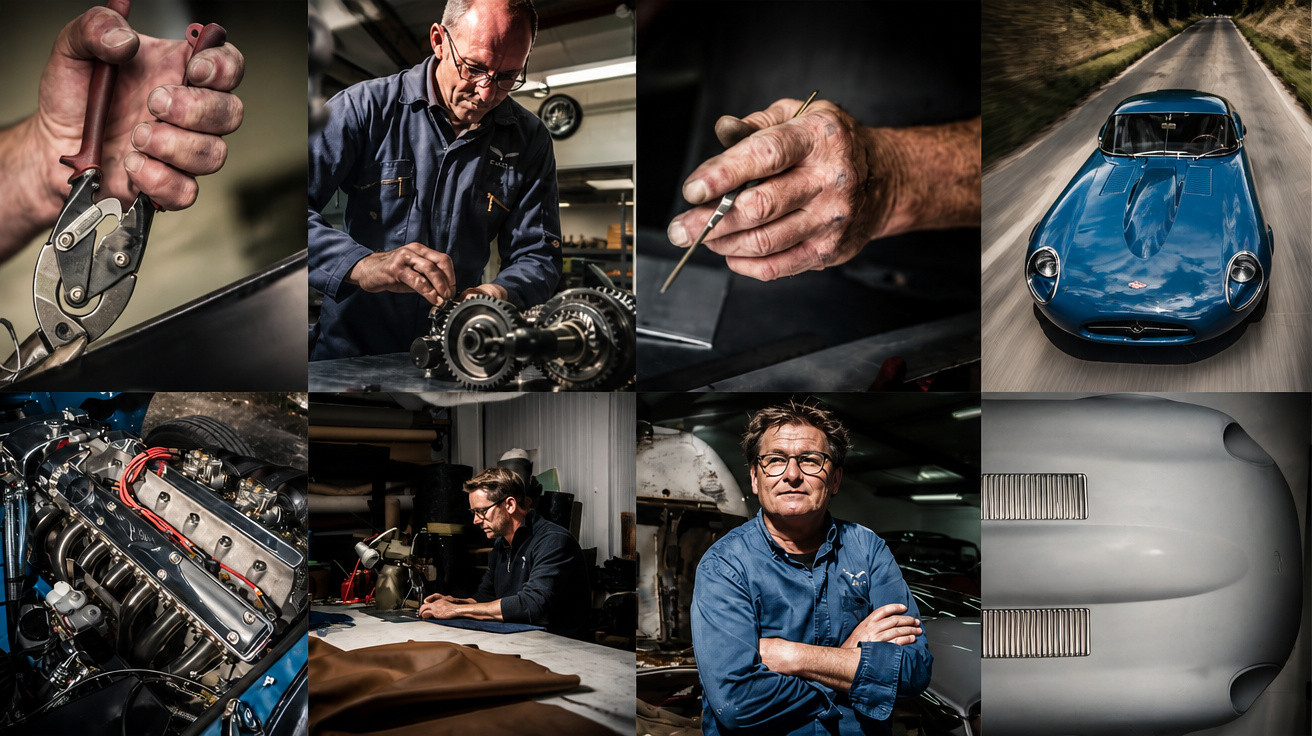
The upper steering column housing sets the tone
It starts with something you’d never point out at a show: the upper steering column housing. I’d been trying to find an entry point that would make Eagle’s almost unnerving precision feel tangible. This is it.
When you commission a car from Eagle - whether that’s a restored E-Type or a rebodied special such as the Lightweight GT featured here - they will, wherever possible, rescue and reuse parts from an original donor. That steering column housing is usually corroded, so it’s aqua blasted (never dry blasted, because that’s too aggressive), cleaned back, and put right. Yet after 35 years of doing this - and with a workshop full of specialist hands - Eagle goes further. They already know the mounting points beneath the dashboard can flex and, over years, fracture, so they add extra welds to reinforce the area.
They also know how Jaguar originally cut small incision slots in the tube so it could clamp more easily around the plastic bush the steering column rotates through. The trouble is that the plastic bush is too soft, so it wears. Eagle swaps it for a harder nylon component, then welds up those now-pointless slots and polishes the tube back. To make the fit spot-on, the nylon bush is reamed before it’s pressed into place. Eagle could simply have a supplier make new “improved” parts from scratch - it would likely cost less - but that misses the point. The original piece is re-engineered instead, and that alone takes hours.
Words: Ollie Marriage // Photography: Rowan Horncastle
(Themed carousel content placeholder)
A yard full of parts - and people who know them
How many individual components make up an Eagle E-Type? Nobody seems able to give a definitive number, but the evidence is everywhere: parts laid out with precision on racks, held in jigs, stacked on shelves, or sitting on benches, all waiting to be connected with patience and care - valve springs, washers, aluminium sheet, steering arms, looms of wiring. And if a piece isn’t already in front of you, it’s probably being made somewhere else behind another door in the spotless yard of this tucked-away farm.
Every door leads into a small world of its own. Through one, you’ll see Gregg May hand-building a 4.7-litre straight-six, checking and logging everything down to a thousandth of an inch (about 0.025 mm) - no millimetres here. He’s spent 15 years with these engines. Next door, Tim Wharton (eight years’ service) has a gearbox laid out in pieces, so pristine it feels like it deserves to remain disassembled. In another bay, Lorenzo “everyone calls me Larry” Crane (16 years) is shaping and finishing aluminium bodywork. On a warm day the doors are open, sunlight falls across his bench, and each reworked sliver helps refine the breathtaking unpainted Low Drag GT behind him. That skin - 27 separate panels - represents 2,500 hours of labour. That’s close to a year. Labour, though, sounds too small a word for it: it’s astonishing craft.
Larry learned by repairing Rolls-Royce bodies. These days even Rolls is more likely to replace than repair damaged panels - panels that were probably pressed or superformed to begin with rather than hand-rolled. As Ryan Thompson (four years) says between spells of hand-sanding complete bodies, “if it was easy, everybody would be doing it".
The doors helpfully carry labels, with names beautifully etched into glass. My favourite is Fabrication, largely because of the ancient machinery in Andy Pitwell’s corner and the spirals of metal scattered on the floor. This is where seat frames are made, suspension drop links are welded and improved, brackets are bent into form, and a thousand other small jobs happen - each with its own quiet backstory. And this is also where, hunched over those machines, the same man puts the steering column right.
(Big Read image - left - themed placeholder)
The Eagle E-Type philosophy: knowledge turns care into design
The larger truth is that every single component is treated with the same deliberation as that upper steering column housing. Plenty of people can offer care and attention; the difference is the thinking behind it. And that kind of thinking comes from knowledge - knowledge earned, repeated, and tested.
It explains why the floor is dropped and the rear bulkhead shifted backwards to create more cabin space; why extra bracing stiffens the chassis along the flanks; why the famously finicky triple Weber carburettors behave with such smoothness; and why the doors shut with such exactness. Paul Brace (31 years), director and the person leading technical and design work, takes particular satisfaction in that last detail.
Open the Lightweight GT’s door and the leather looks as though it’s glowing - warm, healthy, almost lit from within. Strange to think Floridian cattle paid the price. The hides are stitched together at the top of the yard on an old Singer sewing machine - ancient, but apparently still beyond improvement - by Paul’s fellow director Matt Dewhurst (31 years). Eagle employs around 20 people in total. Founder and boss Henry Pearman isn’t in today.
I’m left slightly light-headed. Every doorway reveals another pocket of beauty and fascination. For me, nothing matches the narrow room - almost a corridor - tucked behind the assembly area. No one is in there, only parts: restored and re-engineered components that have arrived from across the yard, now arranged on racks and waiting their turn. Soon, Steve Head (19 years) or Jake Snedden (eight years) will pick them up and fit them to the deep blue Low Drag GT they’re assembling.
Some items are bought in - Öhlins dampers, a Nardi steering wheel, Focal speakers - but the most compelling pieces are the ones that had a “before”, and now have an “after”.
Lightweight GT and the Eagle specials - and where Jaguar began
Eagle releases no more than four cars a year from its nest. Right now they’re working on their 49th E-Type and their 12th special. The specials are the reason most people know the name: Speedster, Low Drag GT, Spyder GT, and, newest of all, the Lightweight GT. Each has genuine historical relevance.
With the Lightweight, the origin story is clear: Jaguar built 12 Lightweight E-Types for racing in 1963, each using a 3.8-litre with 300bhp. Eagle isn’t producing carbon copies; they’re creating restomods. Paul Brace is perfectly comfortable with the term. “After all, we’re restoring and modernising.”
(Inline galleries - themed placeholder)
Here, the engine Gregg assembled is a 4.7-litre unit making 380bhp, while Tim’s gearbox is a five-speed manual. Inside, Matt’s trim work is extraordinary, and Andy’s seat frames feel markedly stronger than those in an original. Add Larry’s bodywork and James Salmon’s (five years) paint, and it’s simply on another level.
That’s the thing: once you’ve walked the yard, you start attaching components to the people you’ve watched making them. The car gains an extra dimension.
Lightweight GT engineering: modern materials without the mass
And yet it doesn’t gain weight. Because beneath the Lightweight GT sits another strand of the story: genuinely cutting-edge lightweight engineering.
Air feeds the engine through a full carbon-fibre airbox, then passes into the carburettors via a 3D-printed nylon housing. After combustion it travels through an Inconel manifold and exits through a titanium exhaust. The wheels are magnesium - and so are the sump, the differential casing, the gearbox, the bell housing, and more besides.
The amount of effort is frankly startling - far beyond what most modern manufacturers commit to when building a lightweight version of a current supercar. That might trim up to 100 kg. Eagle’s Lightweight GT comes in more than 200 kg lighter, for a total kerb weight of just 1,017 kg.
(Big Read image - right - themed placeholder)
Driving the Eagle Lightweight GT
Unsurprisingly, it all works with an ease that feels inevitable once you’ve seen how even the most modest piece of metal is treated with respect. Press the starter and the Lightweight wakes into a resonant thrum; the gearlever slides cleanly into first; and without any drama you’re moving.
That frictionless, well-oiled action is also the giveaway that this isn’t a standard E-Type. There’s no slack in the steering, no cabin creaks, no vague gearbox hunting for gears, and no engine reluctance at low revs. But none of that comes as a shock when you’ve watched the workmanship being poured into the parts - and know it will show up in how the car behaves.
Torque arrives almost immediately - thick, rich, and glorious. With so little mass to shift, even though this car’s gearing is longer than I’d personally choose, each gear is devoured in a rasping surge. At 3,500 rpm it comes onto the cam, hits again, and then barks right out to the 5,800 rpm limiter. Chrome catches the sun, the slim polished wheel warms under my fingers, the leather holds me in place, and the view along that long blue bonnet is pure pleasure. Heaven.
And I do mean that. In terms of driving experiences, I can’t think of anything that matches it. Modern supercars have swapped sensation for outright pace. If you want something genuinely addictive, it’s here: a car that sings to you not only through its engine, but through every component.
Yes, there’s a faint tremor through the chassis, but it drives with such crispness - and such perfectly judged balance, agility, and grip. I began cautiously, never once considering sliding an £800,000 one-off into a corner. But the Lightweight GT is so confidence-inspiring that restraint didn’t last. And I knew it would be fine, because the steering rotates perfectly inside Andy’s renewed upper steering column housing.

Comments
No comments yet. Be the first to comment!
Leave a Comment