
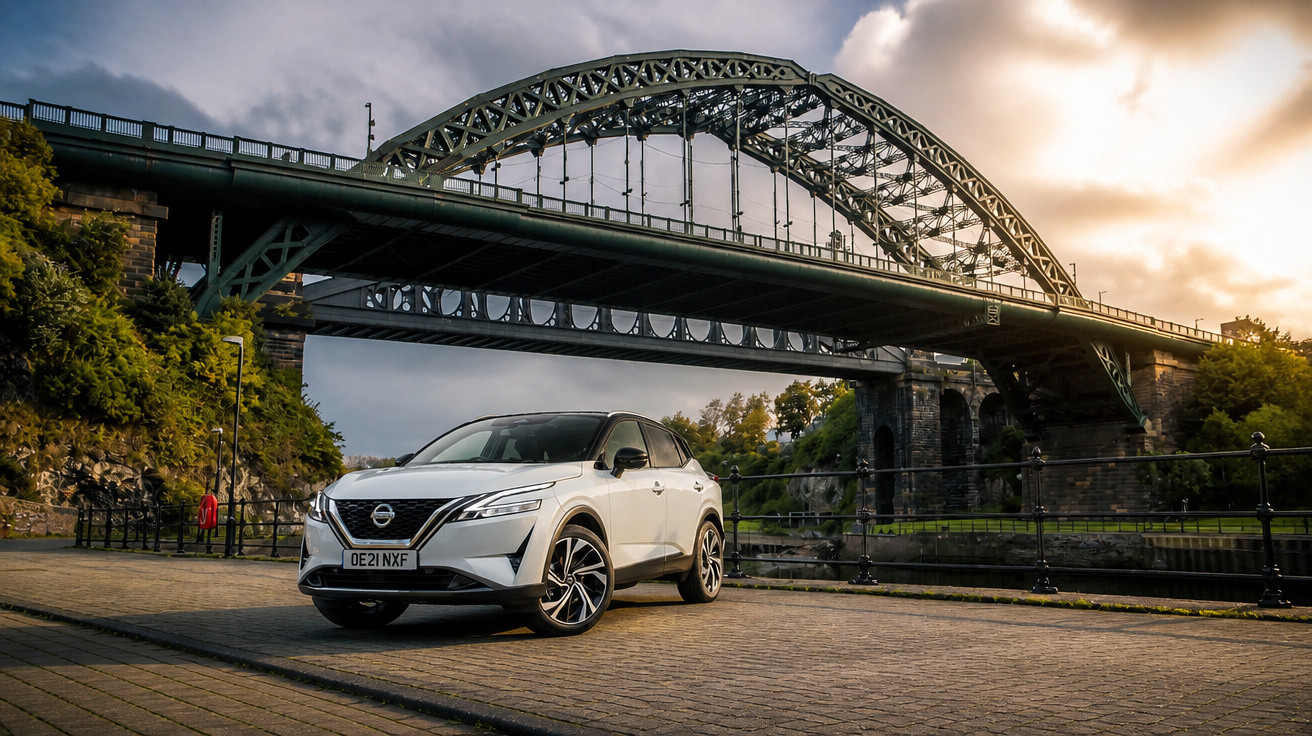
The UK is stirring after its COVID-enforced lull, and “Sunderland to south of Inverness” doesn’t exactly sound like the sort of dream road trip you’d pick for peak travel inspiration. For the British car industry, though-also shaking itself awake-it’s a route that matters. After taking blows from Brexit and the pandemic, the sector has been desperate for something positive. Right on schedule, Nissan has provided it.
Nissan’s Sunderland investment and the Nissan Qashqai’s role
A £1 billion investment will add a battery gigafactory to Nissan’s Wearside site, bringing more than 6,000 new jobs and recasting Sunderland as a self-styled “world-first EV manufacturing ecosystem”. The car in front of you won’t come from that future setup just yet, but it sits squarely on the path towards it: the third generation of the original crossover, the Nissan Qashqai.
Conceived, engineered and then assembled in Britain, the Qashqai was the high-riding hatchback that properly broke into the UK’s bestseller charts-even if plenty of people still aren’t sure they’re saying its name correctly.
I’ll admit I’ve long tried to persuade friends not to buy one, usually pushing them towards something keener to drive (generally without success). That’s in spite of the fact Mackem blood runs happily through me. If you’ve ever wondered what “Mackem” means, it’s thought to come from Sunderland’s shipbuilding era and the saying “we make them, they take them”-we mack ’em, they tack ’em.
Nissan’s Sunderland plant typically macks around half a million cars a year. And of the 3.8m Qashqais produced so far, they represent one in five cars made on British soil since 2007, while helping to sustain 35,000 jobs. The public, meanwhile, has been more than willing to tack them: 20 per cent of those 3.8m have been sold here in the UK.
From Sunderland to the Scottish Highlands (via the A1 and A82)
Today we’re the link between making and taking. Our role in the Nissan supply chain is to collect a Qashqai at the end of the production line and deliver it with a little extra theatre to its new owner, Colin McAndrew, who’s based in Inverlochy in the Scottish Highlands. Ahead is a six-hour, 300-mile (about 480 km) run, with the goal of threading Colin’s car through heavier-than-usual sightseeing traffic faster than any packed-to-the-rafters transporter could manage.
Photography: Jonny Fleetwood
[(Image carousel)]
Once the final checks are signed off at the line’s end, we slap on the number plates and set off-but not before looping through the city that’s so fundamental to this car’s story. Since the shipyards and coal mines closed, Sunderland has relied on two major institutions to circulate hope: the football club and the car plant. The former has been stuck in a third-division rut for years. Mackem spirits could do with this new Qashqai playing in the Premier League.
Tekna+ cabin: familiar controls and low-stress usability
The early signs, as we pass the city’s cultural landmarks (don’t laugh-it was shortlisted for UK City of Culture 2021), suggest Nissan has played it safe in the best way. There’s no Volkswagen-style reinvention of basic ergonomics: in the Qashqai, the buttons are still plentiful, and they’re still big.
This top-spec Tekna+ adds a large touchscreen and digital instruments, though the type sizes make me think of those magnified smartphone displays you sometimes see older people using. Still, the payoff is obvious: you climb in and everything works exactly as expected, with no learning curve at all. It isn’t glamorous, but in a big family holdall it’s massively practical.
Joining the northbound A1 makes it plain that, of this engine’s lively-sounding 156bhp and the less lively 9.5secs 0–62mph claim, it’s the latter that aligns with how it feels in day-to-day driving.
There’s mild-hybrid help for the 1.3-litre 4cyl up front (in this car sending drive to the front wheels via a 6spd manual), yet it doesn’t really paper over the turbo lag. The upside is refinement. It isn’t especially punchy, but it’s exceptionally quiet-almost absurdly so.
I remember this same unit in a Mercedes A-Class, where it came across like a hedge trimmer. Here, Nissan seems to have stuffed the bay with sound-deadening with the zeal of a teenager frantically taping egg boxes to a bedroom wall before a first band practice-except, in this case, it actually works. If there’s a mainstream petrol car that’s quieter than this, I’ve not driven it.
Oddly, not much of our 300 miles is motorway work. After a brief glimpse of Glasgow’s taller buildings-another industrial city now leaning into culture-we join the A82 for the remainder. From there it becomes a continuous, slow-moving serpent of cars, speeds changing unpredictably as holidaymakers descend on Glen Coe’s Icelandic look as a stand-in for a poolside all-inclusive.
Up to this point, the Qashqai’s straightforward nature has kept my pulse in check. Then it hits me: we’re meant to hand over this car looking pristine, fresh from Final Line Inspection perfection. Some of the UK’s finest driving roads are about to be tackled at crawling pace. And today there’ll be no hastily bought Greggs consumed at the wheel to keep my blood sugar up.
We stop at the first (and possibly only) quiet viewpoint for a snack. The Qashqai’s elevated stance-so different from the dreary Almera it replaced-means we’ve got our pick of lay-bys. It’s not the headline benefit that made Nissan gamble on crossovers nearly 15 years ago, but it’s one small advantage we petrolheads can prise from a car that otherwise slightly irritates our fussy preferences.
Jonny the photographer is wide-eyed at the quality of the light. It’s a properly summery day, made marginally less perfect by an outrageous number of midges, and he starts hauling camera kit from the boot. “It looks great, doesn’t it?” I presume he’s talking about the mountains, but he’s apparently referring to the Anglo-Japanese SUV.
What’s certain is that it looks a tad more exciting than it drives
Whether it’ll still feel that bold once there are a bazillion of them across Britain is another matter. What’s undeniable is that it has a bit more visual fizz than it has dynamic sparkle.
There’s plenty of squidge in the suspension, yet there’s also a firmer edge-particularly on the new 20in (about 508 mm) alloys-that should stop it making smaller passengers in the back feel queasy. It hangs on well, but it doesn’t encourage you to seek out every last millimetre of grip. And the manual gearchange is so light you could imagine the engineers using a 911 R as a “do the opposite of this” reference point.
That, of course, is the whole idea. It’s quiet, it’s gentle, it’s effortless-and for slightly anxiety-inducing delivery duties, that makes it ideal. It may not have been the brief, but it turns the Highland hordes into something easy to deal with.
As enthusiasts, we tend to applaud cars that demand something from you: handling that needs taming, controls that require muscle. Anything intentionally easy-going gets dismissed as a compromise. The sales charts usually make us look daft, though, and this Qashqai feels purpose-built for sitting back and letting the scenery do the work on a trip exactly like this.
It even has a seat massage function, whose motors are probably the loudest moving parts Jonny and I encounter all day. It feels a bit cheeky to enjoy it before it’s had the chance to knead Colin’s stresses away, but surely he’d rather his delivery driver stayed as calm as possible while transporting the new McAndrew motor car.
Handover in Inverlochy: Ceramic Grey, Hamish, and the double-floor boot
Colin himself is as relaxed as anyone I’ve met, and given where he lives, it’s not hard to see why. After one last fuel stop and an intense wash, rinse and polish in Fort William-for maximum new-car sheen, even though it’s now halfway run in-we turn into a quiet little street.
Waiting for us is the Qashqai’s new custodian and his stocky enforcer, Hamish the French bulldog. One of them eyes the Ceramic Grey SUV with a lot more suspicion than the other. Reading the situation, I hurriedly transfer the blanket and bed from the outgoing X-Trail so Hamish can back his bouncer-like body into position and assess the newcomer properly. Hamish, not Colin. But you knew that already.
If my time running a Morgan in the Top Gear Garage has taught me anything, it’s that where and how a car is made can be as emotionally persuasive as how many g it can pull in a corner. The crossover segment isn’t exactly overflowing with dazzling character; most options are simply different variations on “decent”.
So the case for choosing the original-the one designed, developed and built in Britain, tuned to our preferences and carrying a smaller carbon footprint-is hard to ignore.
A car engineered to be this mainstream and this eager to please will always have a slot among the UK’s bestsellers. It seems Frenchie-pleasing too. Hamish is now completely settled, and Colin is so taken with the space of the double-floored boot that he even floats the idea of getting a second dog to go in there. Hamish’s ears immediately shoot up like antennae.
If it suits them, it suits us. The next time a friend tells me they’re thinking of leasing a Qashqai, I doubt I’ll try to steer them towards anything else. Now, how do I get back home?
VERDICT
VERDICT: The crossover pioneer isn’t the best car to drive in its class, but it’s quite possibly the easiest to live with, which is surely what matters more. It’s made locally, too...
Comments
No comments yet. Be the first to comment!
Leave a Comment