
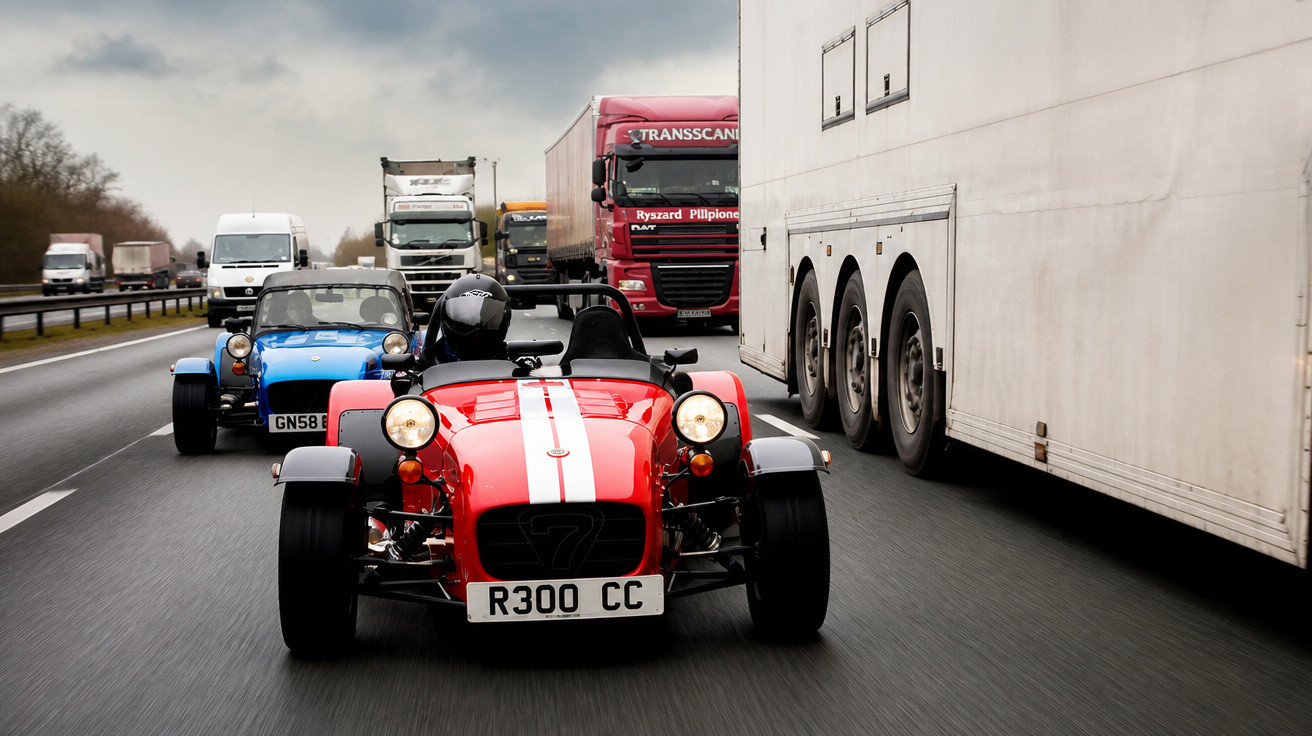
Park the ego for a minute and think about it properly: these two Caterhams run the same 175bhp, 2.0-litre Ford engine and sit on essentially the same underlying layout. Yet one comes with a more forgiving five-speed gearbox, extra space thanks to the widebody SV chassis, plus a windscreen, heater and a roof. The other adds an extra ratio, a limited-slip diff and more carbon fibre, while shedding pretty much everything else - less mass, less screen, and generally a lot more less. So which is the better time, more often: the B-road-friendly Caterham Roadsport 175, or the barely road-legal Caterham Superlight R300?
[Carousel: themed]
This feature was first published in Issue 193 of Top Gear magazine (2009)
Images: Lee Brimble
Why most people instinctively choose the Superlight
Most of us, naturally, would point straight at the Superlight. Why? Because "compromise" is an awful word. It reeks of half measures, of safe middle lanes and close-but-not-quite. It’s the sort of word that forces you to be responsible, weighting you down with sensible decisions and a kind of beige, middle-management gloom. The Roadsport is plainly the compromise choice, and obvious compromises rarely earn you admiring looks.
But a car tuned for the real world ought to let you tap into more enjoyment, more of the time - shouldn’t it? Is this where you go hunting for dependable, easy-to-access thrills, rather than the hard-to-reach peaks of something more committed? Is softcore now the new hardcore?
The Caterham Roadsport 175: an ‘all-seasons’ Seven
Here’s the idea. Caterham positions the Roadsport as an ‘all-seasons’ Seven instead of a fair-weather, dry-Sunday weapon. The thinking is simple: specify it more gently, use it more often (even if each drive is a touch lower intensity), and you’ll end up getting more out of it overall.
It isn’t intended to be track-led, and it arrives with the kit you’d expect for year-round use: roof, windscreen, 15-inch (381 mm) alloy wheels, heater, full carpets and all the other bits and bobs. You can even specify a radio. A limited-slip diff isn’t included as standard, but you do get a five-speed gearbox with longer ratios to cut down on shifting, plus armrests and big, thick seats in the name of comfort. In essence, this is Caterham’s take on a Maybach.
Reality check: still a Seven, and still not much of a tourer
That extra equipment can lull you into thinking it’s something it isn’t, because underneath the surface the Roadsport is basically an R300 wearing a slightly awkward costume. Even with what counts as a kitchen-sink spec by Caterham standards, the Roadsport tips the scales at only 550kg.
Performance doesn’t exactly suggest a relaxed cruiser either: 0–100km/h (0–62mph) in 4.8 seconds, and a top speed of 222km/h (138mph). And it’s still a pretty hopeless long-distance car. After about 129km (80 miles) on the motorway, I was genuinely wondering if we’d accidentally mixed the cars up.
Look at the side-by-side figures and you might imagine the Roadsport as a distance-devouring machine, but on the road it’s brutally loud, the heater achieves precisely nothing, and no matter what you do your right armpit ends up permanently frozen. You fight your way in under the flimsy canvas contraption that claims to be a roof; you fight to climb back out; and, if we’re honest, you fight to understand why you’re bothering.
Even the driving experience can feel strangely unrewarding, with track time ultimately defined by fairly terminal understeer. As a supposed all-rounder, the Roadsport comes across as surprisingly mediocre.
Caterham Roadsport 175 vs Caterham Superlight R300: the scary one that isn’t
Which is exactly why the Superlight creates a little dread. If the Roadsport has you yearning for the comforting stability of a Kia Cee’d, then the Superlight sounds like it should be utterly savage.
There’s no windscreen, a short-ratio six-speed gearbox, an LSD, and no roof at all. It’s 35kg lighter than the Roadsport and trims 0.3 seconds from the 0–100km/h (0–62mph) run. Based on the Roadsport experience, you’d assume it would be a miserable road companion.
And yet it isn’t.
Yes, you need to dress properly for the conditions. And yes, the racing harnesses are a nuisance at petrol stations - or when you realise the key is in your jeans pocket after you’ve already strapped yourself in. But once you’ve settled onto the carbon slivers the Superlight calls "seats", it’s actually more comfortable than the Roadsport. Truly.
It’s quieter when you’re wearing a helmet, even crawling around the M25 at rush hour. Getting in and out is simpler too (you just step in), and the seat shapes itself to you, not the other way round. Your view out improves. So does what you can feel through the car. Everything seems more authentic, more connected, and it justifies every last second of harness-related faff.
Even doing ordinary, day-to-day driving, modern engineering means the engine doesn’t fluff, the gearbox doesn’t whine, clunk or complain, and the road manners are entirely useable.
Road and track: Brands Hatch tells the truth
Unsurprisingly, at Brands Hatch the Roadsport can’t live with the R300. The engines may be identical on paper, but the Roadsport ends up feeling like a tractor: the sense of connection is somehow frayed, and the absence of an LSD is a massive handicap.
Back on the road - where you’re running below the axle line of DAFs and Ivecos - there still isn’t a clear advantage for the Roadsport either, which is the real surprise. Most of us would arrive expecting the Roadsport to make the case for what’s genuinely useable (and therefore enjoyable) on public roads, while the Superlight would be exposed as chest-puffing pseudo-raciness.
I’d assumed the wild track specials we all lust after were, in practice, harder to extract maximum entertainment from than their more real-world siblings. One-potato, two-potato, three-potato, four. We’ve both got this car, but mine’s just a little bit more. More power. Added lightness. Stiffer suspension. Bigger wheels.
The common belief is that we buy the scariest, priciest version not for the five per cent of the time we’ll actually exploit adjustable carbon fibre exhaust-tip venturis, but for the 95 per cent of the time we can boast that we have adjustable carbon-fibre exhaust whatsits.
Modern ‘sporty’ cars, and why the logic has shifted
These days, it’s difficult to wring 100 per cent out of a modern sports car on the road without either killing yourself or attracting the attention of helicopter-mounted police and a swarm of slow but persistent jam sandwiches. So choosing something even more 'sporty' - something with an even higher ceiling at the sharp end of the performance envelope - seems pointless for most of us who are still trying to locate the performance post office.
But that argument doesn’t really hold any more.
Now, even the most focussed track specials tend to have broadly the same road manners as the cooking models. Yes, they can be firmer and less cosseting. But they aren’t automatically more difficult to drive, harder to live with, or less dependable. And for the one or two per cent of the time you can properly explore those extra reserves of ability, they are absolutely worth it. Really. "Don’t dilute the drug."
Yes, the Caterham Seven Roadsport 175 costs from £24,995 for a factory-built car. The Superlight R300 £27,995. A three grand gap. But to my mind there’s no contest. Go hardcore, or go home. And hand me the keys to the R500 on the way out of the door.

Comments
No comments yet. Be the first to comment!
Leave a Comment