
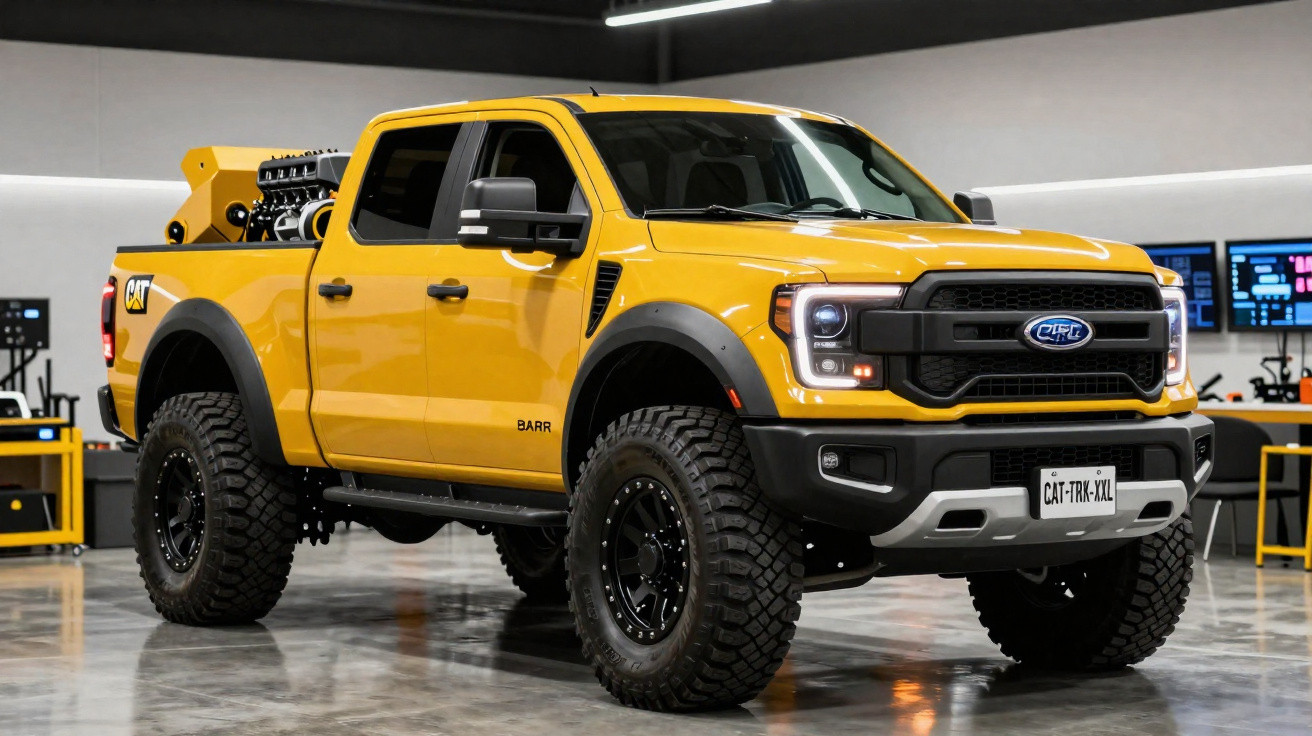
Caterpillar, long associated with enormous excavators, bulldozers and generators, is moving into unfamiliar territory: with the “Cat Truck”, the group is unveiling its first in-house pick-up. Behind the yellow-and-black badge, however, it is not a clean-sheet Caterpillar design, but a smartly repurposed Ford technology package - including a ferocious V8 diesel.
From tracked excavators to a pick-up: why Caterpillar is building vehicles now
Founded in 1925, Caterpillar began in Texas by producing machines for the toughest jobs: tracked equipment, excavators, cranes and diesel generators. On construction sites across the world, there is almost always a yellow “CAT” machine somewhere in the mud.
Unlike brands such as Volvo or Hyundai, which have long offered lorries and vans alongside their core products, Caterpillar has historically stayed out of mainstream road-vehicle manufacturing. That is now changing. The company is launching a heavy-duty vehicle that aligns closely with its bread-and-butter work: a 4×4 pick-up designed for towing, hauling and overseeing major construction sites.
“The Cat Truck isn’t a lifestyle pick-up - it’s a rolling tool for extreme jobs, designed uncompromisingly around the reality of day-to-day site work.”
The concept had been circulating within Caterpillar’s leadership since 2024: a “Swiss Army knife” on wheels, combining several site functions in one platform. Turning that idea into a production-ready vehicle is another matter, so Caterpillar has partnered with a company that has spent decades building work vehicles: Ford.
Ford engineering: what’s really underneath the Cat Truck bodywork
For the Cat Truck, Caterpillar is using an established platform from Ford’s line-up. The underpinnings are drawn from the heavy Ranger and Super Duty family. The key point is that this is not a compact, mid-size pick-up, but a full-fat heavy-duty truck developed to handle extreme towing and payload demands.
Visually, Caterpillar has made its mark: the Cat Truck gets a distinct, substantial grille, wider headlamps and - inevitably - the familiar CAT logo. But the chassis, axles and overall architecture are clearly derived from Ford’s US template.
V8 diesel with serious muscle
Caterpillar also sources the engine directly from Ford’s parts bin. Under the bonnet sits the 6.7-litre V8 “Powerstroke” diesel, well known from the Ford F350 Super Duty.
- Engine: V8 diesel “Powerstroke”
- Displacement: 6.7 litres
- Power: 500 PS
- Torque: 1,356 Nm
Those figures make the purpose crystal clear. This is not a show truck for the high street; it is a workhorse built to move heavy trailers, tool containers, backup generators or mobile workshop units. The enormous torque also enables high-demand power take-offs - for example, to run hydraulic pumps, winches or compressors on site.
Construction sites first: what the Cat Truck is actually for
Caterpillar is not pitching the Cat Truck as a leisure pick-up for campers and weekend adventurers. Instead, it is presented as a “short-distance vehicle” intended for use on and between work sites. Its role is to support safety duties, supervise operations and assist maintenance teams.
“The Cat Truck becomes a mobile control centre: it monitors, documents and supports the work of entire site crews.”
To achieve that, Caterpillar is integrating several technical modules that go well beyond a typical commercial vehicle:
- Driver fatigue monitoring: Cameras and sensors track the driver’s gaze and responses, warn of microsleep tendencies and can document incidents.
- Drone platform: The vehicle includes a designated launch-and-landing area for autonomous drones. These fly predefined routes to check earthworks, material storage areas and hazard zones.
- AI voice assistants: Digital assistants respond to spoken queries about the machine, maintenance intervals or safety protocols, and can work through checklists.
This turns the Cat Truck into a four-wheeled hub where technology, logistics and health-and-safety oversight meet. On large-scale pipeline, mining or infrastructure projects, vehicles like this could significantly tighten up workflows.
Direct comparison: Cat Truck vs Ford F350 Super Duty
Because both vehicles use the same engine, a look at the core technical numbers is unavoidable. The layout highlights where Caterpillar adds value - and where Ford defines the fundamentals.
| Model | Engine | Power (PS) | Torque (Nm) |
|---|---|---|---|
| Cat Truck (Caterpillar) | V8 Powerstroke 6.7 l diesel | 500 | 1,356 |
| Ford F350 Super Duty | V8 Powerstroke 6.7 l diesel | 500 | 1,356 |
From a mechanical standpoint, they are extremely close. The separation comes in the fine print: Caterpillar equips the Cat Truck with its own software, bespoke monitoring tools and drone systems, and then tunes the entire package specifically for construction-site use. While the Ford F350 also targets farmers, tradespeople and towing enthusiasts, Caterpillar appears to be thinking almost exclusively in terms of large industrial customers.
No route to the UK - but still relevant for local readers
One thing is clear: the Cat Truck will not come to the UK or wider Europe. The powertrain, emissions after-treatment and sheer size are ill-matched to local approval frameworks and road conditions. Caterpillar is aiming at regions where vast off-road sites, long distances and high towing loads are routine - such as North America, parts of South America, or resource-heavy territories.
Even so, it is worth examining from a UK perspective. Caterpillar’s move underlines how the construction site is evolving: away from isolated machines and towards connected systems that capture data, analyse it and support decisions directly at the point of work.
“The Cat Truck is a symbol of a job site where data is becoming as important as diesel and concrete.”
UK construction firms already use fleet management, telematics and drone surveying. A vehicle that integrates these functions as standard could be compelling here too - even if, for regulatory reasons, it ultimately needed a different powertrain or a more compact footprint.
What risks and opportunities come with a concept like this?
A “high-tech work vehicle” like this is not benefit-only. More sensors and more software also mean more complexity. If a key system fails, it can slow down entire site processes. The central questions include:
- How resilient are AI systems and drones in dust, mud, cold and heat?
- Who owns and manages the data collected - the client, the operator or the manufacturer?
- How can servicing and repairs be handled when these specialist vehicles are working far from the nearest workshop?
Here, Caterpillar can lean on a core strength: it runs global service networks for heavy construction equipment and could extend similar structures to support the Cat Truck. With that in place, the step into pick-ups looks less like an eccentric side project and more like a logical extension of the existing business.
What UK industry professionals can take from the Cat Truck
For contractors, engineering consultancies and planners in the UK, the project offers several practical ideas:
- Vehicles as data nodes: Pick-ups and vans can act as mobile hubs, combining measurement data, drone imagery and maintenance information.
- Building safety in on board: Fatigue-detection systems can be added to conventional fleets without needing an all-new vehicle programme.
- Making partnerships work: Caterpillar and Ford show how traditional industry boundaries can blur - an equipment manufacturer does not need to design every bolt of a vehicle from scratch.
Anyone planning major sites in future will have to engage more seriously with solutions like these. Whether the Cat Truck, in its current form, ever rolls beyond US job sites remains uncertain - but Caterpillar’s direction sends a clear message: tomorrow’s construction site needs more than big machines; it needs intelligently connected vehicles that function as the project’s digital nervous system.
Comments
No comments yet. Be the first to comment!
Leave a Comment