
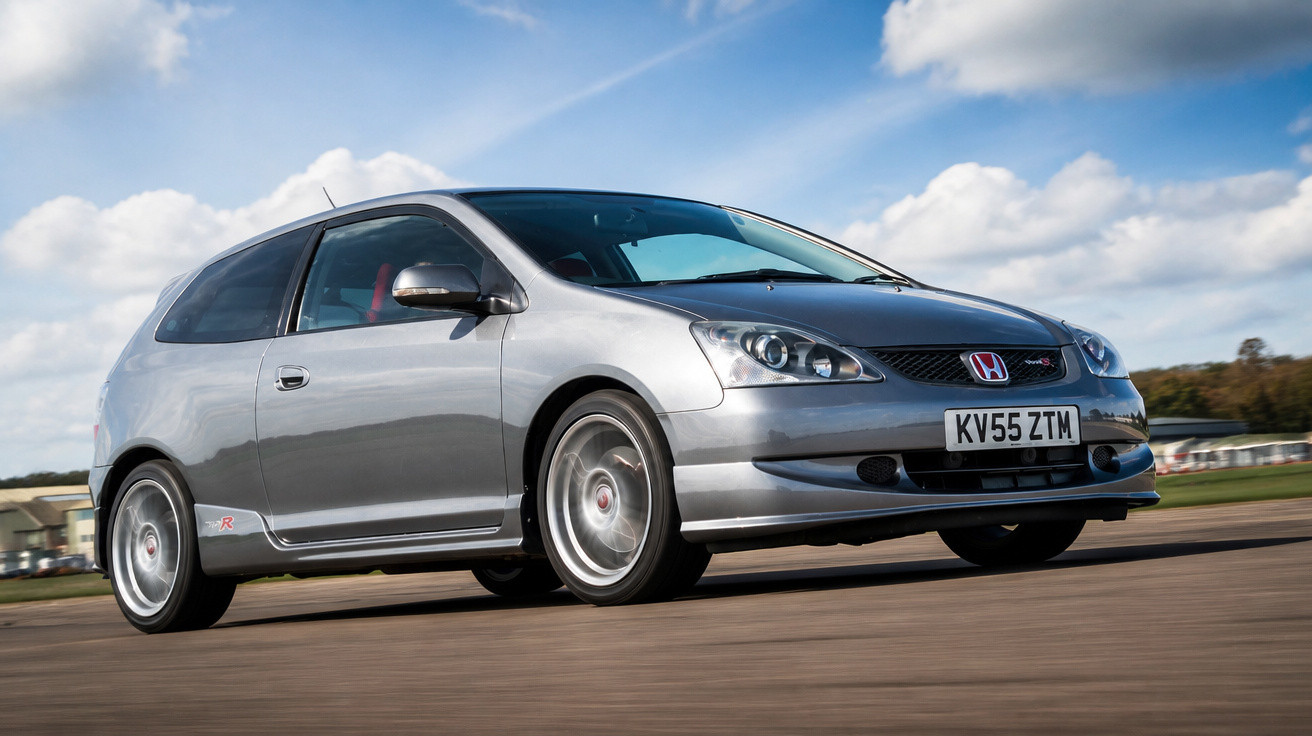
I’ve come across this one plenty of times before. In fact, 20 years ago it felt as though I was climbing into a Type R almost weekly, each drive another skirmish in the never-ending argument about the best hot hatch. Hot hatches-do you remember them? Before getting behind the wheel of this EP3, I tried to recall what stood out. In my head, the Civic’s trump card was its engine-really, the whole powertrain-and the weak link was the chassis.
It turns out I’d got that the wrong way round. The chassis is an absolute cracker. It’s the steering that disappoints. Still, there’s a reason this is the Civic that everyone goes on about. Yes, the car before it-1997’s FK9-already had VTEC variable valve timing, but it never quite sat comfortably in the European hot hatch template. We weren’t sure what category it belonged in.
The Honda Civic Type R EP3 and the ‘breadvan’ shape
Honda’s solution was to make the next one look like a box. The EP3 was soon dubbed the breadvan. It’s an odd-looking thing: a single-plane nose and an upright tail that make it resemble a cheeky, shrunken MPV. People carriers were all the rage at the time, and Honda doubled down on everyday usefulness with decent rear seats and a 315-litre boot.
But practicality wasn’t what had us wiping sweaty palms on our trousers.
Photography: Dean Smith
Inside, they’d mounted the gear lever up on the dash-perfectly placed, nice and high, just a handspan from an equally lovely steering wheel. They also fitted a brilliant set of Recaro seats, plus clear white dials. For all its slightly peculiar shape, the cabin both looked right and felt right.
On the road: VTEC punch, manual shift and the chassis
I used to think the driving position felt tall. It doesn’t now, not after years of being conditioned by crossovers. I also remembered the EP3 as a car on the boundary between classes. It offered the size and usefulness of a Golf or a Megane, yet carried the cheek and sparkle of a Clio or a Mini. It doesn’t seem big today either, but it remains seriously athletic and agile.
The trick is that you have to rouse it. It’s like Orangina: potter about and you’ll struggle to understand the hype. The ride can feel a touch wooden, the engine offers virtually no torque, and although there’s real satisfaction in using controls this accurate, you don’t automatically feel as if you’re at the helm of something special. You have to go looking for it.
Give it a proper shake. Wind it out. At 6,000rpm it snaps awake and charges off as if it’s just been given an intravenous triple espresso, the induction noise yapping away in a frenzy. I can’t say whether the claim that Honda has never had a single mechanical failure of its VTEC system is true, but it certainly feels unburstable.
Better still, it’s backed up by one of the all-time great gearchanges: a cool little metal lozenge that sits in your palm just so, then performs a kind of mechanical ballet as it snicks cleanly through the gate. Experiencing a great Honda powertrain is something any car enthusiast ought to do. It doesn’t have to be this-an S2000, an NSX, or an Accord Type R would do just as well-but it has to be manual and it has to be naturally aspirated.
As the engine starts working properly, the suspension seems to step up too. There are no adaptive dampers here, yet it can feel as if there are. It’s a bit firm and wooden when you’re just pootling, but once it has something to do it finds a fluency I’d completely forgotten.
It turns into corners with a hint of roll, cocks an inside rear wheel into the air, then scoots round crisply and cleanly. There’s no differential, but on a dry road you don’t really pine for one. What you get is a complete package-an eager Beagle of a car.
The EP3 is a mini masterpiece and, if you’re not frightened of silly mileages (you shouldn’t be), you can buy one for under £5k. With that much talent on offer, the surprise is how mute the steering feels.
Never mind-you’ll manage. I’d take this any day over the FN2 that replaced it. That one really did have a wooden chassis. At least, that’s how I remember it.
Comments
No comments yet. Be the first to comment!
Leave a Comment