
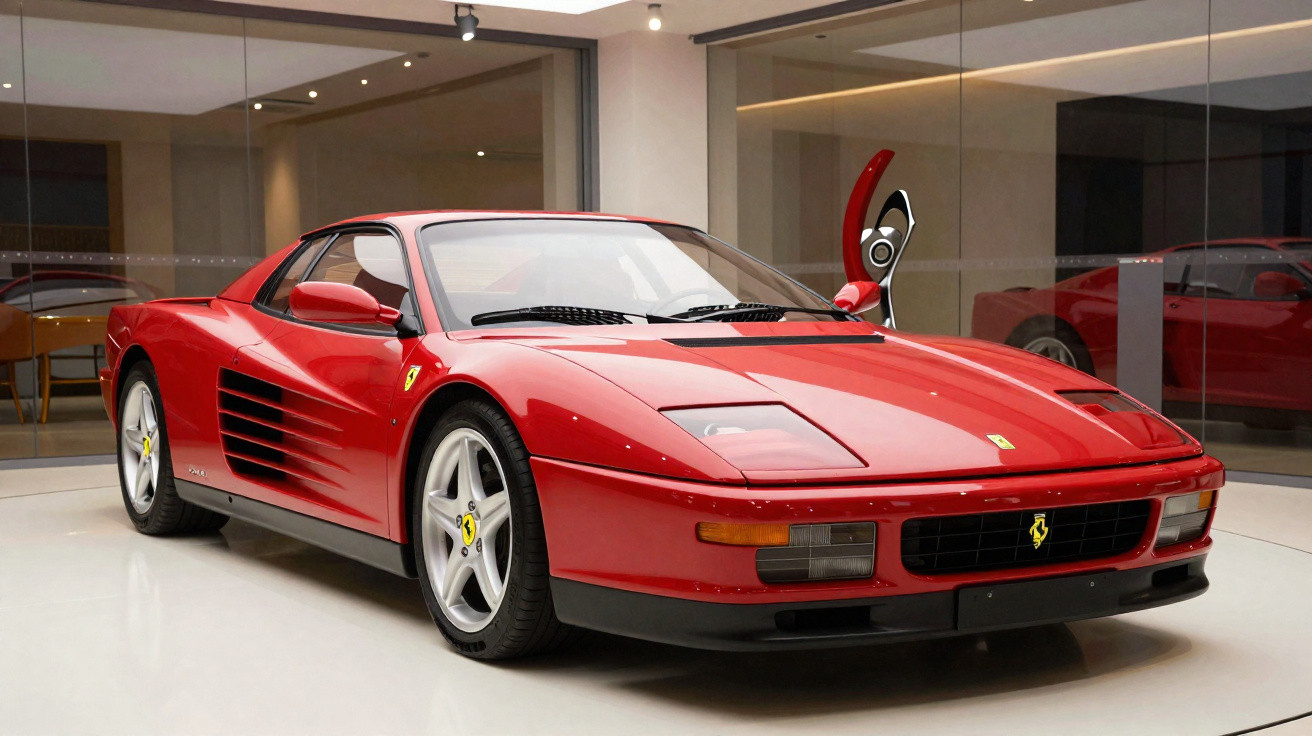
A Ferrari has revived a legendary name to replace the not‑especially‑loved SF90, and I put it to the test on road and on track.
For anyone who grew up in the 1970s and 1980s, Testarossa isn’t merely the name of a Ferrari supercar. It also brings to mind a model whose influence spilled far beyond the car world, becoming an era-defining symbol through films and video games we all remember.
This new Ferrari 849 Testarossa may not be aiming for quite that level of cultural impact, but it still has huge shoes to fill. It carries the burden of being the Italian brand’s new flagship - among series-production cars, of course - while respecting the legacy behind the badge and, at the same time, outperforming its predecessor: the SF90 Stradale.
I travelled to Spain’s Monteblanco circuit to drive it. Yet I’m not sure where I had more fun: on track or on the roads around Valencia. To settle it, it’s all captured in the video. Turn the volume up.
The headline figures are staggering. You get three electric motors plus a twin‑turbo V8, and together they produce 1050 hp. Stamp on the throttle and it pins you into the seat with the same determination whether you’re doing 50 km/h or 150 km/h.
As you saw in the video, the weather was far from ideal when you’ve got this much power under your right foot. And it was precisely in those conditions that this Ferrari really surprised me.
A new phase at Ferrari
The SF90 was undeniably a technological landmark, as Maranello’s first series‑production plug‑in hybrid. But despite the spectacular numbers and the space-age tech, it never won unanimous approval among Ferrari devotees. The most demanding critics largely targeted the styling.
That’s why this Ferrari 849 Testarossa effectively starts where its predecessor left off. The platform is the same, as are the engine and the suspension, but everything has been revisited - including the design.
From a styling standpoint, nothing feels carried over. The proportions are tight and muscular, with a wide, purposeful rear end. The aerodynamic work is obvious, but never theatrical.
At the back, active solutions vary downforce and drag depending on speed and longitudinal demand. At Monteblanco, through the fast support sections, trust me: that extra downforce is very welcome. The Testarossa can hit 200 km/h in less time than it takes you to read this sentence from start to finish. There’s more than 400 kg of downforce from 230 km/h.
Some people still miss the “brushstroke” of the Pininfarina studios on Italian bodywork - I’m one of them… - but I do think the way we all judge this model’s looks will shift over time. In the metal, it’s everything you want a Ferrari to be: imposing, striking, magnetic and genuinely stirring.
Fewer buttons, more function
Ferrari has tuned the cabin with the same philosophy it applied to the chassis: less noise, more purpose. Physical controls are back on the steering wheel, particularly for key functions.
Even so, screens are still everywhere and they take some getting used to. But it’s a big step forward compared with what we had before.
Build quality is excellent, as you’d expect. The aluminium on the centre console feels cool to the touch and contrasts with the leather, adding a sense of heft to the environment. There’s no unnecessary showmanship.
Boot space is limited, but that comes with the structural trade-off of packaging a battery, three electric motors and a twin‑turbo V8 into such a compact supercar. Weight? We’ll get to that… but it’s under 1600 kg.
Take a deep breath before you drive
As I said in the video - and wrote a few lines above - the hybrid system is inherited from the SF90, pairing a heavily revised twin‑turbo V8 with three electric motors. Two sit on the front axle, handling traction and independent torque vectoring. A third motor is on the rear axle, integrated with the eight‑speed dual‑clutch transmission. Combined output is 1050 hp.
More important than the raw number is how it all works together. The combustion engine has been extensively reworked, with more than 40% of its components revised. The goal wasn’t only more power; it was sharper response and greater linearity.
On paper, larger turbos tend to increase lag. In reality, the electrical system makes up for that initial inertia. Electric torque fills any gap and the handover is imperceptible. Power builds cleanly and continuously, without artificial steps. And when you want it, it can deliver one hell of a kick in the back.
Throttle progression is exact, the nose stays true to the line, and the rear axle communicates load and available grip with real clarity. There’s no feeling of excessive mass and no sense of being separated from the driving by technological complexity. The human–machine connection is still there - and it hasn’t been diluted.
At Monteblanco, driving an 849 Testarossa with the Assetto Fiorano package, you can feel just how deep the development runs. High‑speed braking remains impressively stable in a straight line. The load transfer as you turn in is managed, predictable, and lets you carry braking to limits that seem almost unthinkable.
FIVE - the Ferrari Intelligent Vehicle Estimator - is crucial here. It builds a real‑time virtual model of the car, predicting behaviour and adjusting engine, suspension and braking parameters before the situation fully plays out.
The end result is a supercar with huge acceleration and stability that still offers a clear read on its limits. Letting the rear axle slide becomes a choice - almost as natural as moving your hand. Watch the track section of the video. You don’t need to be a racing driver to use 1050 hp with confidence.
In fact, braking at the limit becomes a decision backed by structural confidence. This is exactly where the 849 delivers what the SF90 lacked: it’s more interactive, more immediate and more interesting to drive.
Where could it improve? The sound. It’s exciting, no doubt about it. But you can tell that somewhere between the headers and the exhaust, Europe’s rules of the game have had their say. There must be a way around that…
How much does it cost?
Positioned above €500,000 before personalisation, the 849 Testarossa sits at the top of Ferrari’s range. At this level, the discussion stops being comparative and becomes contextual.
What you’re paying for is access to the marque’s most advanced technology and its fastest series‑production model ever. Exclusivity is part of the package, but the real selling point is the engineering.
And for anyone who believes “a lot” still isn’t enough, an extra €50,000 buys you the Assetto Fiorano pack. It removes 30 kg, adds multiple carbon components (wheels, diffusers and interior elements), and delivers an even more extreme driving experience.
The result? It became the third‑fastest Ferrari ever around the Fiorano test track. Only the all‑conquering, ultra‑exclusive F80 and the radical SF90 FXX have gone quicker. Convinced? If you’re in doubt, go for a drive.
Comments
No comments yet. Be the first to comment!
Leave a Comment