
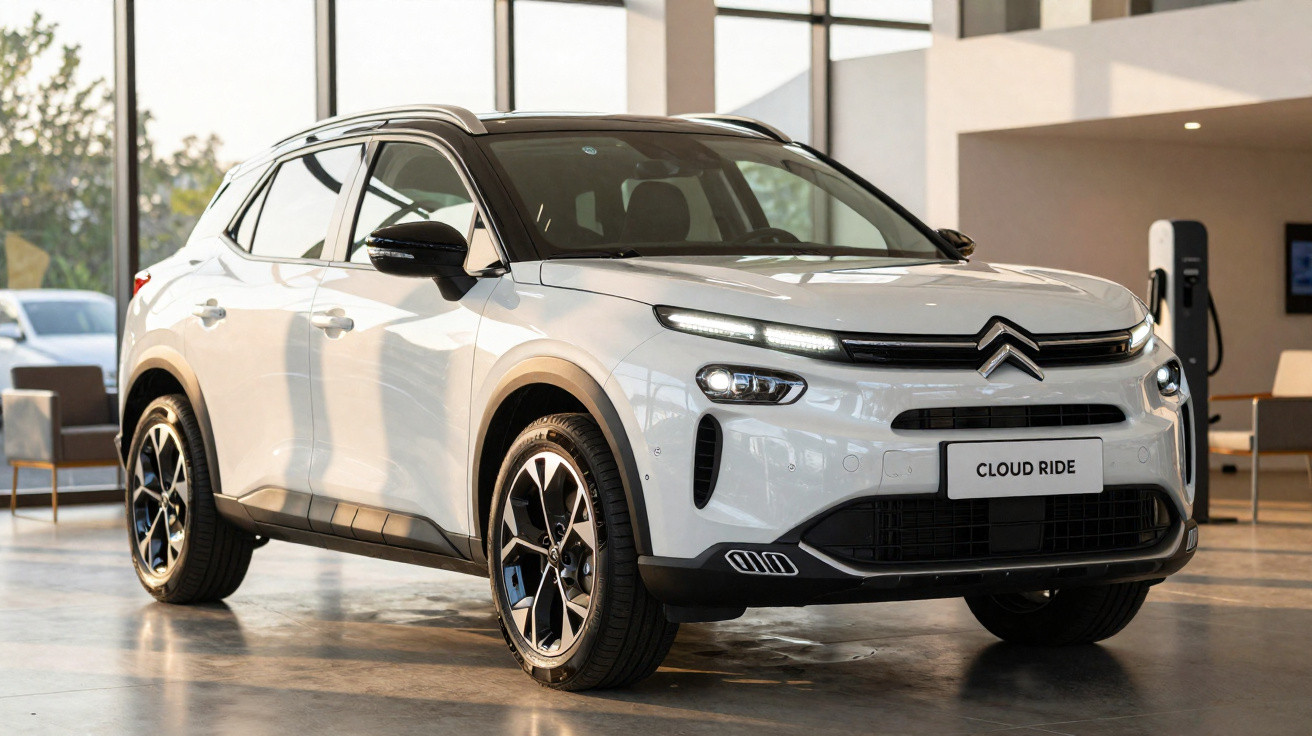
Citroën’s latest C5 Aircross - particularly the electric Long Range version - isn’t chasing the title of most dynamic SUV. Its priorities are comfort, usable range and sharp value, and it does so while quietly hoping you don’t stare too hard at the read-out on a public rapid charger.
A steering wheel you could twirl with a pinky
What hits you first in the new C5 Aircross is the steering weight - or, more accurately, the lack of it. You don’t so much hold the wheel as guide it; a light touch is enough to sweep the nose into a neat U‑turn. Next to its Peugeot relative, the rim is a little less dinky and more normal in shape, but in everyday driving it still comes across as extremely light.
The steering is ultra-assisted: effortless in town, detached on a twisty back road.
That easy steering suits the car’s wider character. The C5 Aircross isn’t aimed at drivers who relish attacking a sequence of bends. Its chassis tuning is comfort-led first and accuracy second, and you notice it immediately over speed bumps and crumbling, patchy surfaces.
Suspension that turns bad roads into soft focus
Here, Citroën leans into its familiar “Advanced Comfort” recipe, using progressive hydraulic bump stops to round off sharp hits. Put simply, there are extra hydraulic cushions right at the end of the suspension’s movement, designed to soak up the hardest thumps before they make it into the cabin.
Around town, that delivers a properly gentle, floating ride over speed humps, joins in the tarmac and manhole covers. At crawling speeds, the dampers can still knock a little over very abrupt edges, yet the overriding feeling is of a large SUV doing its best to insulate occupants from the road.
The body moves around a fair bit in corners, but that’s the trade-off for this level of ride comfort.
Naturally, this softness comes with compromises. Lean on it and it starts to feel languid: you’ll notice body roll and there’s not much feedback about what the tyres are up to. Plenty of buyers - especially anyone who remembers old-school Citroën saloons fondly - will see that as a feature, not a flaw. Anyone who enjoys keen handling may disagree.
At its best on the motorway
Point the C5 Aircross at a long stretch of dual carriageway or motorway and its logic becomes clear. The electric Long Range version driven here isn’t a rocket ship: 0–62 mph (0–100 km/h) arrives in just under nine seconds. For normal use that’s perfectly adequate, though quicker rivals will feel more eager.
What you get in return is a relaxed, low-effort experience. In MAX trim, semi-autonomous assistance comes as standard: adaptive cruise control teams up with active lane-keeping, and the car will even carry out automatic motorway lane changes when you indicate.
Refinement is a strong point. There’s no trick laminated glass, but wind and tyre roar are still kept nicely muted, and the EV drivetrain removes engine vibration from the equation. At 70 mph, the interior stays serene and slightly cocooned.
The C5 Aircross feels less like a high-riding SUV and more like a softly sprung long-distance train carriage.
The integrated route planner also treats EV range with reasonable maturity, offering believable estimates and taking motorway speeds into account. That helps you plan longer runs without obsessing over the remaining-miles readout.
Big battery, mixed charging manners
Range that reassures
The electric C5 Aircross is built on Stellantis’ STLA Medium platform and, in Long Range form, uses the same hefty 97 kWh battery as the latest Peugeot 3008. Citroën claims a WLTP range of up to 680 km, which equates to roughly 420 km of real motorway travel if consumption sits at about 23 kWh/100 km.
For UK and US readers, that’s around 260 miles at faster-road speeds - enough for a London–Leeds run or a New York–Washington trip with a healthy margin. In practice, that kind of real-world ability matters more than an attention-grabbing lab figure.
Charging that can frustrate
In theory, the 400V system supports up to 160 kW DC rapid charging. In practice - at least during this test - it didn’t always play ball. On one stop, with the battery at around 40%, it stubbornly hovered close to 50 kW, even though the pack had been preconditioned. At another charger with a similar state of charge, it managed about 105 kW and held it to 60%.
The charging curve felt inconsistent, sometimes decent, sometimes strangely flat, and never close to the promised 160 kW.
That inconsistency adds tension to longer journeys, particularly if you’re relying on quick, in-and-out charging stops. Citroën could smooth things out via later software updates, but it’s worth going in with eyes open: charging speeds in the real world may be variable.
Home charging is a more positive story. With a wallbox, the C5 Aircross accepts up to 11 kW AC, which makes sense given battery capacities of 73 or 97 kWh. With a proper home charger, an overnight top-up is entirely feasible.
There’s an odd limitation for anyone chasing off-peak tariffs: you can programme a charging start time, but not an end time. The car then pulls power steadily until it hits 80% or 100%. Some competitors offer tighter scheduling windows, which is more convenient.
Easygoing in town, with a few rough edges
Even though it’s larger than before, the new C5 Aircross remains fairly easy to place. Measuring 4.65 m long and 1.90 m wide, it isn’t huge by current SUV standards. A small turning circle helps, and the sharp 360° camera view makes it easy to spot kerbs and bollards at low speed.
Outward vision is less consistently good. The bonnet extends a long way, which can feel a bit daunting when edging out at junctions, and the windscreen is on the narrow side. Looking over your shoulder is also hampered by a chunky C‑pillar, which makes reversing out of angled bays more awkward.
The brake pedal takes getting used to as well. Early in its travel it feels soft and slightly spongy, which isn’t especially reassuring in stop-start traffic. Paddles behind the steering wheel let you choose between three regenerative braking strengths to slow the car more with the motor, but even the strongest setting still stops short of genuine one‑pedal driving.
Space, seats and that Citroën “sofa” feel
Inside, the C5 Aircross plays to familiar Citroën strengths. There’s ample space up front and in the rear, and although the back seat is now a single fixed bench rather than three separate sliding chairs, the cushions are notably soft and the backrests are well padded, with recline adjustment.
Rear passengers get a lounge-like feel, especially on longer journeys, with deep cushioning and plenty of legroom.
The move away from individual rear seats does blunt the outgoing car’s clever modularity, yet day-to-day comfort actually feels improved. The centre tunnel is modest, so the middle-seat passenger doesn’t end up sitting knees-high, even if the central backrest is firmer than the outer sections.
Rear vents are fitted, but passengers in the back can’t choose their own temperature setting - unlike the closely related Peugeot 3008, which can be specified with tri‑zone climate control.
Boot capacity is strong. With the rear backrests in place, you get 651 litres. Fold the rear bench and it expands to 1,668 litres. That’s enough room for multiple large suitcases, a pushchair and the familiar pile of bags that come with family travel.
Design that dares to be different
Even with its comfort-first mission, the C5 Aircross still aims to look distinctive. Up front, the lamps use a C‑shaped light signature reminiscent of the facelifted Berlingo, and for the first time on a Citroën they’re paired with Matrix LED tech. The system can selectively mask parts of the beam to avoid dazzling oncoming traffic while keeping full main-beam brightness elsewhere.
Along the sides there’s chunky plastic cladding that adds a mildly rugged vibe, and optional 20‑inch wheels fill the arches more than you might expect from the brand. At the rear, Y‑shaped tail-lights stretch into the C‑pillars, creating a dramatic, concept-car-like look that’s particularly striking after dark.
Small coloured inserts on the bumpers and doors offer mild customisation, even though the overall colour palette is relatively muted for a Citroën.
Cabin tech up, perceived quality down
From the driver’s seat, the cabin feels far more up to date than the previous car. A broad, horizontal dashboard is centred on a 13‑inch portrait touchscreen, with a 10‑inch digital instrument display and a head‑up display alongside.
The infotainment makes sense to use: the layout is clear, and climate functions remain permanently available via touch-sensitive shortcuts, so changing fan speed doesn’t mean diving through layers of menus. In a segment where many cars bury simple controls behind multiple taps, that’s welcome.
Where the C5 Aircross loses ground is in perceived material quality. The upper dashboard is finished in hard plastic where you might anticipate softer surfaces. The door trims - front and rear - also lean heavily on similarly rigid materials. Broad strips of recycled fabric add light and warmth, but they don’t completely disguise the cost-conscious choices.
The interior design looks modern, yet some finishes feel more budget than the tech and price would suggest.
The gloss-black centre-console trim is a magnet for scratches and fingerprints, and the steering wheel’s lacquered control panels don’t feel especially premium. None of it affects functionality, but it does leave the C5 Aircross a step behind some rivals in tactile polish.
Equipment and pricing: value as a weapon
Citroën pitches the C5 Aircross as the more attainable option within the wider Stellantis line-up. In France, pricing begins at €34,300 for the mild-hybrid petrol and €39,490 for the electric model, placing it below comparable Peugeot 3008 versions.
Even the entry version comes well stocked: adaptive cruise control, keyless start, the 13‑inch touchscreen, dual-zone climate control and 18‑inch alloy wheels are all standard.
Main trim levels at a glance
| Trim | Approx. starting price (France) | Key features |
|---|---|---|
| Base | From €34,300 (mild-hybrid) | Adaptive cruise, 13" screen, dual-zone climate, 18" wheels |
| Plus | From €37,240 | Rear camera, keyless entry, tinted rear windows, navigation, ambient lighting, rear air vents |
| Max | From €40,180 | Matrix LED lights, powered tailgate, 360° camera, head‑up display, electric driver’s seat, heated steering wheel |
The Long Range battery fitted to the test car isn’t currently offered on the Citroën. For the moment, Stellantis is prioritising its larger 97 kWh packs for the Peugeot e‑3008 and the DS 8. If current price gaps hold, a fully specified C5 Aircross MAX with the long-range battery could end up expensive enough to fall outside some national EV incentive thresholds in markets such as France.
Who this “cloud on wheels” really suits
The new C5 Aircross is at its most convincing for drivers who put comfort, space and range ahead of crisp handling. It suits families who do long motorway miles, commuters whose daily routes are scarred by poor surfaces, and retirees swapping a large saloon for something higher and easier to climb into.
- If you tow regularly or want a sporty, punchy feel, the soft suspension and merely adequate performance could grate.
- If most of your driving is in towns and suburbs, the light steering, relaxed setup and quiet cabin are likely to appeal.
- If you often travel long distances, the large battery and calm motorway character make a persuasive case.
It’s also worth being clear on a couple of EV terms that come up repeatedly with this car. WLTP range is a laboratory-derived European figure and is often optimistic at sustained motorway speeds. That’s why the quoted 680 km can drop to about 420 km in real, faster cruising. DC rapid charging power is another: the peak kW headline is only part of the story - the crucial factor is how long the car can maintain a high rate along the charging curve.
In a typical example, if the charging curve behaves nicely at, say, 130 kW, a 10–80% top-up could take roughly 30–35 minutes on a battery this size. But if big parts of the session sit at 50–80 kW, it’s easy to end up waiting closer to an hour. For families with young children in the back, that difference can make or break the practicality of an electric road trip.
The C5 Aircross mitigates some of that by being comfortable, spacious and capable of strong real-world range, which reduces how often you need to stop in the first place. If you can live with its unhurried character - and an interior that feels more straightforward than luxurious - this softly sprung SUV may quietly be one of the most rational buys in the Stellantis stable.
Comments
No comments yet. Be the first to comment!
Leave a Comment