
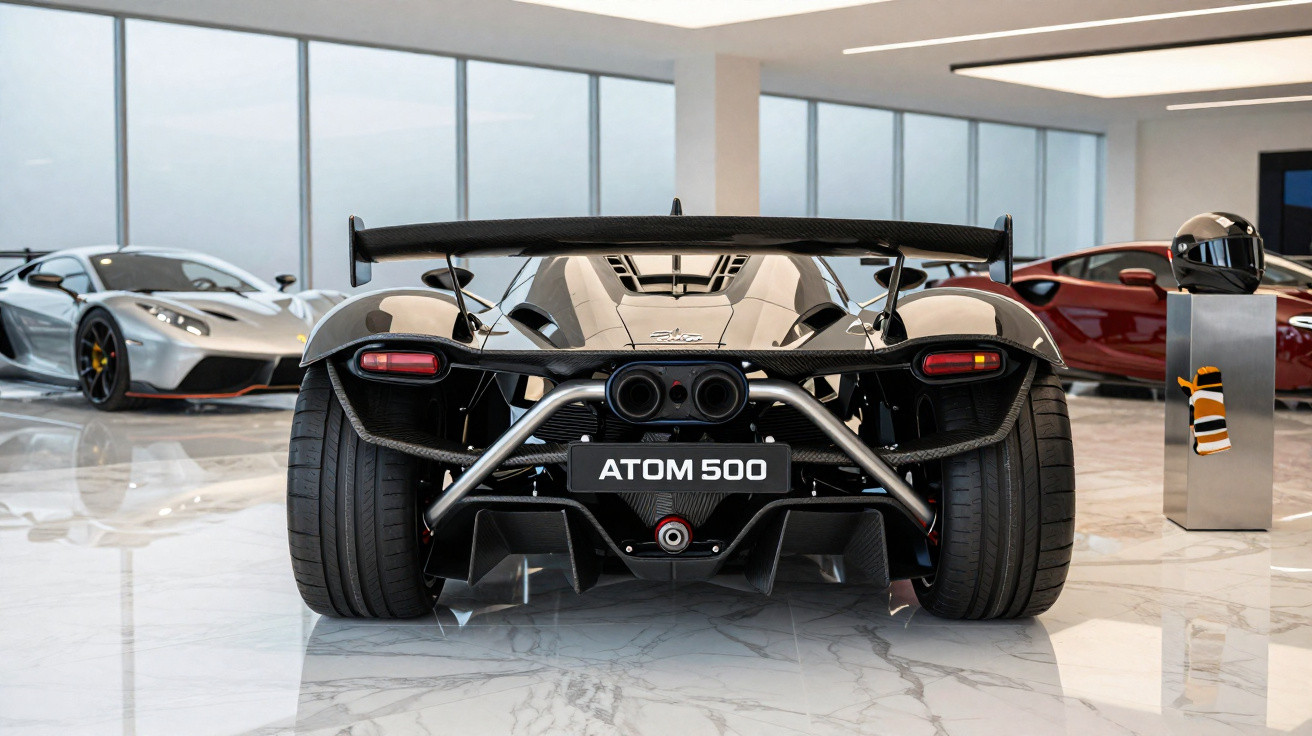
That a tiny sports-car maker from the West Country is managing to weather the recession is notable in itself. That the same outfit has now produced something with performance on a level with today’s gang of blue-chip supercars is frankly staggering.
Ariel Atom V8: the headline numbers
Say the three words ‘Ariel’, ‘Atom’ and ‘V8’ to most people and the three that tend to come straight back are ‘Jesus’, ‘Effing’ and ‘Christ’. There’s a reason for that. This is a car that tips the scales at a touch over 500kg (just over half a tonne), yet it’s now producing 500bhp. That works out at close to 1,000bhp per tonne - nudging towards double the figure of a Bugatti Veyron. For sheer, no-excuses pace - on pretty much any surface, in pretty much any gear - it could well be the fastest road car on the planet. And Top Gear has been allowed to sample it before anyone else beyond Ariel’s own factory gates.
This feature was first published in Issue 209 of Top Gear magazine (2010)
**Images:* Lee Brimble*
[Inline gallery: images 0]
The Atom 500: track focus, gearing and that V8
Which raises an obvious question: is this, in all honesty, a sensible idea? The Atom 500 is road-legal, but it is unapologetically built around circuit use - evident in the ratios of its Sadev six-speed sequential gearbox and, of course, in that outrageous power-to-weight figure. The V8 itself is ultra-light and compact, created by combining two Suzuki Hayabusa engines, and it spins to beyond 10,000rpm. At those speeds, helmet or not, the horizon is liable to smear into a single streak and the soundtrack inside your head becomes a genuinely frightening shriek.
Modena: taking the Atom 500 to supercar country
We’ve brought the Atom to Modena, the spiritual home of the modern supercar - the patch where Ferrari, Pagani, Lamborghini and Ducati sell their dreams. These sunbaked hills are never quiet: mid-engined lunacy on constant shakedown before delivery to eager buyers worldwide, and hush-hush prototypes being hammered to within an inch of their lives. If there’s any place where a road-going V8 Atom makes sense (and we’re not convinced there is), it’s probably here.
At a thoroughly unreasonable hour, parked in a dusty lay-by on a twisting road, the Atom is eased down from the tail of Ariel’s vivid red transporter. First to emerge is the front wing: an all-carbon, F1-style slab that sits so close to the ground it looks as though it might not clear the stones beneath it. Then comes the familiar Atom nose, followed by the first proper look at that distinctive tubular steel chassis - finished this time in a warm, burnished gold. Matching gold five-spoke wheels sit outboard of vast intercooler ducts, low and wide along both sides. A huge rear wing completes the package: still a remarkably compact little beast, quietly glittering in the thin morning sun.
Inside, it remains an Ariel cockpit with little in the way of frippery, but the added power and readiness for track work have brought a slightly dizzying spread of switches and buttons behind the Alcantara-trimmed steering wheel. On the 500 there are small, beautifully made carbon paddles either side of the rim, and beyond them toggles for traction control, launch control, and even wet and dry modes. The digital display cycles through a mountain of live data, but keeps the essentials - the gear indicator and the sweeping rev-counter graph - front and centre.
Harnessed in, hands light on the wheel and fingers hunting for the paddles, breath starting to fog the visor, someone leans forward, flips a switch labelled ‘ignition’, and presses the black rubberised starter. There’s a few seconds of hard cranking and then - wham - the US-built Hartley V8 (this deranged superbike marriage) detonates into life. Even at idle it sounds threatening. In any Atom you sit uncomfortably, brilliantly close to the mechanical action thanks to the total absence of sound deadening, but a 500bhp V8 fizzing and popping at this distance is as near as you’ll get to single-seater intimacy on the road.
First gear clunks in with a sharp, gassy slap, and as the clutch comes up - with not even a tenth of the available revs being used - the Atom lunges ahead. The easiest way to avoid stalling and suffering a hearty dose of embarrassment is simply to keep both your nerve and the revs up, so I give the right pedal a committed shove, roll out of the gravel lay-by, and turn briskly on to the tarmac.
How the Atom 500 drives on the road
Climbing into an Atom straight from an ordinary road car is always a shock. When the previous drive was a long-legged Italian hire car, the contrast becomes almost laughable. Every tiny input - steering, throttle, brake - produces an immediate, dramatic response. The Atom 500 reacts with such startling speed that it feels as if it has already anticipated your decision, beating your own nervous system to the punch. And what you apparently decided to do was go fast. Very, very fast.
The sequential ’box is as quick as anything you’ll find on the road, swapping ratios up or down without a clutch, each change delivered with a clean, addictive smack that buys you precious moments to focus on what’s coming next. Because the road ahead - you can be certain - is disappearing beneath you at a rate that doesn’t feel remotely normal. Ariel estimates 0–60mph in 2.5secs (0–97km/h in 2.5secs), and a top speed of 168mph (about 270km/h). But those headline stats are almost beside the point compared with what V8 torque does in the gears.
What’s almost as jaw-dropping as the speed itself is how straightforward it is to access. The Ariel team were keen to point out that the 500 is remarkably tractable - and, they claimed, actually simpler to drive than the less linear supercharged Atom sitting (a long way) beneath it in the range. That’s the sort of thing you often hear from very gifted drivers, and from people who understandably believe in what they’ve built. Yet this machine - with 1,000bhp per tonne, a racing gearbox and a Sex for Breakfast approach to comfort - really was easier to drive smoothly than the Alfa Romeo MiTo we collected from the airport. (It even had a very similar turning circle.) Ridiculous, but true. Bonkers-fast, yet oddly friendly: within 10 minutes it’s obvious the Atom 500 is something special.
Extraordinary performance is never inexpensive, though, and the figure that may make a few feverish Ariel devotees gulp is the price: the 500 is expected to come in at around £140,000, depending on specification. There will only ever be 25. And at the time of writing, 21 are already spoken for. So even if you’ve got the money and the madness, you’ll still need to move quickly.
As the hairpins and awkward cambers begin to relax and we drop south towards our first stop in Maranello, there’s finally room to let the 500 stretch itself. And what a set of legs it has. Imagine Usain Bolt at full tilt: huge, lunging, brutally powerful strides.
Because the engine is naturally aspirated, the power delivery is clean and linear - there’s none of that peaky turbo thump in the small of your back. Instead it feels as though you’ve been hit from behind by a bullet train, one that has absolutely no plans to brake.
You scarcely have time to glance in the mirrors before overtaking, because you’ve reeled in the car ahead so quickly. Snick down a gear, feed in the power, and the scenery turns to liquid, twisting past in a nauseating smear. As the revs race for the 10k redline, the howl in your ears, the narrowing focus and the fear - real, physical fear in your stomach, your groin, and in the hammering of your heart - makes it feel beyond doubt that this is the quickest thing on the road today with four wheels and a tax disc.
The Atom 500 is absurdly fast, then, but it’s also absurdly expensive - and it couldn’t be further from the leather-lined, air-conditioned exotica that fills this region. So what would Ferrari make of it? We rang head office to ask whether they’d be willing to provide an official spokesperson to take a look. The response was a polite refusal: they don’t comment on other people’s products. Fair enough - why would they care? We went anyway. And it turns out they cared quite a lot.
In the middle of Maranello village the 500 was instantly mobbed: young and old, men and women, mechanics, suits, consultants, cooks and cleaners. This isn’t a thorn in Ferrari’s side; it’s a kindred spirit, and the crowd it attracted proved it. Everyone seemed to love the Atom 500 - from the thrilled kid who just spotted big wings and bucket seats, to the experts in oil-stained red overalls studying the Hartley V8 and the beautifully finished exhaust system.
[Inline gallery: images 1]
It was exactly the reaction we’d hoped for: unapologetic excitement for something slightly unhinged and unmistakably British.
With a big, unofficial thumbs-up in the bag, we head to Pagani next. (Lamborghini disappears for the whole of August - sensible - and Ducati was too busy eating pasta.)
From Maranello’s grand theatre to Pagani’s modest industrial estate is only about half an hour, a wriggle through roadworks and along single-carriageway stretches where the Atom stays patient, if frustrated. Predictably, we attract the attention of the Carabinieri, who play out a proper good-cop/bad-cop routine with a heavy lean towards the bad. A bit of ‘no hablo’ doesn’t help, but once they’ve got past their disbelief that the Atom is actually road-legal, we’re waved on with a cheerful grin and a click of jackboot heel. Everyone, it seems, has a soft spot for the 500.
And that goodwill peaks at Pagani. The electric gates rumble open as we arrive, and the Atom is immediately surrounded by the company’s small band of wildly enthusiastic mechanics. They prod and peer, grin broadly, and fire off an endless stream of smart questions - genuinely delighted that something like this exists at all. A short walk away, up a paved path, one of the five Pagani Cinque Roadsters ever to be built is being fettled, and we can’t help but feel a flicker of pride that the people capable of creating that million-pound hypercar have such sincere admiration for something so comparatively modest. Pagani’s chief test driver asks for a passenger run - what better stamp of approval is there? - and when we bring him back minutes later he’s a couple of shades paler, still grinning ear to ear.
Once the Pagani crew drift back into the workshop, we’re shown inside and offered a drink. In a corner of the foyer a widescreen TV is playing onboard footage that grabs my attention: this is July, when a Zonda R set the production road car lap record at the Nordschleife. The time was 6.47 minutes, knocking 11 seconds off Ferrari’s own mark - set by the 599XX, a car that isn’t road-legal anyway. It’s a neat reminder of how small seeds can grow into mighty oaks, and it makes you wonder where Ariel might be in a few years if Pagani can do all this in under 20.
With gearing for a top speed just shy of 170mph (about 274km/h), the Atom 500 isn’t likely to take the overall Nordschleife crown any time soon. But with a handful of tweaks and set-up changes, you’d have to be a brave person to bet against it one day - and braver still to climb in and try.
Comments
No comments yet. Be the first to comment!
Leave a Comment