
The neighbour is standing in the garden in a dressing gown, coffee mug in hand, staring sourly at a green wall of thuja that runs like a barricade along the boundary. There’s a light breeze, a couple of sparrows, and the sun breaks through - peaceful, you might think. If it weren’t for that hedge, which has long since become more than a screen and is now closer to “tree height”. Well over 2 metres, dense, and planted close to the line. For months, it has been the unspoken topic in every half-irritated chat over the fence.
From 9 April 2026, that familiar little scene suddenly takes on a sharper edge. Because annoyance turns into written, enforceable rules - and the green wall can become a fine-worthy issue.
If you’re thinking, “That’s for other people,” it’s worth taking a quick look at your own garden.
What will change from 9 April 2026 - and why so many people will be caught off guard
All at once, there’s a date that will matter to a lot of garden owners: 9 April 2026. From that day, hedges that are higher than 2 metres and planted less than 50 centimetres from a neighbour’s property must be cut back. Not “at some point in summer”, not “when I get round to it”. It becomes a legal requirement.
This isn’t simply about a bit of greenery getting too enthusiastic. It’s about sightlines, daylight, safety, and the reality of living next to people who just happen to share your postcode. And yes - it’s also about penalties that, at first glance, can seem surprisingly steep.
Anyone sighing internally at this point won’t be the only one.
Take a walk through any typical terrace-house estate and you’ll see it immediately: in front gardens and along boundaries, hedges stand like silent evidence of years of neighbourly compromises. Some are carefully shaped, some are left to run wild, and some have been deliberately trained into living privacy walls.
It’s exactly in these streets that the new requirement will generate plenty of talk. One example: the M. family - a standard detached house, two children, a dog. Their cherry laurel hedge sits at roughly 2.40 metres and runs almost directly on the boundary line. The neighbour has spent years looking annoyed but never actually said anything. Now he hears about the new rule, asks at the local council offices, and suddenly a letter lands in the M. family’s letterbox - with a deadline, an obligation to cut back, and a warning about potential fines.
Overnight, the hedge stops being “garden décor” and turns into a paperwork problem.
Legally, there’s nothing whimsical about that date. It’s an attempt to impose clearer order on an area that, for a long time, has been shaped by habit and local quirks. Many neighbour law rules at regional level have already included minimum distances and height limits for hedges. In practice, though, it was often waved through - as long as nobody complained.
Under the new approach, the line is drawn more plainly: above 2 metres and closer than 50 centimetres - those two things no longer go together. The rationale from authorities focuses on loss of light, patios being overshadowed, boundaries becoming increasingly “walled in”, and rising conflict in ever more densely built residential areas.
Let’s be frank: hardly anyone spends their evening reading neighbour law guidance with a pint in hand. That is precisely why this change will catch so many people cold.
How to make your hedge legally compliant - without triggering all-out neighbour warfare
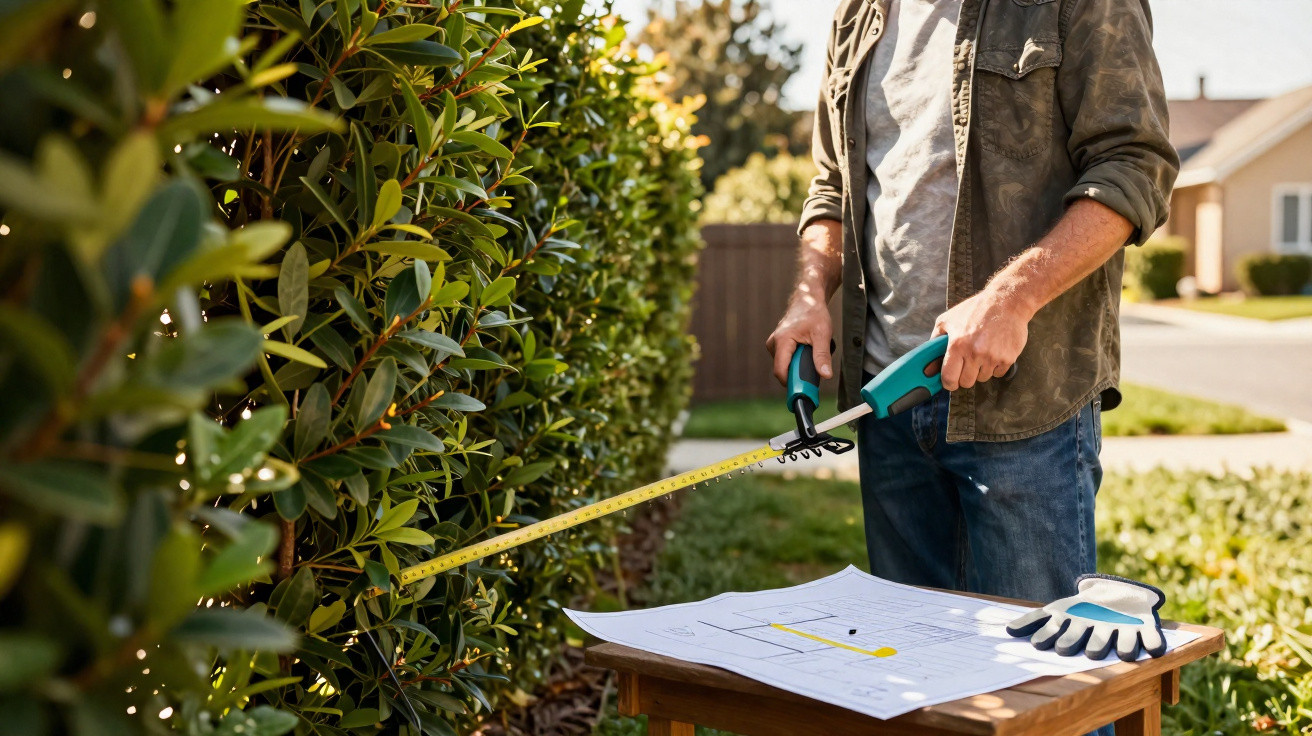
If you’ve got a hedge that might be affected, the priority is a plan, not panic. The first step sounds obvious, but it’s the one that matters most: measure. Don’t guess, and don’t do it “roughly” - use a tape measure or a laser tool. Check the height at the middle of the hedge, and measure the distance from the centre of the trunk to the boundary.
If the hedge is less than 50 centimetres from the line and stands over 2 metres, there’s usually no realistic way around cutting it back. Ideally, think in terms of a gradual, stepped reduction rather than one brutal chop in a single session. Older hedges in particular can react badly if you suddenly remove 60 centimetres of growth.
A hedge isn’t a fence - it’s alive, it responds, and it can take offence.
A lot of people make the same mistake here: they leave it until the final moment and then start sawing in a rush. That’s stressful - and it also ramps up tension with the person next door. A better route is to talk early. A simple line over the fence such as “Our hedge is too tall - I’ll deal with it in spring” can defuse a lot.
Another common trap is timing. For nature-conservation reasons, strict limits apply between March and the end of September when it comes to heavy pruning, because birds nest and small animals shelter in thick growth. Many councils require permission during this period for major cuts. And, separately, fines can also apply if you just go at it regardless.
Using a professional contractor removes much of the uncertainty - but, of course, not the expense.
A building-law expert I spoke to recently put it rather dryly:
“The days of letting hedges grow by feel and hoping nobody complains are coming to an end. If you build high right on the boundary - in stone or in greenery - you have to live with rules.”
In day-to-day reality, a handful of straightforward principles tend to reduce the stress significantly:
- Check early
Measure height and distance by the beginning of 2026 at the latest - not on 8 April. - Call the authority
Ask your local building control or enforcement team whether any regional specifics apply. - Bring your neighbour in
Explain what you intend to do and, if helpful, look at the boundary together. - Gentle, not drastic
Where possible, reduce the hedge in stages across two seasons to reach the permitted height. - Document everything
Photos before and after, plus brief notes - useful if a dispute arises later.
Between greenery, rules and emotion - what this change really does to our gardens
In the end, this isn’t only about clauses and centimetres; it’s also about a subtle but noticeable shift in everyday life. For a long time, gardens have been private retreats where people simply did their own thing. The new rule pushes us to see that space more clearly as part of a shared arrangement. If you want to grow tall right up to the boundary, it raises a question: how does the person on the other side live with that shade, that wall, that sense of being boxed in?
At the same time, there’s a feeling of lost control in the background. The idea that a public authority could, in principle, impose penalties because a hedge is “too tall and too close” rubs against the romantic image of having your own little kingdom behind the fence. For many, that initially feels wrong - almost like interference in something deeply personal.
Perhaps, though, there’s an opportunity hidden inside this awkward requirement. A reason to finally address long-standing neighbour tensions. A prompt to replace a hedge that has brought more frustration than pleasure for years. Or simply a chance to ask yourself: do I really need a 3-metre privacy wall? Or would a lower, well-kept planting be nicer - for both sides?
The most interesting stories often begin exactly where people have to talk, because a quiet wall of green can no longer do the job for them. You can be irritated by that. Or you can read it as a gentle nudge to rethink your garden.
Ultimately, every cut decides not only the height of a hedge, but also - to some extent - the height of the emotional walls between two properties.
| Key point | Detail | Benefit for the reader |
|---|---|---|
| New obligation from 9 April 2026 | Hedges over 2 m and closer than 50 cm to the boundary must be cut back | Clarity on whether your garden is affected and whether you need to act |
| Protect the law & nature | A mix of neighbour law, light and privacy issues, plus nature-protection rules on pruning | Helps the reader avoid fines and conflict by understanding both legal and ecological requirements |
| Practical plan | Measure, speak to the authority, involve neighbours, prune in stages | Clear steps to adjust your hedge in a legally compliant and neighbour-friendly way |
FAQ:
- Question 1: Does the obligation to cut back really apply to all hedges over 2 metres on the boundary?
Answer 1: It affects hedges that are higher than 2 metres and less than 50 centimetres from the neighbouring property. There may be regional variations because neighbour law is set at regional level. A quick check with your local authority is worthwhile.- Question 2: What happens if I don’t cut back my hedge despite the rule?
Answer 2: Typically, the first step is a formal notice with a deadline. If you do not respond, fines can be imposed and, in extreme cases, enforcement action may be ordered where a contractor carries out the work at your expense.- Question 3: Can I heavily cut back the hedge at any time to meet the requirements?
Answer 3: Between March and the end of September, major cut-backs are heavily restricted for nature-conservation reasons. During that period, only maintenance trimming is generally allowed to protect nesting birds and small animals. Plan bigger work for late autumn or winter.- Question 4: Who pays for cutting back the hedge?
Answer 4: Usually the hedge owner - meaning the person on whose land it stands. If the hedge is jointly owned by both neighbours, an agreement is needed. If it becomes a dispute, a court decides in the last resort.- Question 5: Can I force my neighbour to cut their overgrown hedge?
Answer 5: If the hedge falls under the described rule and interferes with your use of the property, you can approach the enforcement team or proceed via a solicitor. Often, a calm conversation that points to the applicable requirement is enough before things become formal.






Comments
No comments yet. Be the first to comment!
Leave a Comment