
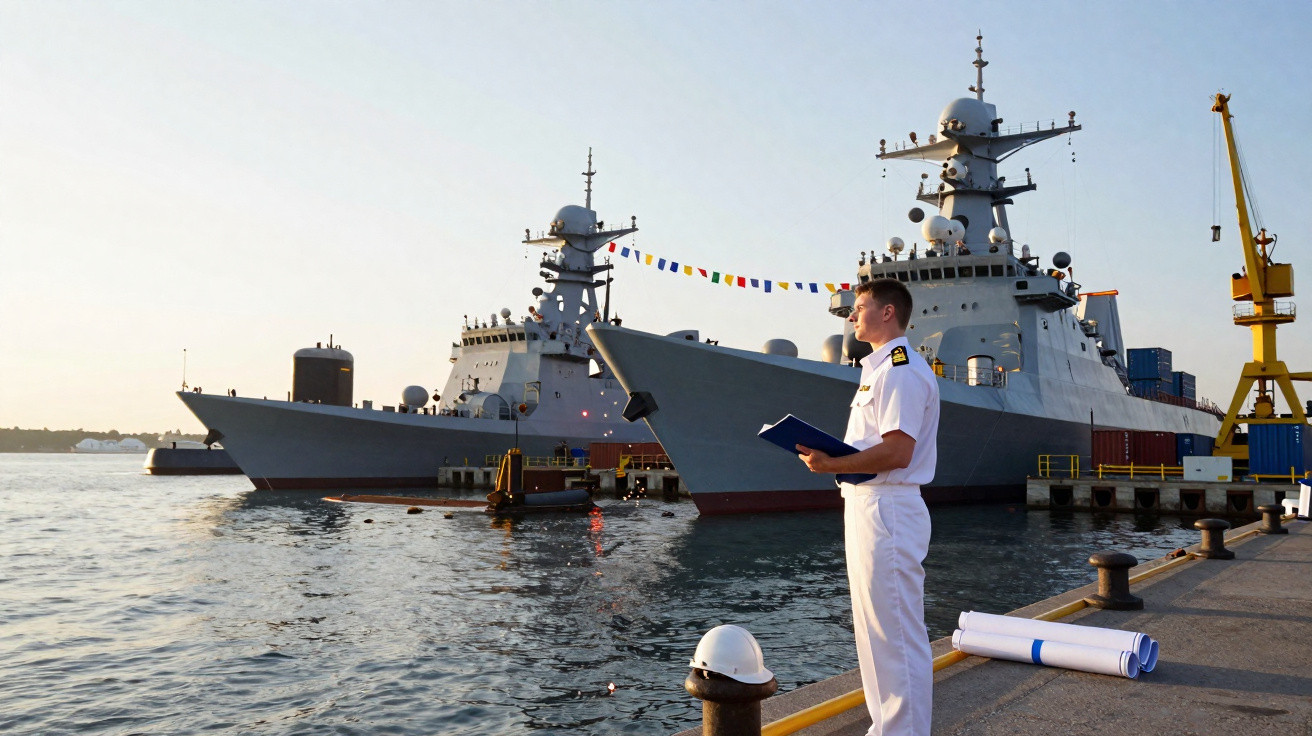
2025 deliveries to the Russian Navy from United Shipbuilding Corporation (USC)
As part of the wide-ranging modernisation drive now under way, the Russian Navy took delivery in 2025 of 19 new surface ships and craft, plus three submarines, all built at yards belonging to United Shipbuilding Corporation (USC). The update was shared by Viktor Yevtukhov, currently head of the Presidential Directorate for State Defence Industry Policy, who underlined that this milestone was achieved alongside Russia’s progress in replacing foreign-made components with domestically produced alternatives in almost all instances.
Reflecting on his remarks, made during the commissioning ceremony for the third of the new Lada-class submarines, he stated: “In 2025, our shipyards delivered 19 surface ships and various craft, as well as three submarines, including the modern strategic nuclear ballistic missile submarine Knyaz Pozharsky, unmatched in the world, and two new non-nuclear submarines built at the Admiralty Shipyards: Yakutsk and Velikiye Luki. I want to reiterate that we have the most modern navy. This fact has been confirmed by both Russian and international experts.”
Russian Navy submarine additions highlighted by Yevtukhov
Knyaz Pozharsky (Borei-A / Project 955A)
Keeping attention on undersea capabilities-and following the sequence set out by Yevtukhov-it is worth recalling that the Russian Navy accepted Knyaz Pozharsky, a Borei-A-class submarine (Project 955A), last July at the Sevmash shipyard. The event was attended by President Vladimir Putin, alongside a range of political and naval officials, including Admiral Alexander Moiseyev, head of the service.
With that boat entering service, Russia has now assembled a force of eight Borei-family submarines, split between three units of the original model and five of the Borei-A variant. This matters, given that these submarines can deploy up to 16 R-30 Bulava intercontinental ballistic missiles fitted with MIRV warheads as their primary armament, in addition to torpedoes, a variety of electronic countermeasure systems, and features intended to enhance stealth.
Yakutsk (Improved Kilo / Project 636.3)
Separately, in June the Russian Navy added Yakutsk, an Improved Kilo-class submarine (Project 636.3), which joined the Pacific Fleet to bolster its capabilities. The submarine was handed over at Admiralty Shipyards JSC in St Petersburg, once again in the presence of the Russian president and an accompanying delegation of officials.
In this case, the platform’s key strength is clearly its ability to fire Kalibr-PL anti-ship missiles, alongside modern 533 mm heavy torpedoes. It is also known that, compared with the original Kilo design, the model brings meaningful improvements in both stealth and range, the latter sitting at around 7,000 nautical miles when snorkelling. Another noteworthy point-this time about the build and acceptance process-is that the period of sea trials from launch to commissioning was completed in under a year, illustrating how quickly it was brought into service.
Velikiye Luki (Lada class)
Third is Velikiye Luki, a Lada-class submarine added to the Russian inventory this week, entering service with the Russian Navy’s Baltic Fleet. As we previously reported, it too was commissioned in a ceremony at Admiralty Shipyards, after completing an extensive test programme in the Gulf of Finland three years on from its launch.
Among its principal strengths, the design can employ Alfa and Oniks cruise missiles, as well as torpedoes and naval mines, offering a broad weapons suite. In the view of Admiral Moiseyev: “The Lada-class submarine combines cutting-edge technologies and complex technical solutions. Despite its relatively small displacement, the ship is an important asset for naval warfare and has broad combat capabilities, both offensive and defensive, thanks to all the solutions incorporated into its design.”
Ongoing modernisation plans and remaining construction
Lastly, it should be noted that although USC has delivered this significant number of ships and submarines to support the Russian Navy’s modernisation, there is still substantial work ahead to complete the wider effort. As President Putin has said on previous occasions, the country is pursuing the construction of up to 70 ships, which-if delivered on time and as planned-would strengthen the service’s position as one of the most powerful globally. Within that larger set of vessels, six new nuclear submarines still remain to be built, while the Lada class is also expected to be expanded by a further three boats in the future.
Images used for illustrative purposes






Comments
No comments yet. Be the first to comment!
Leave a Comment