
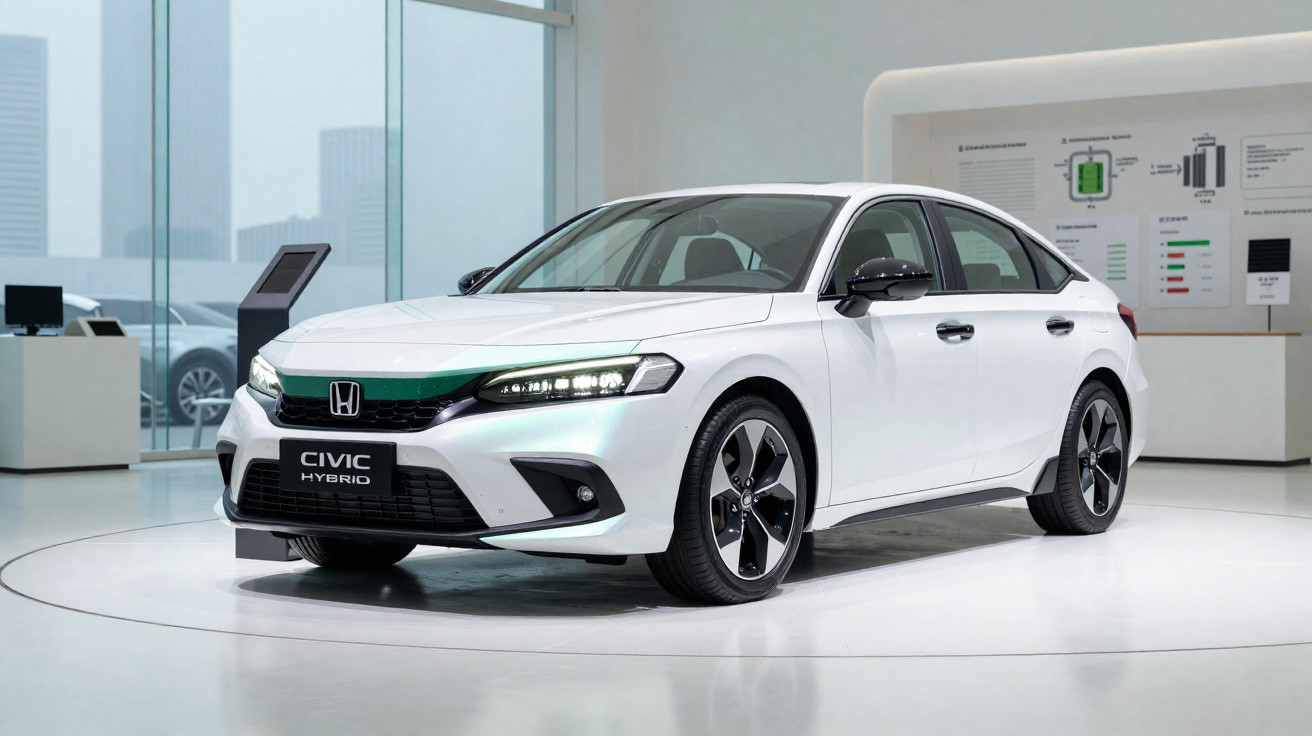
In this new generation, the Honda Civic has dropped the pure petrol versions and, instead, is offered only with a hybrid powertrain - with the Type R as the lone exception.
Does this new set-up make us forget the well-regarded 1.5 VTEC Turbo and 1.6 i-DTEC engines? Helping that cause is fresh styling - more understated and elegant - plus a cabin that feels more upmarket than ever.
We spent a week with the new Honda Civic to answer these questions, and a few more besides.
Does it win on fuel consumption?
At the heart of the latest Civic is a hybrid system - not plug-in, meaning you can’t charge it from a socket - that "pairs" a naturally aspirated petrol engine with two electric motors. One of those motors drives the front axle via a fixed-ratio transmission (there’s no conventional gearbox, much like in most fully electric cars).
Honda says the combustion engine, which runs on the more efficient Atkinson cycle, enables a significant reduction in fuel use.
It only took a few miles behind the wheel - despite the engine’s sizeable 1993 cm³ - to realise that, whichever driving mode you choose (Econ, Normal or Sport), the Civic seems incapable of developing a big appetite. That’s welcome news for anyone who prioritises economy, and a helpful counter to rising fuel prices.
Across this test, it was easy to achieve averages between 5-5.5 l/100 km, and when I deliberately tried to maximise the Civic’s saving potential, the average dropped as low as 4.2 l/100 km. There’s no doubt about it: in this department, you won’t miss the Diesel engine - and you’ll miss the old petrol engine even less.
And what about performance?
The end result of the "marriage" between the combustion engine and the electric motors is 184 cv and 315 Nm. Those figures beat the 182 cv and 240 Nm produced by the 1.5 VTEC Turbo that powered the strongest non-Type R Civics of the previous generation - but how does that translate to the real world?
Given it’s heavier than its predecessor and clearly geared towards efficiency, it was always likely the new Civic wouldn’t make you forget the old petrol model, particularly when it comes to outright performance.
Don’t get me wrong. With 184 cv and 315 Nm, it can maintain a brisk pace, but the way it delivers its power is noticeably smoother and less… exciting.
If you set it against the previous Diesel engine, the new Civic comes out "ahead across the board": it’s not only more economical, it’s also quicker.
Worthy of the lineage
If there’s one area where the Honda Civic has consistently stood out over the generations, it’s its dynamic ability; and this electrified iteration is no exception.
The previous Civic was already one of the segment benchmarks here, and the latest model keeps that status. The steering remains accurate, direct and nicely weighted, but it’s the damping that really impresses, striking a better balance between comfort and handling, and reinforcing the Civic’s long-distance strengths.
At moderate speeds, the suspension feels less harsh than before, doing a better job of smoothing out broken surfaces. Push the Civic’s chassis harder, and body movements stay disciplined and well controlled.
All of that means the Civic is as enjoyable to drive as a Ford Focus or a Mazda3, and it sits a little apart from the more "by the book" - though no less effective - Volkswagen Golf.
Is it the right car for you?
In this new generation, the Honda Civic is more refined than ever, and it should appeal to a wider range of buyers.
Compared with its predecessor, the step forward is obvious: the look is more restrained and broadly agreeable, and the hybrid engine proves it’s possible to "kill two birds with one stone", combining low fuel consumption with very acceptable performance and a measure of driving enjoyment.
It’s just a shame the price of admission is so high. The on-the-road price of the tested Civic e:HEV Sport is 42 500 euros, and it lines up with other similar hybrid options, such as the Toyota Corolla 2.0 HDF, which was recently refreshed and is now more powerful, at 196 cv.
However, its home-market rival offers a more affordable hybrid in the range, in the form of a 1.8 HEV with 140 cv. It would make sense for the Civic to receive the same hybrid powertrain as the HR-V, which combines a 131 cv electric motor with a 1.5 l petrol engine.
The tax hit would be much smaller, and it could bring the entry point to the new Civic to around 10 thousand euros less than this 2.0 l.


Comments
No comments yet. Be the first to comment!
Leave a Comment