
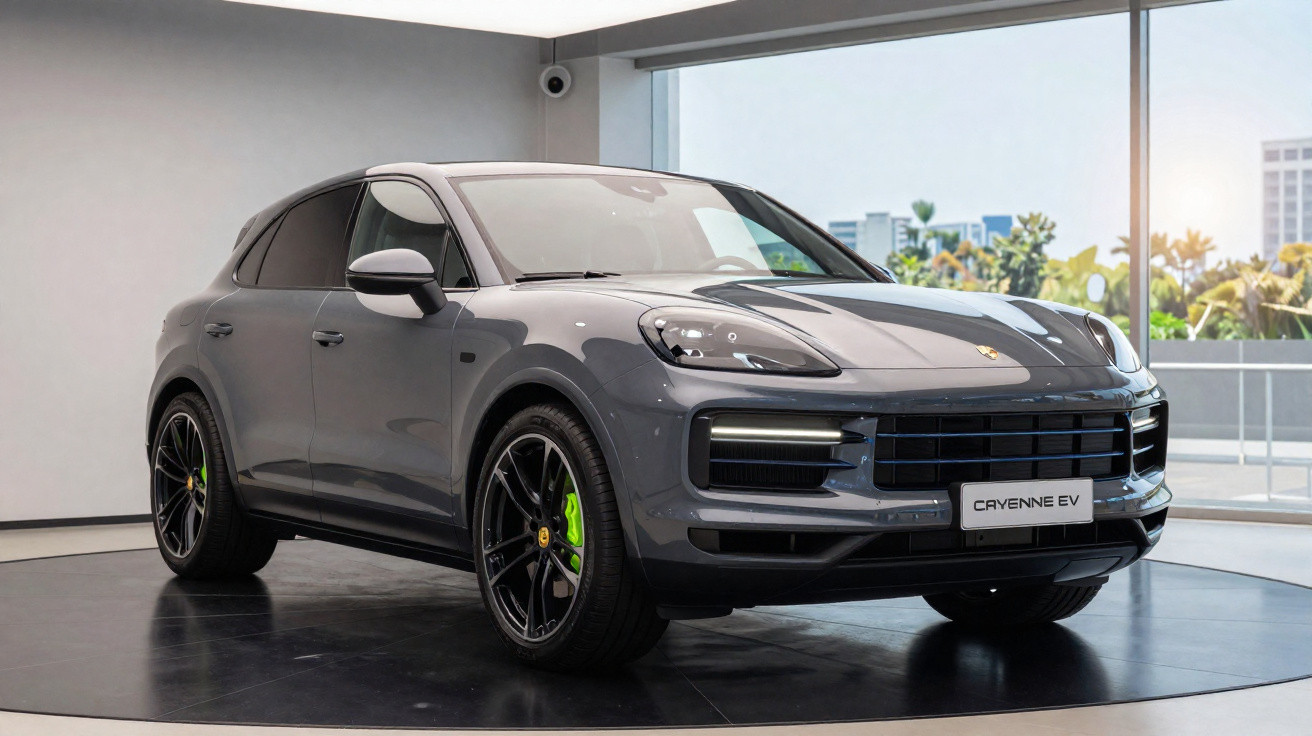
All the key specifications for the brand-new Porsche Cayenne Electric have finally been made public. And if anyone still questioned how important this model is for Porsche, that doubt tends to vanish the moment you see the choices the company has made.
This is not only the first fully electric Cayenne. It is also the most powerful production Porsche ever built and, at the same time, the manufacturer’s most technologically advanced car. It is an SUV designed to redefine what “Cayenne” means in the electric era-while still being sold alongside the combustion-engined Cayenne.
We travelled to Porsche’s home turf in Stuttgart, Germany, to see the new Cayenne Electric in person and understand how the brand has reimagined it for the EV age.
Faster than the new 911 Turbo S
For the first time in the model’s history, the Cayenne goes 100% electric-yet it’s the power and performance figures that steal the spotlight. And for the Cayenne Turbo Electric, there’s only one way to put it: monster. Peak output (with Launch Control) reaches 850 kW (1156 cv), making it the most powerful production Porsche of all time.
It’s a staggering number, and in real terms it delivers performance strong enough to make even the all-conquering 911 Turbo S-recently revealed and already tested by us-look newly modest.
The 0–100 km/h sprint takes just 2,5s. 0–200 km/h? Only 7,4s-one second quicker than the 911 Turbo S-which is absurd when you remember this is a 2,7-tonne SUV. The Cayenne Turbo Electric does concede on top speed, though: it tops out at 260 km/h, which is 60 km/h down on the iconic coupé.
The entry version is more restrained: although it keeps the twin-motor layout (one motor per axle), it delivers 325 kW (442 cv) of maximum combined output (Launch Control) and covers 0–100 km/h in 4,8s. For top speed, it reaches 230 km/h.
Powering everything is a 113 kWh battery with dual-sided cooling, enabling up to 642 km (WLTP combined cycle)-more detail is available in the video mentioned above.
The 800 V architecture supports charging at up to 400 kW, enough to go from 10% to 80% in under 16 minutes. There is also 11 kW inductive charging, an absolute first for the brand.
On top of that, it can recuperate up to 600 kW under braking-figures on a par with Formula E single-seaters. Porsche says 97% of everyday braking is handled purely through regeneration, yet it still offers carbon-ceramic brakes as an option on the Turbo.
One of the most aerodynamic SUVs ever
Porsche has also focused heavily on efficiency, and nothing “shouts” efficiency in an EV quite like aerodynamics. Drag coefficient (Cx) is just 0,25, placing it among the most aerodynamic SUVs on the market.
To achieve this, the brand has borrowed aero solutions usually reserved for supercars: active front vanes that open and close depending on the airflow needed, and rear aeroblades that extend to improve airflow separation at the back.
On the Turbo, there’s also an active roof spoiler and a diffuser designed to boost stability at higher speeds-because we are talking about an SUV with performance capable of embarrassing proper sports cars.
That pursuit of cleaner airflow has influenced the styling as well, but overall it reads as a natural evolution of the combustion Cayenne’s shape. Even so, it brings cues that tie it to Porsche’s latest EVs, such as the Macan: much slimmer Matrix LED headlights, a lower bonnet line, and a redesigned rear section intended to maximise efficiency. It is unmistakably a Cayenne, just sharper.
Even so, it has grown in every direction: it is 55 mm longer and, more importantly, benefits from a wheelbase roughly 130 mm greater, which translates into a roomier cabin than the combustion Cayenne.
Boot space remains ready for almost anything: capacity is 781 litres, expanding to 1588 litres with the rear seats folded. There is also a front luggage compartment (frunk) offering 90 litres.
We won’t “bore” you with the long list of interior details here-we already did that weeks ago on video. What we can say is that this is the most digital cabin ever fitted to a Porsche, with displays taking centre stage. Watch or rewatch it.
Everything under control
The new Porsche Cayenne Electric is large, heavy, and has more power than most of us would ever consider necessary in an SUV. But the German brand is not leaving its reputation in anyone else’s hands.
The Cayenne Electric comes with a full dynamic toolkit to keep it all in check and, Porsche promises, to deliver the sharpness and driving experience expected of the marque. The headline feature is the Active Ride suspension, which can virtually eliminate body roll and keep the SUV level under acceleration, braking, or fast cornering.
Alongside that sits adaptive air suspension with PASM (Porsche Active Suspension Management), both fitted as standard, plus optional rear-axle steering. Porsche claims this is the Cayenne that comes closest to behaving like a sports car.
For those who can’t resist leaving the tarmac, there is an Off-Road package with specific calibrations. And unlike some other electric SUVs, the Porsche Cayenne offers a 3,5-tonne towing capacity.
When does it arrive and how much does it cost?
Order books open today, and Porsche Portugal has already confirmed more than 100 units reserved. This is despite the Porsche Cayenne Electric and Turbo Electric not being covered by the tax advantages available to other EVs (except ISV and IUC).
The biggest surprise, however, is that the new Cayenne Electric will be the cheapest model in the entire Cayenne line-up, including the combustion versions. Prices in Portugal start at 110 086 euros for the Cayenne Electric and rise to 171 919 euros for the Cayenne Turbo Electric.


Comments
No comments yet. Be the first to comment!
Leave a Comment