
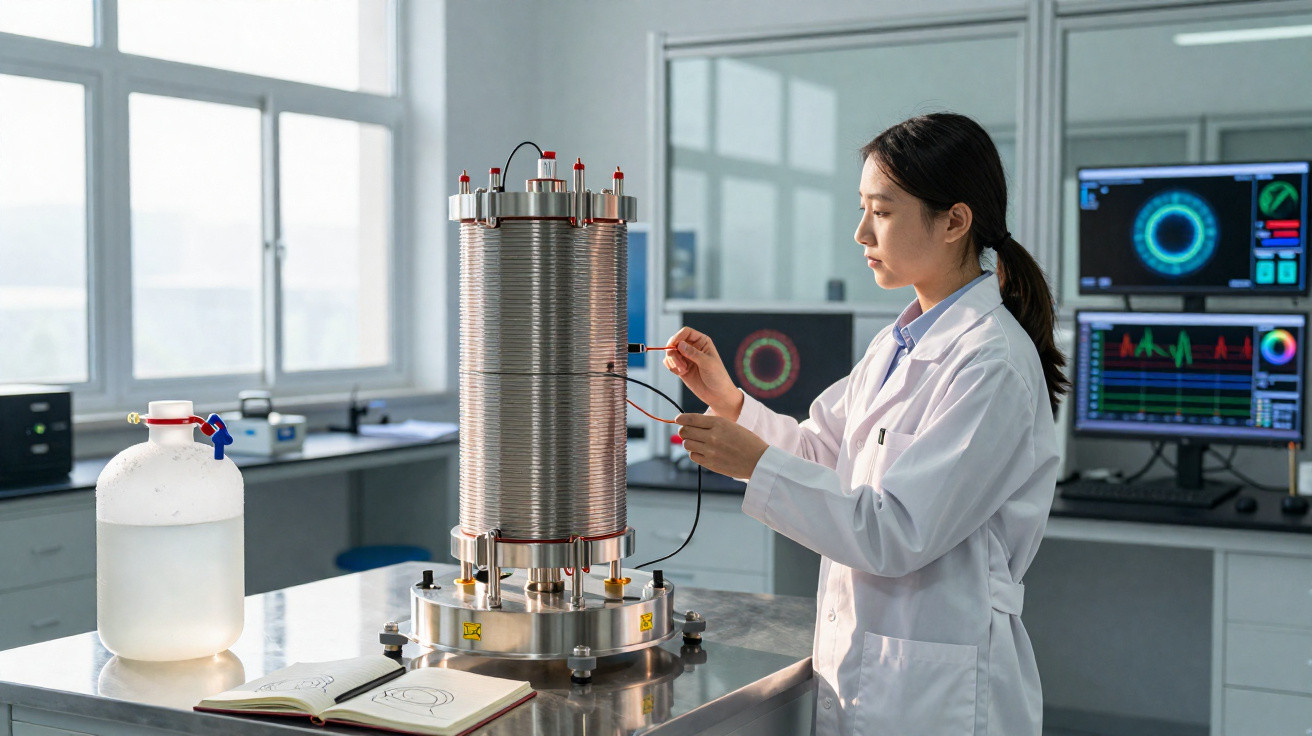
China has produced a steady magnetic field using a magnet built entirely from superconducting materials, reaching an intensity 700,000 times stronger than Earth’s and setting a new benchmark for the strongest stable field of its kind yet reported.
Holding that level continuously turns ultra-strong magnetism from a short-lived laboratory feat into a dependable tool that scientists can schedule, repeat and design experiments around.
Record magnet for users
At the Synergetic Extreme Condition User Facility in Beijing (SECUF), the magnet generated the field through a 3.6-centimetre opening intended for practical, real-world experiments.
The system was designed, built and run by engineers at the Chinese Academy of Sciences (CAS), who demonstrated that the magnetic field could be maintained reliably without slipping into instability.
Rather than delivering a momentary peak like many earlier high-field demonstrations, this magnet sustained its record strength under controlled conditions suitable for repeated use.
That dependability makes it easier to examine both how the achievement was made possible and what constraints still lie ahead.
The value of consistency
Many record-setting magnets only reach their maximum for a few seconds before the field drops, making careful measurement difficult.
With a steady field, instruments can integrate faint signals and suppress noise, improving the confidence of the data.
SECUF operates the system as a user magnet, meaning it is shared infrastructure that external research teams can access for planned, timetabled experiments.
That model pushes the engineering focus towards repeatable performance, not simply a single dramatic peak in the laboratory.
How superconductors help
In ordinary metal conductors, electrical resistance produces heat as current flows, and that heating caps the strength at which a magnet can operate.
A superconductor carries current with essentially no resistance, avoiding that heating and enabling much higher currents.
By keeping the material at cryogenic temperatures, it remains in its superconducting state, allowing the magnet to stay energised without wasting power as heat.
Even so, extreme fields drive materials close to their limits, and one vulnerable region can trigger a rapid shutdown.
Inside the coil stack
To achieve record field strengths, the team used a nested design: a smaller insert coil placed inside a larger outer coil.
The inner insert relied on a high-temperature superconductor-one that can operate at comparatively warmer cryogenic temperatures-to push the field higher.
Surrounding conventional superconducting coils carried most of the current and helped keep the magnetic field uniform across the bore.
This layered strategy plays to each material’s strengths, while also making cooling and protection systems more complex.
When coils strain
As the magnetic field increases, the forces on the coils intensify, compressing and twisting them and placing heavy loads on metals, insulation and support structures.
Meeting strict targets for field strength, stability and homogeneity made the build an inherently cross-disciplinary challenge.
Wang Qiuliang, a CAS researcher specialising in high-field magnet engineering, highlighted the scale of the difficulties.
“However, the development of high-field superconducting magnets involves interdisciplinary integration and faces numerous engineering bottlenecks, with extremely demanding requirements for field strength, stability, and homogeneity,” said Wang.
A single fracture or local warm spot can still force an emergency shutdown, rapidly releasing stored energy as heat.
Fusion needs confinement
Fusion research heats gas into plasma-a mixture of charged particles-and magnetic fields are required to keep it from contacting the reactor walls.
In September 2025, a team in Hefei maintained 351,000 gauss, or 35.1 teslas, for 30 minutes, surpassing 323,500 gauss.
Set against Earth’s magnetic field of roughly 0.5 gauss, that performance underlined how far high-field engineering has advanced.
Fields at that level can make fusion concepts more feasible, but they also require cooling systems that operate flawlessly.
Stronger magnets, clearer data
More powerful magnets can also improve instruments used to study matter, particularly methods that detect extremely weak signals from atoms and molecules.
In nuclear magnetic resonance-a technique for analysing molecules in a strong magnetic field-greater field strength separates signals that would otherwise overlap.
Sharper spectra allow chemists and biologists to resolve complex structures more effectively, supporting materials research and drug design.
Because this is a user-access system, the benefits are not confined to a single laboratory that happens to own rare equipment.
Magnetism in motion
High-field magnets also support work on electrical machinery designed to reduce energy losses, including motors and compact generators.
Superconducting coils can carry very large currents in limited space, enabling more power density and lighter hardware.
Magnetic-levitation trains and some spacecraft thrusters likewise rely on strong fields that remain predictable under operational loads.
Whether such systems are adopted widely will depend on cost and reliability, as large magnets must operate safely around people and complex equipment.
Scaling the technology
Pushing to even higher fields will mean stronger conductors and more robust support structures, because the forces rise rapidly as magnets scale up.
Teams involved in the programme have already identified a next goal of 40 teslas with a larger bore.
Reducing running costs will be equally important, since refrigeration and power-control systems account for much of the expense when providing user access.
With each step forward, high-field superconducting magnets move from headline achievements towards everyday tools that other researchers can rely on.
Where it leads
China’s newest all-superconducting magnet illustrates how stable, user-ready fields can shift from specialist development into shared national facilities.
If the aperture can be increased while keeping costs under control, the same approach could support new scientific breakthroughs and cleaner, more efficient machines.
Photo: Xinhua/Wu Huijun.






Comments
No comments yet. Be the first to comment!
Leave a Comment