
Supercars are finished, as far as I’m concerned. Sports cars might as well be wheelbarrows and hot hatches roller skates, because I’ve just hurled a Prodrive BRX Hunter into an enormous four-wheel drift and then smashed my way up its sequential gears with the twin-turbo V6 howling away by my right knee. It’s as singular an experience as it sounds. Every upshift is loosely accompanied by a whipcrack of flame from the side-exit exhaust, despite there being enough rain for it to be bouncing back up off the tarmac - and the Hunter simply doesn’t care. The Hunter is, effectively, setting fire to the rain. A touch of pyromania helped along by violently toxic £3-per-litre fuel with an octane rating somewhere in the ‘jet’ bracket, yes - but honestly, there isn’t a car here (and I’m including the Lamborghini STO and Ferrari SF90) that will make you feel quite as alive as a full-fat Dakar buggy with space to play.
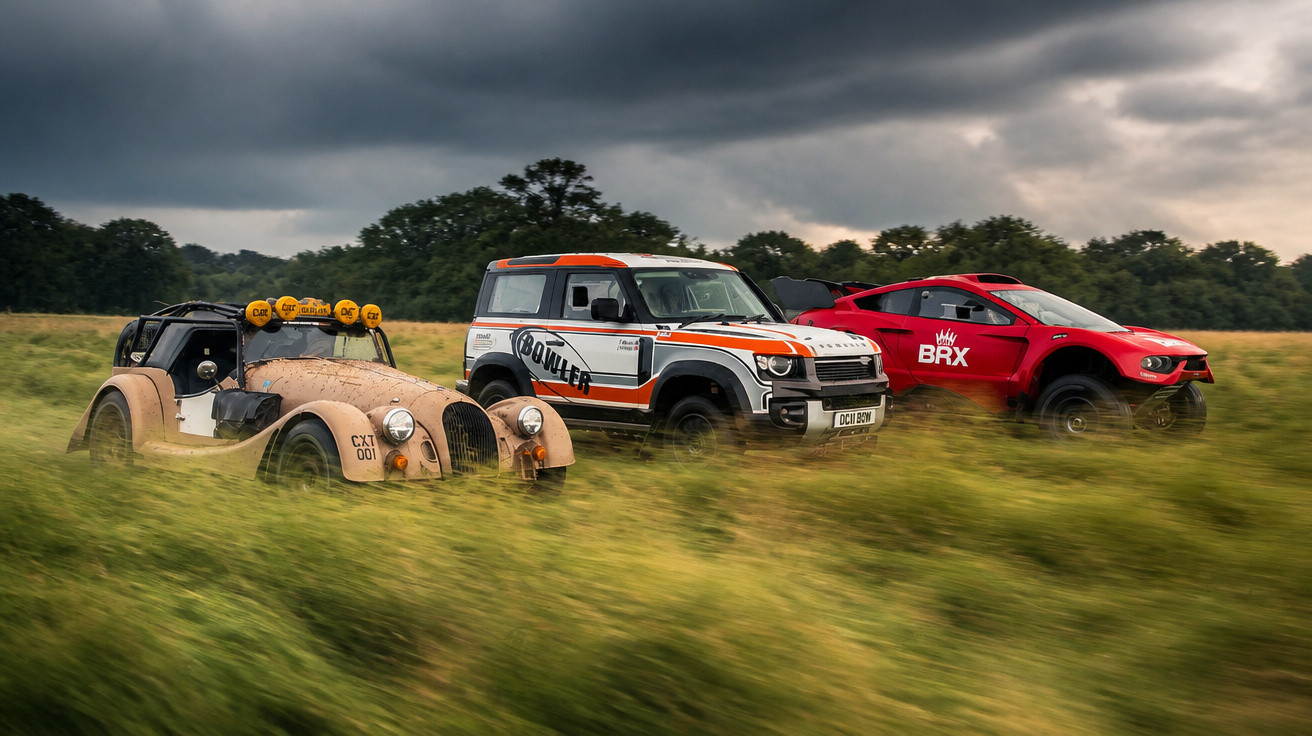
And the Prodrive isn’t the only lightly unhinged machine currently doing laps. Tucked neatly beneath the Hunter’s ‘concentrate or die’ intensity is the Bowler Land Rover Defender: a Defender 90 reworked for off-road racing, with a gutted cabin, an FIA roll cage, rally prep hardware and a 2.0-litre petrol engine tuned to 300bhp. On a soaked, biblical Dunsfold it’s basically a masterclass in power-on understeer - but start throwing it around at the edges of the circuit, in wet grass and mud up to 3ft (about 0.9m) tall, and it’s so confidence-inspiring it turns the under-skilled and over-confident into heroes. It’s a track car with less “race” and more “farm”. Even so, it’s easy to drive, and it comes with a plug-and-play competition package bolted on. More on that shortly.
There’s a third ‘off-roader’ at this little get-together, too: the Morgan CX-T. Yes, it’s a Morgan, complete with the olde-worlde charm that implies - but here it’s a Plus Four that’s been given a Safari Rally-style treatment. Or, more accurately, an overlanding makeover. There’s no roof tent fitted right now (though apparently one can be added), but it does have long-travel suspension, off-road tyres, radically reworked suspension kinematics and what looks like a full SAS supply drop strapped into the rear. It’s refined, rugged and faintly ridiculous. It’s basically Bear Grylls on knobbly tyres.
Photography: Jonny Fleetwood
Image carousel (themed)
You can probably tell: this is an excellent group to be let loose with, and I’m not exactly suffering for entertainment. A bit of context on each car helps, though - so we’ll begin with the Big Red Bus.
Prodrive BRX Hunter T1+: Dakar-spec fire and fury
Officially, it’s the Prodrive BRX Hunter T1+. The BRX T1+ is an evolution of Prodrive’s original BRX, reworked to meet the latest Dakar regulations. Versus the earlier version, it’s 300mm wider, it now sits on 37-inch (about 94cm) tyres on 17-inch (about 43cm) wheels (rather than 32-inch/16-inch - roughly 81cm/41cm), and it boasts 350mm of suspension travel delivered by eight sets of bypass dampers (two per corner).
The body is still an Ian Callum design (yes, that Ian Callum, formerly of Jaguar), but the bigger wheels and squarer stance give it a far more purposeful look - helped along by a new, nastier quad-eyed front end. Underneath, there’s a spaceframe chassis with a carbon monocoque that seems to have grown around it like a tree enveloping a fence post, while the body panels themselves have that carefully judged “competition flimsy” feel. Up close it’s slightly unsettling: it’s simply enormous, and those apparent rear three-quarter air intakes are actually spare wheels flanking a 500-litre fuel tank. And yes, that figure is correct.
Power comes from a 400bhp Ford EcoBoost twin-turbo V6 borrowed from the Raptor, mounted under the windscreen and effectively half in, half out of the cabin. One of the turbos sits right by your knee, separated from you by little more than a thin composite skin. The cockpit gets seriously hot. The air conditioning didn’t work. I was sweating like a horse.
Not only because of the temperature, either. Any proper race car carries intimidation, but Dakar kit feels like it’s operating on a different plane entirely: endless systems, endless switches - it’s closer to a helicopter than a road car. Add a seat positioned for the BRX’s current driver, 6ft 5in (around 1.96m) Nani Roma, and it was like being 14 again and trying to reach the controls in my dad’s car.
Still, once you’ve primed the fuel pumps, turned the ignition on, brought it to life and got your head around the sequential transmission (back for up, forward for down, then a button press and flick for reverse), it’s… not actually that hard to drive. The steering is astonishingly light and pretty numb - forklift-like, really - which makes sense for desert punishment but does little for tarmac feel. There’s also a hefty dose of transmission shunt while the diffs and drivetrain settle themselves. But once you’re rolling, the key is brutality: the Hunter rewards 100 per cent commitment. Do that and every nerve wakes up, and you’re suddenly fizzing with joy.
This isn’t something you drive intellectually. If you start overthinking, you’re finished - you just go all-in and ride it. The chassis feels mega-stiff, but the suspension is long and then firms up towards the end of its travel, so if you keep the speed up the car seems to sort its own direction out. After that you find yourself in a strange realm of understeer that you can cure by adding throttle, until the BRX settles into a dead-straight four-wheel drift - all four tyres clawing forwards while the whole vehicle is travelling about 35° off its line. It’s unnerving, astonishing and wildly moreish.
At that point physics seems to lose interest in arguing with it and simply lets the Hunter freestyle. Off-road? I can barely imagine it - but blasting across a wet field had me laughing so hard my eyes watered, so getting unleashed across the Empty Quarter would probably finish me off. There is talk of a ‘civilian’ version for around a million quid, although I can’t see it ever being road legal. Still: what a machine. Particularly if you live in Dubai.
Bowler Land Rover Defender Challenge: Dakar-lite, plug-and-play
Next to the Prodrive, the Bowler is much more familiar to look at - and yet it’s close to being just as entertaining, in a far more approachable format. That’s likely because it trades on a recognisable base. This particular car is a Bowler Defender Challenge entry: a one-make rally series designed as a stepping stone into endurance rallying (Dakar included). Bowler sells packages for seasoned competitors and total newcomers alike, complete with full support.
The specification is serious: a 300bhp 2.0-litre turbo petrol engine, four-wheel drive, and a long list of race upgrades. You get the FIA full roll cage, plus thick aluminium underbody armour that runs right along underneath the vehicle. There’s a plumbed-in fire suppression system, race seats, and a competition-style single paddle on the right-hand side of the race steering wheel controlling the eight-speed gearbox (forward for down, back for up). Add extra lights, and the rest - it’s all here.
The seven races in the Challenge cost £99,500 including VAT as a package (and you own the car), with more comprehensive ‘turn up and race’ options available if you’re prepared to spend extra.
Motorsport is rarely cheap, but that does sound like strong value - because the Bowler is a proper plaything. No, it won’t make your heart buzz the way the BRX does, but it’s a genuine first rung on the ladder for serious off-road competition. The responses are upbeat, the engine is surprisingly keen, and - once again - you need to drive it with a hint of brutality to extract the best from it.
It’s loud and it’s firm, but once you adapt to the idea of throwing it at the landscape and letting the car handle the consequences, it turns into the black Labrador of off-road racers: eager, a little bit daft, and loyal unto death. Personally, I’d be tempted to soften the rear slightly, though without a proper off-road test it’s hard to be sure. What I can say is that anyone entering the Challenge won’t come away disappointed: Bowler builds tough kit, and the Defender feels exactly like what it is - a Dakar lite. Spot on.
To drive, it’s actually much, much better than a Plus Four. Sorry, Morgan
Morgan CX-T: Safari Rally attitude, overlanding oddity
The Morgan CX-T isn’t pitched as a hardcore off-road tool, but that’s precisely why it’s so entertaining - and it’s far from delicate. I drove it at 50mph (about 80km/h) straight into a field of 3ft-high grass and briefly turned into Malvern’s first combine harvester. One of the trio of windscreen wipers immediately departed the vehicle (that’s ‘character’, that is), but the chunky Morgan dealt with sizeable bumps without bottoming out, and on track it slid around with real confidence.
In the dry, at least. In the wet, with a loose diff, it was mostly lethal - but, oddly, that danger is part of the charm. The body is Morgan’s latest aluminium structure, apparently 100 per cent stiffer than previous efforts (that’s the ‘CX’ part of the name), with the ‘T’ meaning ‘Trials’ - a wonderfully niche kind of off-road autocross.
It’s built by Rally Raid UK, and it isn’t just for show. The suspension is redesigned with 140mm of rear travel, longer arms, rally damping and wider tracks. There’s serious underbody protection and an external roll cage - the full treatment.
Power remains the Plus Four’s BMW-sourced 255bhp/258lb ft turbo engine paired with a six-speed manual gearbox, but here it’s matched to a locking rear differential from an xDrive BMW - although it didn’t seem to be doing much, which became apparent while I was happily pirouetting through Chicago corner.
Even so, it’s genuinely better to drive than a standard Plus Four - hence the apology. It probably isn’t as outright rapid, but there’s still plenty of power, dependable grip, and it’s entertaining even at low speeds on tarmac. Take it off the road and it becomes hilarious. Yes, it remains cramped, strange and uncomfortable, but how do you price this level of glorious eccentricity? Well: £204,000, which is hardly pocket change. Still, when you consider it’ll likely be more fun to use 95 per cent of the time than a £250k Ferrari or Lamborghini, the compromise starts to look sensible. And it has a rakish charm, whereas a supercar can make you look like you’re slightly underfunded in the confidence department.
Getting with the freaks
None of these cars could ever be called sensible - and yet, in their own way, they make perfect sense. Plenty of other machinery is quicker and easier to live with, and probably comes with more instant cachet and Instagram appeal, but beside this lot it all feels a bit… empty.
These three aren’t about how they look; they’re about how they feel. They’re not fragile, and they’re not theatrical just for the sake of it. If you want to laugh out loud - to make an impression through driving, not merely speed - you need something that takes a little more processing. You need to spend time with the freaks.
Comments
No comments yet. Be the first to comment!
Leave a Comment