
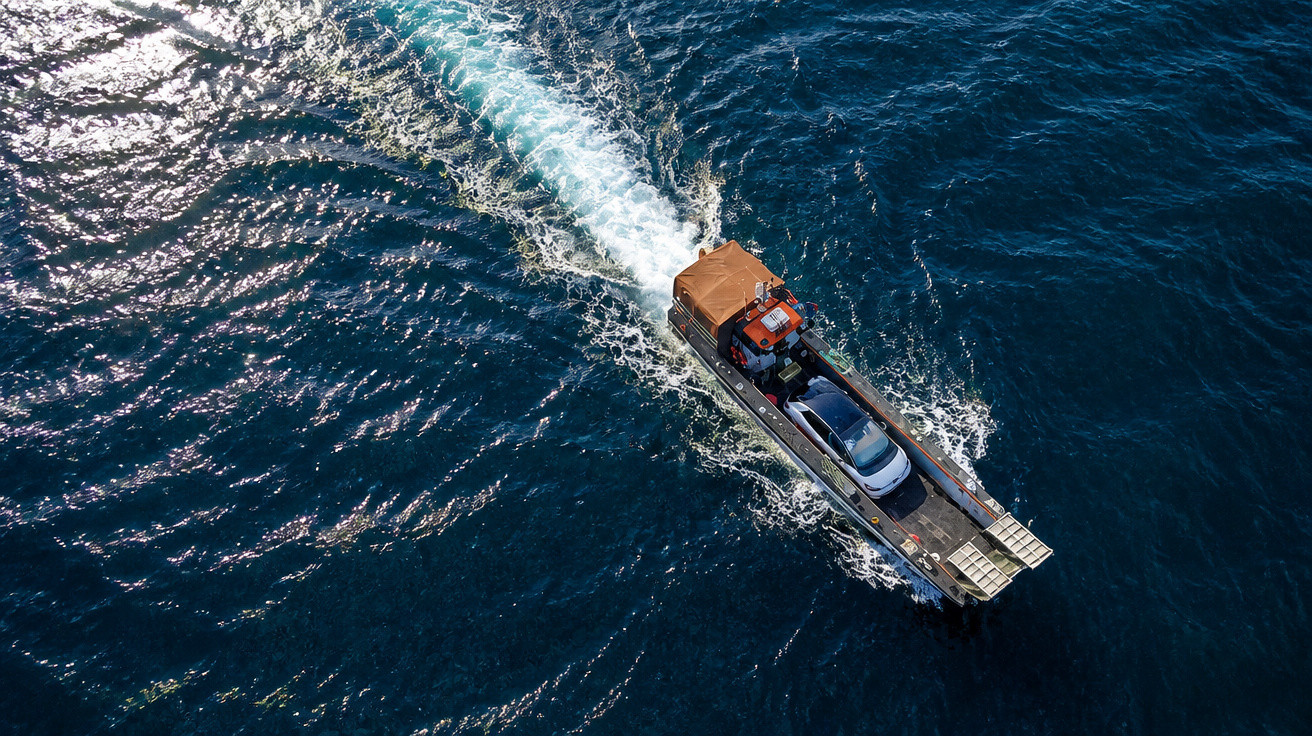
It escalated fast, this. One moment I’m gliding past a loch in a contented daze, feeding myself M&Ms and half-listening to a podcast on the birth of rave culture; the next I’m edging backwards down a slime-slick slipway, trying to post a VW ID.3 into an ex-MOD landing craft that first launched in the very year I arrived.
With the wing mirrors folded in (the only chance it’ll squeeze), they’re effectively redundant, and the metal ramps that stand between 58kWh of high-voltage lithium-ion battery and an involuntary dip are swaying left to right with the swell. A little audience has assembled to watch me reverse an electric hatchback, blind, through a moving pinch point - and the lone person offering guidance looks like a Father Christmas that’s been pickled in brine.
Text: Jack Rix // Photography: John Wycherley
Before anything else - and I mean this - it isn’t another tale about taking an electric car a needlessly enormous distance and then moaning about Britain’s not-quite-there charging network.
[node:fieldbigreadimageleft-themed-delta:0]
The plan: a pint at The Old Forge, Inverie, Knoydart
The chargers do exist; they’re multiplying at pace, and for the most part they do precisely what they’re meant to. With a bit of thinking ahead, my roughly 805 km (500-mile) run from the VW press garage in Milton Keynes to Mallaig Harbour - tucked under the sole of Skye’s boot - unfolded like this: drive to Preston, rapid charge while eating a distinctly underwhelming sandwich; drive to Dumbarton, charge overnight and grab some sleep; drive to Mallaig Harbour.
If you can tolerate the rhythm, EVs get the job done. The new ID.3 does it especially well - more on that shortly - but this piece isn’t really about electric cars at all. It’s about going to the pub.
The world’s been a bit unhinged lately, and my brain has a limited capacity for the 24-hour doom carousel. Which led me to a simple thought: few things settle my head like a properly deserved pint. Now picture that pint in absolute peace, far from the spit-sprayed crowds picking over Boris’s latest misstep and desperately forcing in a couple more units before the 22:00 curfew. Social distancing taken to unnecessary extremes… a pint in mainland Britain’s most remote pub. That sounded like something worth doing.
We're taking social distancing taken to unnecessary extremes... a pint in mainland Britain’s most remote pub
A quick bit of online digging surfaced exactly the place: The Old Forge in Inverie, Knoydart. Not only the most out-on-its-own boozer on the mainland, but also reliably rated among Scotland’s top 10 places for a few pints and a bed afterwards. Better still, the website’s description of the crowd suggested it might be the perfect sort of odd: “Poets and troubadours, belly dancers, winkle pickers and tweed clad ghillies, blooded stalkers, musicians, yachties, dogs and more dogs.”
We’d blend in just fine… and the cooking? “Seafood, became shellfish became langoustines, mussels and hand dived scallops from Arisaig, speed reading Nick Nairn, Rick Stein, a foray into sea bass, sea bream, trout, venison, wild boar, and anything else edible with gills or fur that made it from our larder... sea loch or hill, to kitchen. Bramble pickin’ and fungi foraging. Our food menu is a living thing.” You won’t find that sort of prose at Harvester.
The logistics: getting to Knoydart from Mallaig
Before any belly dancing, though, there were obstacles to clear. The Knoydart Peninsula covers about 22,300 hectares (55,000 acres) of raw wilderness. These days it’s home to roughly 130 tough souls - and it’s completely disconnected from the UK road network. You either arrive on a passenger ferry from Mallaig, or you walk in: around 29 km (18 miles) over a chain of rocky munros. Since I’m not the “sturdy boots” type - and I’d absolutely get lost, then end up sleeping inside a sheep for warmth - the sea route was the only sensible option: about 11 km (7 miles) and 45 minutes across.
Except leaving the ID.3 sitting by the harbour and hopping on as a foot passenger felt genuinely upsetting, so we booked a private trip that could take a 1,800kg hatchback. Think UberXL, but saltwater-compatible.
[node:field_carousel-themed]
Obstacle two: in a brief flash of organisational competence, I rang the pub to say we were coming. The owner, JP - a magnificent, bearded oak of a man, Belgian by birth - was perfectly up for it, but he also flagged that Tuesday 29 September would be the final night before the place closed up for winter. We could only pick up the car in Milton Keynes around lunchtime on Monday. Time to move.
The drive north in the VW ID.3
Transport was the new ID.3: the Golf’s forward-looking cousin, a sober five-door family hatch that runs solely on electricity. It isn’t the first EV the VW Group has built, but it is the first on its modular MEB dedicated electric platform - a basis that’s set to underpin a vast number of different shapes across the sprawling VW Group range over the next few years. Here’s the scale of the ambition: by 2030 the VW Group expects/hopes to have produced 20 million cars on the MEB architecture. On current forecasts, that would amount to 40 per cent of the entire global EV fleet.
Ideally, this mission would have suited the big-battery ID.3 (77kWh, 547 km/340-mile range). But initially every UK car is a fully loaded 1st Edition, which means 201bhp from a single motor driving the rear axle, and the mid-sized 58kWh battery, quoted at a WLTP range of 418 km (260 miles). Which, frankly, is fantasy.
[node:fieldbigreadimageleft-themed-delta:1]
On the motorway, with radar cruise locked at 113 km/h (70mph), it looked more like a touch over 322 km (200 miles) between charges. But trying to play chicken with the charging network isn’t realistic - my heart can’t handle it - so if you’re covering serious distance you stop every 290 km (180 miles) or thereabouts. Yes, you could eke out more by slowing down, but I’m not yet ready to embrace that level of misery.
As I’d hoped - and very much in the spirit of this little wellbeing pilgrimage - the ID.3 feels like a calm, sealed-off bubble. On a motorway it’s a bit of a surprise: quieter and more supple than a Golf, with road roar and wind rustle kept in check by its slipperier profile and comparatively narrow tyres. It’s an easy car to devour miles in.
It also became enjoyable once we’d pushed beyond Glasgow - also known as The Interesting Bit. Not in the razor-edged, ultra-talkative hot-hatch sense, but in the way it serves up new and pleasing sensations. Its 0–100km/h (0–62mph) time of 7.3 seconds isn’t proper hot hatch fast, yet because it delivers its best from 0–48km/h (0–30mph) it feels quick point-to-point in town, grabbing gaps with ease, and it’s brisk enough once you’re beyond 80km/h (50mph). Either way, stamp on it and there’s a gratifying shove, plus a faint sci-fi whirr from the motor.
Tuesday morning arrives and we’re still on schedule for the 16:00 water taxi. That leaves time to attempt the impossible: describing the West Highlands. The scale and range of the beauty, and its soft, subtle colours; the way morning mist hangs on Loch Lomond like a 12.5 tog duvet; the widescreen drama of Glencoe; the Martian-looking stones at Lochan na h-Achlaise; the end-of-the-world quiet around Glenuig.
The ID.3 actually feels rear driven, hunkering down under throttle and pushing you with traction and real punch out of roundabouts
The scenery shows up so relentlessly around here that I’m probably depriving my brain of oxygen - helped by the fact nature is cooperating with crisp sunshine and 8K clarity. The best part is having the time to properly take it in and drift onwards, because you simply drive electric cars differently. You do. You coax them, you smooth them along, rather than thrashing them. You set off gently, and once you’re confident you’ll reach your next stop comfortably, you allow yourself a few bursts.
And although the rear-wheel-drive layout is mostly about packaging - chiefly freeing the front end for an impressively tight turning circle - the ID.3 really does behave like a rear-driven car, squatting slightly under power and firing you out of roundabouts and tighter bends with traction and genuine shove. I didn’t see that coming. The steering is light and, as expected, short on feel, but it isn’t polluted by torque steer, so you can lean on it (unless you’ve forgotten to disable the infuriating lane-keep assist that keeps trying to yank the wheel out of your hands). And the brakes (drums at the rear!) manage the handover between regen and friction well - right up until you properly stand on them and the 1,800kg mass makes itself known.
[node:fieldinlinegalleries-themed-delta:0]
If you’re after a lower pulse, this cabin is your friend. It’s a genuinely good place to spend time. A touch wider and taller than a Golf, it feels more spacious… and, by extension, more practical. There are nets, cubbies, slots, holders and bins everywhere you glance. Rear passengers sit slightly higher than those up front, which improves the view out, and there’s strong legroom and headroom, plus a boot that matches a Golf’s. If you’ve got two children or fewer and you’re not routinely hauling oversized agricultural kit, it’ll feel like all the room you need.
Still, it isn’t flawless. If you’re coming from a Tesla, the VW’s build quality will seem revelatory, but there’s also some fairly cheap plastic along the tops of the doors and on the glove box. And while nuking nearly all physical buttons (as with the new Golf) suits the ID.3’s tech-forward vibe better, it doesn’t change the fact it’s an absolute pain. Jobs that should be a click, a scroll, or a press become multiple stabs into sub-menus.
None of that bothered the Scots, mind you - they were captivated. You’d assume the blobby, slightly amorphous styling would let it fade into the background, yet even in this sparsely populated corner it drew attention like Posh Spice in Lidl. People knew what it was, wanted a look inside, asked how quick it felt, how far it went, and whether I’d tell them to buy one. My sense is that EVs now have everyone’s attention: huge numbers of people are teetering on the brink, ready to switch, hunting for that last bit of reassurance that they won’t be making a painful, expensive mistake.
I understood that feeling all too well. We’re on the boat. By some miracle, the car is properly aboard. I’ve climbed out through the window and I’m now gripping a handrail, gamely making small talk with Nigel (the older) and Tiree (the younger) Boston - the father-and-son duo who’ve made a business out of ferrying things to and from Inverie on this sturdy vessel.
[node:fieldbigreadimageleft-themed-delta:2]
I stare out to sea in what I hope is a knowledgeable way, eager for them to think I’ve got any idea what I’m doing, when the truth is I’ve got the sea legs of a newborn giraffe. Meanwhile, John is valiantly attempting to land his drone on a moving boat. We show our support by pointing - then collapsing into laughter when he nearly pitches it into the water.
The risk might have been broadly contained so far, but right now it feels like a real adventure: wild land, rough edges, and an alien white thing on wheels dropped right into the middle of it. Since personal liberty started being worn away faster than the cliffs of Dover, this is the sort of escape I’ve been craving. And it’s delivering in full. As we close in on the slipway and the Old Forge’s whitewashed walls come into view, euphoria hits like a wave. We’ve reached this strange, far-flung place; we’ve left the world behind - and we’ve somehow carried the car all the way with us.
I park up, fetch our keys, trade stories, quietly mourn the absence of tweed-clad ghillies, and sit on a bench surrounded by nothing but grandeur. I lift my glass to the sun as it sinks into the sea… and take a drink.
Yes, travelling this far for a quiet pint - with a fridge full of beer back home - is plainly ridiculous. But a road trip purely for the sake of it, to taste again that freedom we all used to assume would always be there (and that only a car can really provide), was exactly the balm my mind needed. Another sip. Absolute silence. Same again, please.
This feature was created in September 2020 in line with Covid guidelines
Comments
No comments yet. Be the first to comment!
Leave a Comment