
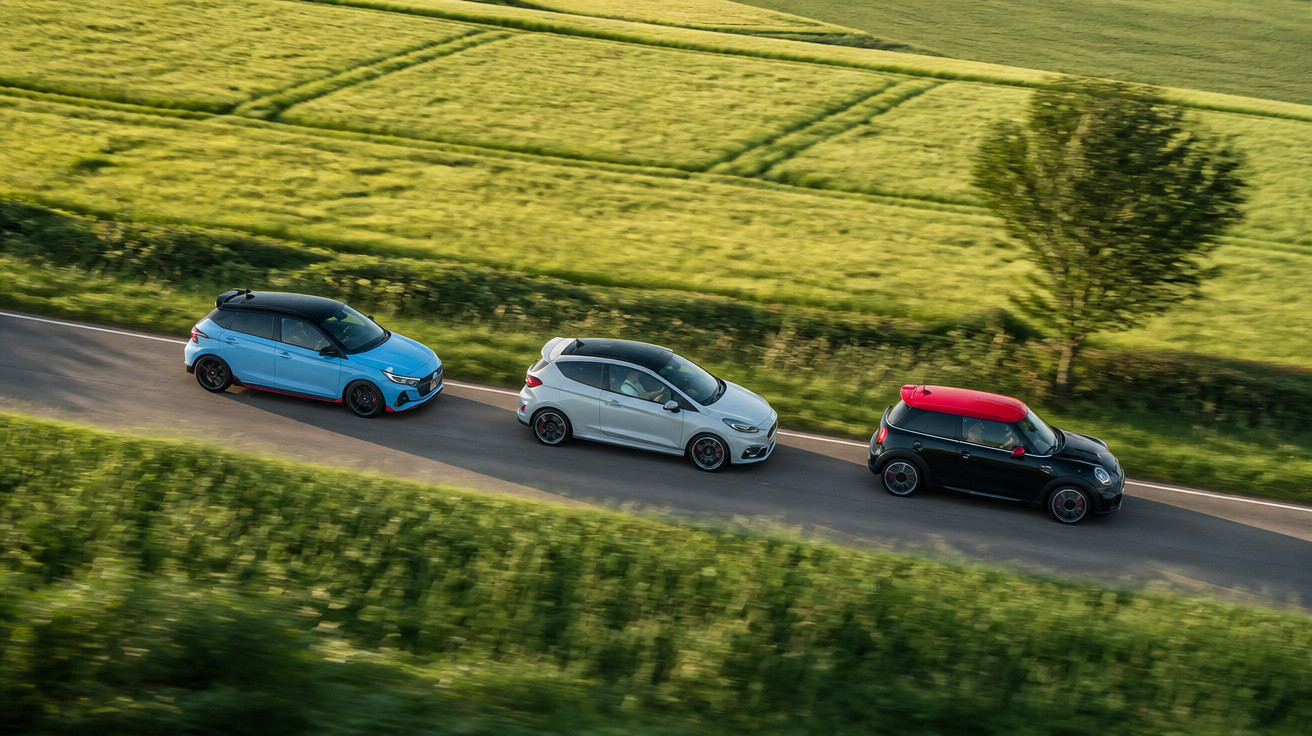
Hyundai deserves a nod for stepping in and stopping the small hot hatch from vanishing altogether. A quick rewind: when the previous Fiesta ST landed, it found itself trading blows with the then-new Peugeot 208 GTI and a reworked Clio RS, alongside plenty of other credible options. This latest ST, though, has enjoyed an easier reign because its maker has effectively seen off most outside challengers.
A shrinking hot hatch field
The rapid Clio and 208 haven’t been renewed. The French - the traditional guardians of this corner of the market since the 1980s - mostly shrug, hint at an electric successor “one day”, and leave it at that. Citroën has ignored the hot hatch idea for around ten years. Vauxhall - once happily slapping VXR badges on Corsas, MPVs and anything else that moved - has also bowed out.
And it’s not just them. SEAT has built the Cupra offshoot, yet fills the forecourt with SUVs rather than a shouty Ibiza. Cast your mind back to the era of the turbodiesel Fabia vRS and Audi’s quattro S1. Those days are gone.
So yes: thank you, Hyundai, for having a go. Finally, the formidable Fiesta has a fresh adversary in the form of a lowered, stiffened i20 from the Korean–German alliance responsible for the excellent i30N. We could have left it as a straight two-car duel.
But small hot hatches aren’t really “cheap” any more. Monopolies have that effect. A Fiesta ST begins at £22k, yet in range-topping ST3 form with the Performance Pack added, it becomes £24,500 (and it’s another £400 if you want rear doors) - roughly £300 a month. Hyundai’s i20N, offered only as a five-door, opens at a fiver shy of £25k.
Nudge a little beyond that and there’s a “Taste The Difference” alternative. The Mini John Cooper Works has worn more questionable facelifts than a Hollywood surgeon’s waiting room, yet older JCWs blended more mature quality with impish manners into a recipe that worked. This example has been loaded with options to the point it’s straying into GR Yaris territory, but it remains the quickest new car you can buy for under £30,000.
Mini John Cooper Works: power without polish
Perhaps because the Mini silhouette is so familiar, it’s easy to miss how long ago it stopped being properly cute. With extra blanked-off mesh and bolt-on brawn, it now looks slightly gargoyle-like. Square-cut add-ons jut from an otherwise rounded body. In the Mini hierarchy, the JCW hatch sits beneath the underwhelming, wing-festooned GP, and it lacks that car’s low-slung, planted posture.
It gets better once you step down past the frameless door and into the tight cockpit. There’s a strong dose of BMW in the low, legs-out driving position - and in the thick, overstuffed steering wheel too. Overall, the cabin has aged well for an eight-year-old design. The oblong screen sitting inside a circular housing still looks odd, but the toggle switches and upright pillars keep that distinctive, kitsch sense of occasion.
This time around you also gain a digital speed read-out and refreshed infotainment graphics… and, well, that’s largely it. Has Mini effectively downed tools, assuming that piling on more power than everyone else is sufficient?
The 2.0-litre turbo - familiar from the terrific BMW 128ti and the more shrug-inducing Toyota Supra - produces 228bhp and 236lb ft, which is plenty in a car this small. Yet you can tell it’s been electronically reined in compared with its other applications.
Past 5,000rpm it seems to tense up, like a runner who’s just been struck by stitch. With the overrun no longer permitted to crackle through a cheeky exhaust, the JCW’s engineered growl comes across as a little thin.
You might overlook that missing eagerness if the JCW then turned its power edge into decisive real-world pace, but the chassis can’t properly deploy it. The traction-control light flickers away through first and second as the front end searches and scrabbles for grip.
Yes, Mini likes to imagine its cars as mischievous little tearaways - Scrappy-Doo with Union Jack butt cheeks. But at this price you’d expect a bit more “settle down and behave” in the repertoire. Driven hard, the JCW stays permanently cartoonish. The ride is slack, bobbing and lurching as though the top mounts are made of elastic. On the sort of up-and-down British B-road it should devour, it feels slightly top-heavy and oddly cumbersome.
The optional eight-speed automatic glides calmly through traffic, but becomes woolly when you try to grab it by the scruff of the neck. Persist anyway and the car’s mass dulls the sparkle. Mini tries to mask the JCW’s heft with quick, wristy steering and a lively rear under braking, yet it consistently feels about 100kg heavier than the hyperactive Fiesta.
It’s also the easiest one to buy by accident. Someone walks in wanting something Mini-shaped at Cooper S money, then realises the monthly payments to jump into a JCW aren’t much higher. Choosing a Hyundai i20N, by contrast, is a deliberate act - it isn’t a household name. Not yet.
Hyundai i20N: the nerd’s hot hatch
Visually, the Hyundai absolutely commits to the tough-guy act. It squats squarely over cambered 18-inch wheels. The body looks as if it was sketched by Zorro during a Japanese-anime phase. The red striping and the wing with its multiple supports are proudly in-your-face. One colleague points out that - unlike the unusually understated Ford - the chopped, slammed i20N will immediately be assumed to be driven with a bit of yobbery. People will make assumptions about you.
In reality the driver will be too busy exploring the set-up. Mechanically, the i20N is fairly straightforward - a 201bhp 1.6-litre turbo four-cylinder sending drive to the front wheels through a six-speed manual and a limited-slip differential - yet it’s an astonishingly geeky piece of kit.
Let’s run through the system, keeping in mind we’re discussing a Hyundai supermini, not a limited-run Nissan GT-R or a McLaren.
Alongside the standard heated-seat controls, a ‘Drive Mode’ switch moves you between Normal, Eco (no thanks) and Sport, with matching typography appearing on the digital instrument display.
Straight away you’ll spot two ‘N’ buttons on the steering wheel, plus a tempting red ‘Rev’ button. That activates the auto-blip function to smooth downshifts if you can’t be bothered with heel-and-toe. It’s a proper nerdy touch - and it’s something the Ford doesn’t give you - but it’s only the start.
For full cagoule-and-thermal-underwear levels of detail, you need the 10.2-inch touchscreen’s ‘N’ section. Among the temperature read-outs, shift guidance and pedal-pressure displays are the controls for N Custom modes. You can choose between three levels of throttle sharpness, exhaust loudness, rev-matching intensity, and how interventionist you want the stability control to be.
You can even set the exact launch-control revs for a clean getaway, and decide when the shift-up beep should chime. Once you’re happy, the car saves it all, ready to recall with a tap of those baby-blue N paddles.
In fact, you don’t always need to press anything. Like many new cars, the i20N uses a camera to read traffic signs for speed limits and school zones. But it also recognises the warning symbol for S-bends and throws a message onto the dash: “Twisty roads ahead. Would you like N mode?”
That’s brilliant. We’ve driven cars with automated burnouts and hidden drift settings, but this is one that sees a sign warning of corners and politely suggests you drive like a bit of a cock. Naturally it’s fantastic. What else would you expect from a hot version that gains 12 extra welds and brackets in the structure to crank up stiffness? The engineers clearly went all-in and pulled an all-nighter.
So the i20N is the hatchback equivalent of a £10,000 carbon-fibre bicycle with electronic shifting, or a water-cooled gaming PC. It’s for Mr and Mrs Serious Trousers. The Fiesta ST is closer to pick-up-and-play Mario Kart. And the Mini? More like a fairground coconut shy: amusing in small doses, but you can’t shake the feeling you’re being had.
In Normal mode, the Hyundai is genuinely easy to live with. It’s the roomiest of the three and has the biggest boot. And while it has one more cylinder than the Ford and can’t shut any down on a cruise (unlike the freakishly frugal Fiesta), it can still manage 45mpg on a motorway run. It’s slightly noisier than the other two at a steady speed, but never to a tiring degree.
Its ride is firmer than the Ford’s and it’s also the one facet you can’t dial up or down, yet if you’re buying into the styling and the way it drives, you’ll likely accept the tautness as part of the deal.
The seats don’t clamp you like the Fiesta’s bear-hug Recaros, but they’re less of a scramble to exit. It’s a shame Hyundai didn’t bring the same colour and excitement to the rather dull, shiny-grey dashboard as it did to the exterior. The money clearly went into the crisply animated displays.
The Fiesta is a riot, a masterpiece of excitement at reasonable, 'let you off with a warning' speeds.
And underneath, too. The i20N is superb: engaging, grippy and determined… but not quite the personality I expected. Hyundai’s second hot hatch comes across as more grown-up than the larger i30N. There’s less kickback through the controls, less buffeting, and less torque-steer. It’s sharp and precise - a ruthlessly effective tool for carving up a favourite road.
Traction is immense - nothing like the Mini’s tyre-frying wastefulness. The limited-slip diff’s bite is less obvious than in the Fiesta, and the steering isn’t as rapid, but that makes the i20N easier to settle into and less nervy. You end up threading it through corners with your serious racing-driver expression on.
The Fiesta, by contrast, charges into bends tongue-out and tail-wagging, hoists its inside rear wheel at the apex, then slides onto the straight in glorious old-school style. It’s a riot, a masterpiece of excitement at reasonable, 'let you off with a warning' speeds. Even a mini-roundabout in this feels as thrilling as a full Nürburgring lap in a GT2 RS.
The Hyundai takes the other approach - not as tail-happy, more intent on speed and discipline. It will still get a little naughty, but then it snaps back onto line as if it’s being pulled by a magnet towards the fastest route.
Honestly, the i20N ought to outclass the ST. Hyundai has had three years to dismantle, reverse-engineer and benchmark its key rival. The base supermini is unquestionably roomier and better stocked with kit. And for these warm-to-the-touch halo versions, both brands have done a cracking job.
Both are superb pick-me-ups. Either could win. So how do you separate them?
Hyundai i20N vs Ford Fiesta ST: where the Ford edges it
The Ford’s trump card is its excellent 197bhp three-cylinder. It answers the throttle more cleanly than Hyundai’s more relaxed four-pot, which feels sleepy below 3,000rpm and reacts a bit slowly to DIY throttle blips if you choose not to lean on the tech. The ST also serves up a fruitier, more unusual offbeat thrum - like a BMW M3 that’s swallowed a helium balloon on a pub dare.
It’s a small gap, but it matters. The Fiesta is the dafter car. For me, that’s just enough to hand it the narrowest win of its life - though it’s about as tight as these group tests ever get. I also happen to like the Ford’s less complicated styling, its more playful rear axle, and its gearshift (even if that’s partly because the knob feels pricier than the Hyundai’s). And that engine is the final ingredient the Ford needs to stay in front - only just.
If that sounds fickle, it’s because these two are effectively inseparable on pure ability; it comes down to taste. You can’t make a bad choice.
Try both. Choose either. And appreciate that, for a little while longer, they still exist.
Photography: Mark Riccioni
Ford Fiesta ST3 - 9/10
1,497cc 3cyl turbo, 197bhp, 214lb ft
0-62mph in 6.5secs, 143mph
42.8mpg, 150g/km CO2
1,262kg
6spd manual, FWD
Price on the road/as tested: £24,580/£27,750
Hyundai i20N - 9/10
1,598cc 4cyl turbo, 201bhp, 203lb ft
0-62mph in 6.2secs, 143mph
40.4mpg, 158g/km CO2
1,220kg
6spd manual, FWD
£24,995/£26,045
Mini JCW Sport Auto - 6/10
1,998cc 4cyl turbo, 228bhp, 236lb ft
0-62mph in 6.1secs, 153mph
40.9mpg, 153g/km CO2
1,330kg
8spd auto, FWD
£25,980/£34,535
Comments
No comments yet. Be the first to comment!
Leave a Comment