
Wildlife, roads and the Grossglockner Pass
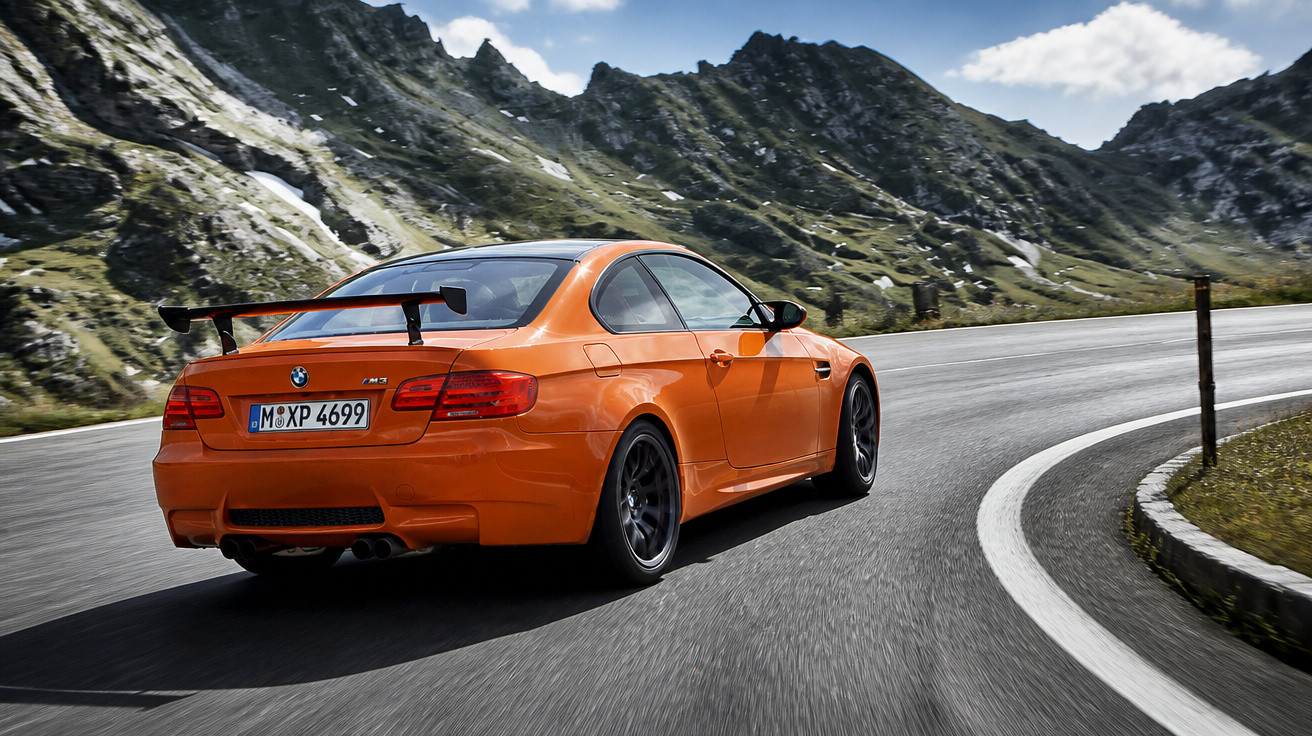
Cars and animals are a bad combination. Around where I live, muntjacs - sweet-looking but genuinely devious little deer - have a nasty habit of stepping into the road, and you really don’t want to meet one at 70mph. Up here in the Austrian Alps on the notorious Grossglockner Pass, about 2,286m above sea level, the caution signs warn you about something that seems far more huggable: the marmot. Strictly speaking it’s a squirrel, though it resembles the gopher that made Bill Murray’s life misery in the comedy classic Caddyshack. Clipping a marmot in an M3 GTS, however, would be anything but funny.
Images: Joe Windsor-Williams
This article was originally published in Issue 210 of Top Gear magazine (2010)
Why the BMW M3 GTS costs £120,000
But this car’s real wildlife issue is bigger - the elephant in the room - so we may as well address it first. Once George Osborne’s 20 per cent VAT hike arrives next January, an M3 GTS is going to cost roughly £120,000. That isn’t merely a vast amount of money; it borders on the absurd.
It also makes this the priciest BMW by a wide margin - unless you go completely mad and spec your V12 760Li with diamond-encrusted cup-holders. Which is quite something, because the GTS is, at heart, a heavily reworked M3 and - when you strip the story back - still a 3 Series. So yes, £120k sounds like fantasy, doesn’t it? Well… not entirely.
There are three explanations. To start with, BMW intends to build only 126 M3 GTSs, and just eight are expected to end up in private UK ownership. Future classic, practically pre-plated in gold. Second, every one of them is already sold, so the argument about value is mostly academic unless you’re itching to wage war on some dubious web forum. Third, I’ve driven it. And it’s so spectacularly capable - and delivers its performance in such a thunderously distinctive way - that it’s (quietly) nearly worth the money.
The same could be said for a day on the Grossglockner Pass, which also isn’t free. Entry is 28 euros, which feels punchy for a public road. Pay it anyway. Like its better-known German cousin, the Nordschleife, the Grossglockner is the sort of place that stays with you.
To be clear, it is absolutely not a circuit. And instead of a parade of modified hot hatches and old German saloons piloted by blokes with Euro-hair, you’ll be sharing tarmac with lumbering RVs and cyclists whose thighs look like condoms packed with walnuts. Turn up early - as we did (it opens at 5am, June to September) - and you’ll almost certainly get it to yourself. It runs for about 48km, the surface is largely superb, and it snakes through astonishing mountain scenery like a stray strand of spaghetti. Even a boggo Ford Focus hire car would make you grin up here.
What you really want, though, is an M3 GTS. Sorry. This is an exceptionally special car. For context, my two favourite high-performance road cars are the Ferrari 430 Scuderia and the Porsche 911 GT3 (2006, 997-vintage). I love that you can hear stones ricocheting off their undersides as you hurl them from bend to bend; that their engines mercilessly punish valves, pistons and cylinders in the pursuit of revs; and that the teams who created them were handed carte blanche to carve out as much weight as they dared. The Scud has the best paddle-shift semi-auto ’box of the lot; the 911 GT3 has traction that feels supernatural.
And yet you can mention the M3 GTS in the same sentence as those two - something that surprised me. Powertrain, chassis, interaction, sound, emotion: it’s right there, honestly. Turning a 3 Series into something that can take on a Ferrari 430 Scud is a monumental shift. But that’s exactly what they’ve done.
We fly into a grey Munich afternoon and head to an anonymous BMW facility on an industrial estate roughly 32km south of Bavaria’s capital. When we arrive there’s no ceremony, but because Top Gear is the first outlet to get a proper steer of the GTS, and although the BMW lot are friendly, it’s obvious that bending this thing is not on the agenda. Grossglockner, they say. Fine. It isn’t snowing. Yet. “You kill the car, we kill you…” Sorry - did you want milk in your coffee?
Then we see it: alone in a hangar, kept away from its lesser relatives as if the mere presence of a diesel engine might insult it. It looks properly hard. Black lightweight alloys. An adjustable rear spoiler pinched from the WTCC BMs. Fresh cooling ducts and a front splitter that can extend by 30mm for extra downforce. And that orange paint. To my eyes it isn’t as visually resolved as the car it most closely echoes in spirit - the E46 M3 CSL - and at this price perhaps they could have pushed the bodywork a little harder. Still. It’ll do.
[Inline image gallery]
Driving the BMW M3 GTS: first impressions
You can normally tell within moments how a car is going to behave, and the GTS is no exception. It puts a smile on your face - a slightly twisted, wicked one - a split second after you jab the ‘engine start’ button on a genuinely spartan dashboard.
Its 4.4-litre V8 snaps into life, then immediately drops into a proper race-car idle: lumpy, grumpy, a touch uneven, while the exhaust burbles and warbles underneath. It sounds like it means business, and like it’s impatient to get on with it. It’s more than a bit intimidating. It’s also absolutely bloody marvellous.
There’s no point spending long getting used to it - there’s sod all in here to get used to. No stereo, no aircon, no iDrive. After years of that ‘joy doesn’t compromise’ marketing hooey, we’re back in ‘ultimate driving machine’ territory. About time, too.
The steering wheel is the familiar chunky three-spoke, its fat rim wrapped in Alcantara. Annoyingly, it still has buttons for things the car no longer features - no stereo, no volume, no need. A dedicated GTS wheel would have been a nice touch. Worse, the GTS-specific bits that are present are universally poor: the logo is some half-arsed chequered-flag nonsense, slapped onto the sill kickplate and the far end of the dash alongside a garish number. This car is 003.
The door to the garage lifts. Forget the bargain-bin logos and the emptiness of the dashboard - what matters is what’s still here. Mainly, the engine. M Sport chief engineer Albert Biermann says the GTS started when his team found a few euros down the back of the sofa and decided to build the über-M3 - partly for the fun of it, partly because the M3 turns 25 this year.
[Large image: left]
That engine is a serious gift, and it’s far more than lightly fettled. It’s a motorsport unit with a race-spec block, and while the bore stays as it was, the stroke has been stretched to 82mm. That lifts the old 4.0-litre V8 to 4,361cc, brings an additional 30bhp (now 444bhp), and adds 29lb ft of torque. Peak torque is now 325lb ft at 3,750rpm - 150rpm lower than before. On paper, it reads like it should serve up its performance with more flexibility than its surprisingly highly strung, high-revving sibling. At 1,530kg, it’s only 75kg lighter, but we’ll take what we can get.
Flick the stubby selector to the right into ‘D’, and feed in a little throttle. Blimey - it really does feel like a racing car. There’s absolutely no slack. None. Roll out onto the side road, join the main road, and creep down to the lights. The whole routine takes about 30 seconds and I’m already in: the GTS feels drum-tight, obsessively engineered - an M car plus about 200 per cent.
I haven’t even used third gear yet.
The Grossglockner is several hundred miles from here, which means a fair few hours behind the wheel. And this is a car that’s unapologetically track-oriented, without air or audio. I did a similar journey a few months back in a 911 GT3 RS, and it’s strange how your thoughts drift - and just how tuned-in (and reliant) we’ve become on outside stimulation. This could be hard work, mentally and physically.
With firmer springs and dampers, adjustable anti-roll bars, more allowance for toe and camber adjustment, and a rear sub-frame mounted directly to the body, it ought to feel borderline painful. Yet on its Pirelli P Zero Corsas, it’s actually unexpectedly liveable.
[Large image: right]
And even if it were as forgiving as a medieval Iron Maiden, the engine and gearbox would still make the suffering worthwhile. On an unrestricted stretch of autobahn I see an indicated 160mph, with more still in reserve (top speed is 190mph). I slot seventh and lope along among the Polos and Astras, enjoying the extra torque and the added flexibility. Not for long, though. That would be ridiculous.
The noise is outrageous. Aside from a bit of boominess around 4,000rpm, the reduced soundproofing and titanium exhaust aren’t a problem at all. Spin it out to the 8,500rpm red line and brace your lugholes. Who needs a stereo? The M3 GTS has the low-frequency lung power of Tom Jones and the top-end rock-star banshee wail of Axl Rose, rolled into one. And the strengthened M-DCT dual-shift ’box is so moreish you catch yourself hanging back, downshifting, then pinning it purely because you can. In this set-up, we finally get a dual-shift system that delivers genuine mechanical sensation.
We tackle the Grossglockner twice. Late on day one the weather is brooding and the surface is slippery as hell. The road itself - built in the early 30s to help revive employment smashed by the Great Depression - climbs to 2,504m, but we’re above the cloud base long before then. At the summit, the cloud even spills into the tunnels, creating a quasi-religious atmosphere that’s properly eerie.
Just as unsettling is how wayward the GTS becomes on wet switchbacks. With the stability systems engaged it won’t fully let go, but turn them off and you’d better know what you’re doing. It’s hilarious, old-school badass BMW behaviour.
We’re back at 6am the next day. It’s deserted - even the marmots are still asleep. The sun is out, the tarmac is dry, and it’s time to get on with it. Now it really does feel religious: engine, gearbox and chassis forming their own Holy Trinity.
The brakes are a bit grumbly but packed with feedback - steel discs, not ceramic - 378mm at the front, 380mm at the rear. But it’s the harmony of the whole package that’s doing my head in.
The engine is simply mighty, but the key is that the GTS feels awake right across its rev range, instead of saving the best for the far end of the dial. The gearbox channels all that output perfectly, instantly. You won’t be able to stop fiddling with it.
And then there’s the chassis. The Grossglockner serves up plenty of quick fourth- and even fifth-gear sweepers, and the GTS turns in, settles, and then drives on with absolute determination. It’s stable, balanced and neutral. Switch off the stability systems and every second-gear hairpin becomes a drifter’s playground. The steering is sublime: heavier than standard, but accurate like a race car. There’s almost no understeer, and oversteer whenever you fancy it.
And it still costs one hundred and twenty thousand pounds. Absurd. Pointless. Perfect.
Comments
No comments yet. Be the first to comment!
Leave a Comment