
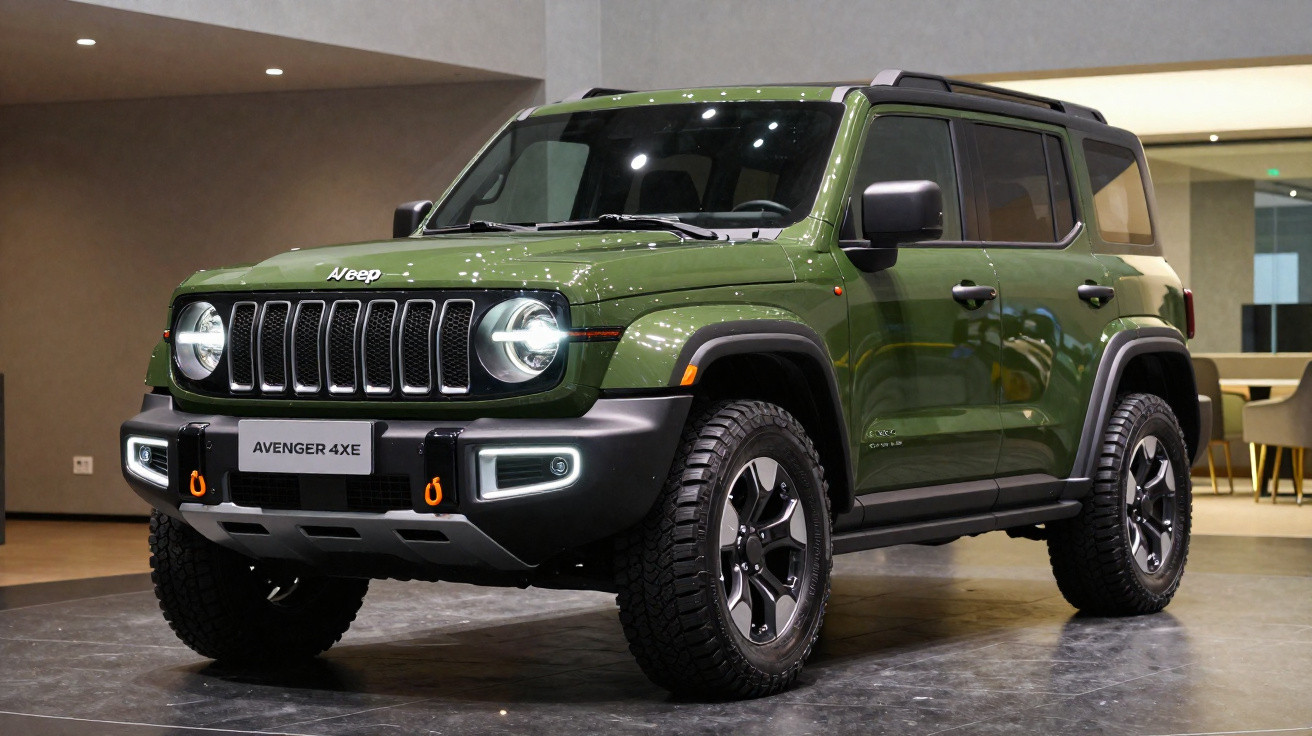
With electric rear-wheel propulsion, the Jeep Avenger 4xe impressed off-road and… on tarmac too, but four-wheel drive is not always available.
At a time when the watchword is “hybridise”, the Jeep Avenger 4xe introduces an all-wheel-drive option to the line-up. Until now, the range consisted solely of petrol engines, a 48 V mild-hybrid and a fully electric version.
For this new 4xe, Jeep’s answer was to add an extra electric motor to the 48 V mild-hybrid set-up, creating a powertrain with two electric motors plus one combustion engine. The first motor sits within the six-speed dual-clutch automatic gearbox, while the second is mounted on the rear axle. Together, they assist the three-cylinder petrol engine to deliver stronger performance while using less fuel.
That additional help also comes into play when extra traction is needed on rough surfaces and moderate ruts with limited (or very limited) grip - mud, gravel, ice, and so on.
In other words, the Avenger feels more like a Jeep, even without a propshaft physically linking the two axles.
Depending on which 48 V hybrid 4xe version you choose - Upland, Overland or Northface Edition - there are notable differences versus the more urban-focused models. Externally, it gains redesigned bumpers with scratch-resistant finishes, steel underbody protection at the front and rear, strengthened roof bars, a tow hook, and green exterior accents.
Inside, there is a black headlining and seat upholstery made from stain- and mud-resistant fabrics, among other changes.
Freedom to leave the tarmac
The Avenger 4xe sits 10 mm higher, with 210 mm of ground clearance in total, giving it more leeway for moderate off-road use. That figure makes this Jeep far better suited to such outings than rivals such as the Toyota Yaris Cross Hybrid (170 mm) or the Suzuki Vitara Hybrid (175 mm).
Its increased capability is also supported by the independent rear suspension, which uses a multi-link layout. Compared with the torsion-beam rear axle fitted to other Avengers, it allows greater axle articulation and also creates the space required to package the rear electric motor.
The turbocharged 1.2-litre, three-cylinder petrol engine produces a maximum of 136 cv and is backed up by the two aforementioned electric motors, which share the same output (21 kW or 29 cv) but deliver different torque: 55 Nm at the front and 88 Nm at the rear - one motor per axle.
Combined maximum output from the three motors is 145 cv - exactly the same as the Junior Ibrida Q4 - and it is paired with the same automatic transmission mentioned earlier, which can also be operated via the paddles behind the small steering wheel.
Strong performance
Engine response is pleasingly brisk from low revs, helped by the instant nature of electric assistance. The claimed top speed of 194 km/h and the 9.5s 0–100 km/h time back up the idea that the Avenger 4xe is quick enough, and it beats the two Asian rivals mentioned above in both measures.
If the driver chooses to use the steering-wheel paddles, there is a chance of letting the engine rev too high, which brings a less polished three-cylinder note - and it also pushes consumption upwards.
Jeep quotes 5.4 l/100 km, but over this 64 km test drive we were well above that average. The main reason was that the route involved climbing a mountain to reach the off-road track.
Four-wheel drive only up to 90 km/h
The driver can select from four driving modes (Auto, Sport, Mud/Sand and Snow), using the control located on the console between the front seats.
The system has a few quirks - notably that, regardless of the chosen mode, above 90 km/h the car is front-wheel drive only.
In the more off-road-focused modes - Mud/Sand and Snow - the Avenger 4xe runs permanent all-wheel drive up to 30 km/h. From 30 km/h to 90 km/h, the 4×4 system only engages when required - when it detects loss of traction at the front wheels - just as it does in Auto.
In Sport, all three motors work at maximum to sharpen acceleration response up to 40 km/h; beyond that speed, the Avenger 4xe also reverts to front-wheel drive.
In the dedicated off-road modes, the traction and stability control systems are tuned differently too, with the aim of preventing even slight wheel slip from being immediately stamped out by electronic interventions.
Specific driving modes
One of the most impressive points of this (part-time) four-wheel-drive system is its ability to pull itself out of very demanding terrain even if the front wheels have no grip and the small battery is empty.
This is possible because the rear electric motor can still be fed with energy, as the front motor can also operate as a generator.
Jeep’s engineers say the car can handle gradients of up to 40% on difficult ground and retain up to 20% traction when the front axle has little or no grip.
Even without verifying those exact percentages, our off-road route showed that the Avenger 4xe can clear any moderate obstacle placed in its path.
The downside is that the Jeep Avenger 4xe never provides four-wheel drive above 90 km/h, which means there is no extra safety margin when, for example, the surface is wet on fast roads.
On tarmac, switching between Auto and Sport also changes throttle response and the steering’s “weight” - both are stronger and “heavier”, respectively, in Sport - and the difference is noticeable either way. However, the change takes around two seconds to activate or deactivate after pressing the relevant button, a sluggishness seen across Stellantis models.
The balance between stability and comfort deserves praise - our test car wore 215/60 R17 tyres/wheels - and the adoption of the new rear suspension improves the way bumps are absorbed, especially for rear passengers. The brake pedal felt slightly spongy at the start of its travel.
Inside, little changes in the Jeep Avenger 4xe
The Avenger 4xe dashboard keeps the same minimalist design seen in the rest of the range. Transmission control is handled by buttons (Parking, Rear, Neutral, Drive) rather than any kind of gear lever and, reassuringly for a brand that prides itself on usability, the climate functions use conventional physical buttons.
All trim surfaces are hard to the touch, but that does not clash with the vehicle’s philosophy. There are also decorative inserts - coloured pieces or a 4xe logo - whose number and colour vary depending on the version.
Some details reveal tight cost control, such as the lighting area by the interior mirror where the finish is not up to scratch, visible screw heads, and the lack of any lining in the door pockets or glovebox.
Both the digital instrument display and the central screen measure 10.25” diagonally, and the infotainment graphics and software take little time to learn, with an intuitive layout and crisp visuals.
Even so, showing “average consumption” in the instrument cluster feels odd when the same menu also displays the time - as a percentage - that the car travelled in 100% electric mode. Wireless Apple CarPlay and Android Auto are standard.
Enough space
The Jeep Avenger is not defined by cabin room, yet four adults who are 1.80 m tall can still travel with sufficient space.
A third passenger in the middle rear seat - which is firmer and narrower - will feel significantly more constrained, as is normal in this class. At least the intrusion in the floor is relatively low and slim, and the rear seats are set higher than the front ones, creating a theatre-style seating effect.
The boot is not large, at 325 litres - 55 litres less than other Avengers - due to the electric motor positioned over the rear axle. Still, it is (just) bigger than the Toyota Yaris Cross Hybrid (320 l) and the Suzuki Vitara Hybrid (289 l).
Price and rivals
The entry-level Jeep Avenger 4xe (Upland) starts at 34 237 euros, which is around 3,000 euros more than the Suzuki Vitara 4WD Mild-hybrid, but almost 5,000 euros less than its Italian “cousin”, the Junior Ibrida Q4.
Above Upland sits the better-equipped Overland, priced from 36 237 euros. At the top of the range is a limited edition developed in partnership with The North Face, limited to 4806 units as a reference to the altitude of Mont Blanc, Europe’s highest mountain. In this case, prices start at 40 237 euros.
Comments
No comments yet. Be the first to comment!
Leave a Comment