
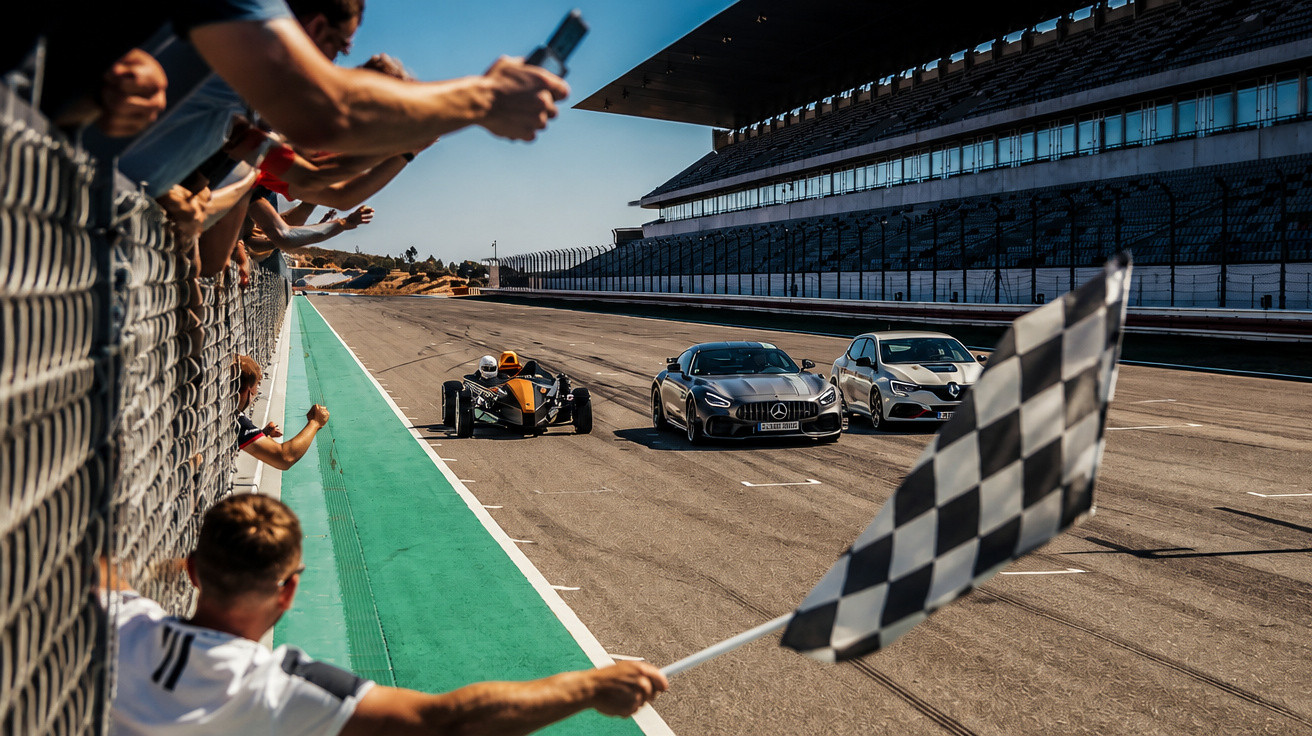
Ferrari 1965, Ford 1966, Porsche 1982, Audi 2010. None of them pulled it off quite like we did: the formation finish. All right, the Renault was a touch behind, but cut us some slack - we were absolutely spent. And, truth be told, our top three caught us off guard. Twenty-four hours earlier, the only car we’d genuinely earmarked as a probable podium finisher was the Megane.
Early expectations and early doubts
Our road-test radar also had the Porsche Cayman GT4 and the McLaren 720S Spider pegged as likely front-runners, yet neither landed with the impact we’d anticipated. The McLaren, largely because it felt like territory we’d already covered (Tom Harrison’s point about built-in obsolescence really does hit home); the Cayman, because there was a shared feeling that the original GT4 had a slightly more stripped-back, more desirable edge.
- Words: Ollie Marriage
- Photography: Richard Pardon
Both, though, ended up being edged out by the AMG GT R Pro. Yes, it’s essentially a small step on from the regular GT R - the same one that couldn’t get past the 720S coupé back in 2017 - but these are tiny margins we’re talking about. And with the Tesla Model 3 in the mix, you can’t help sensing the clock is starting to run down on the boisterous, unfiltered V8 experience, which makes it feel worth cherishing while it’s still here.
I’ve never been a huge admirer of the long-bonneted AMG, yet I can’t ignore how well it’s ageing. I can’t think of a quicker, more approachable or more mischievous front-engined car. It’s explosive. That Tesla? Fine, but it’s a one-trick pony and it doesn’t pull at the heartstrings. The A45 feels over-engineered; the Focus ST is, in plenty of ways, the more rounded and absorbing hot hatch, simply because it goes about things in a more natural manner.
[node:field_carousel-themed]
Track revelations: Megane, Atom and the cars that split opinions
The Megane refused to be overlooked. Aside from the pure racers, it had the single best component fitted to any car here: its brakes. They were outrageous - practically as effective as the 935’s - backed up by a chassis with that familiar, head-spinning level of ability. A front-wheel-drive car that’s more fun and more satisfying on circuit than a Cayman GT4? Yes. I can barely believe I’ve written that.
Then there were the machines that divided the room - foremost the Jaguar Project 8. It’s substantial and muscular, and some found it involving, but for me it came across as heavy, leaning too much as it loaded up into corners. I’ve driven it on the road before and still reckon that’s where it makes more sense. The same goes for the Aston Martin DBS Volante - and you can tell that just by looking at it. What a stunning thing, and when you place it in its proper habitat it’s deeply rewarding from behind the wheel.
The Toyota Supra, too, feels more at home on the road. At Portimão, its showing could be summed up as ‘Woolly’, missing the precision every one of us was searching for.
Reaching agreement is never straightforward. More often than not it degenerates into bickering. But the working assumption is that the more seasoned drivers (read: less imaginative) gravitate towards the tougher, sharper cars than those who can picture the exact shape of the dent they’ll stamp into the barriers if they misjudge it at Galp. That’s why I didn’t see the Ariel Atom 4 stealing the limelight. I expected it to be too hairy-scarey. It wasn’t. Everyone climbed out wide-eyed and buzzing, going on about it. The set-up is so sorted, and it stays so manageable right up to - and past - the limit.
Getting consensus is difficult. Often things descend into squabbling
Keeping the racers out of it - and picking a winner
Beyond the Atom, we obviously had to exclude the racing cars from the final verdict. With extreme restraint - and through gritted, powdered teeth - I had to abandon any notion of naming the Hyundai i20 WRC our champion. The same applies to the VW ID.R and the Porsche 935. Either they’re impossible to get hold of, or they’re so far outside the norm that they barely relate to the rest. Even so, having them here and being able to share them with you is a huge privilege. My push for a Racecar of the Year award begins now. And it’ll soon be followed by a phone call to Mercedes F1.
So, the winner. In recent years there’s tended to be a standout hero - a car that moved the game on. Put simply, nothing made quite the same statement as last year’s Alpine A110, and there’s a sense that the class of 2019 hasn’t sparkled quite as brightly. Perhaps it’s because some cars didn’t have us climbing the walls in the way we assumed they would, or because the racers have raised the bar too far (driving a WRC car has definitely and dramatically warped my perspective). None of that should take away from what our victor achieved.
Here’s a little secret: we had the track after 3pm, and later that evening we went back out driving. And the car that still caught people out - the one that remained supremely interactive and rewarding, and earns the top step of the podium - was the Megane Trophy R.
Comments
No comments yet. Be the first to comment!
Leave a Comment