
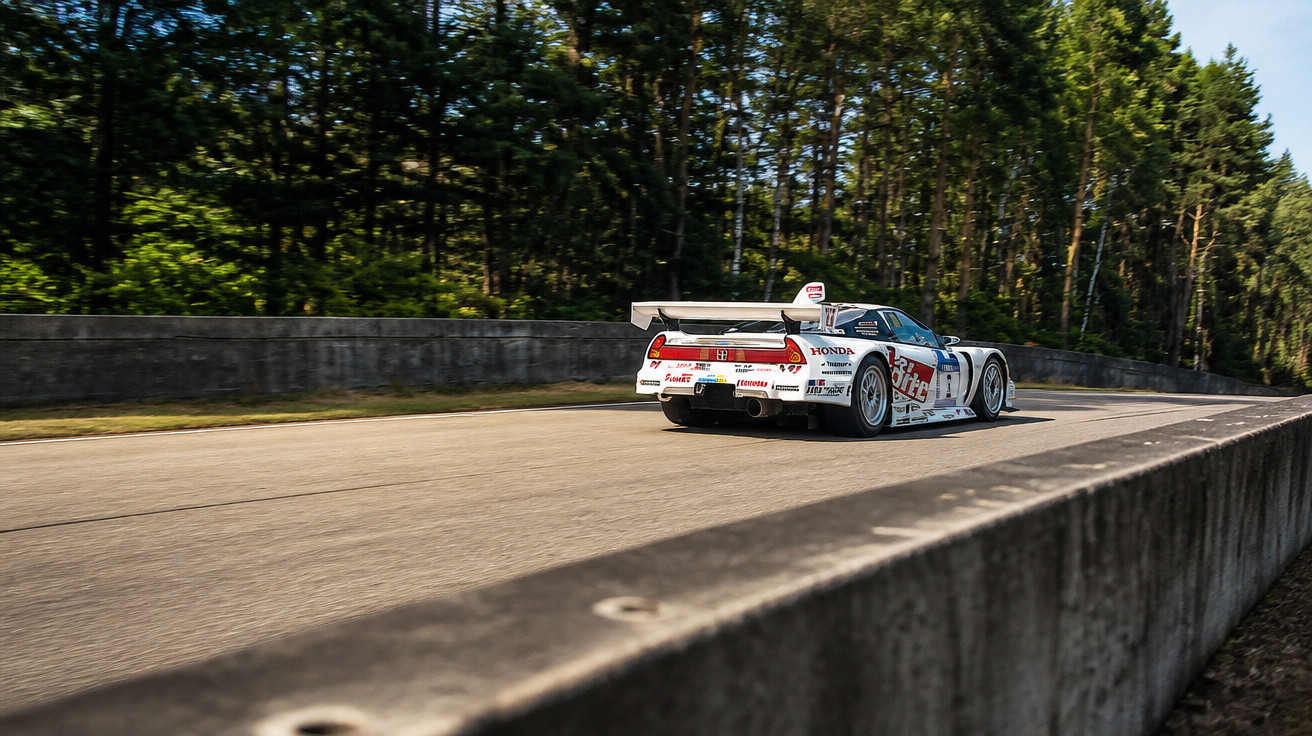
At 170mph as I flash past the pit wall, sweat creeping into the corners of my eyes, everything around me seems to snap into a Matrix-like still. All that’s left is the heavy thump of blood forcing oxygen through my body, and the calm, firm voice of reason bouncing around inside my head.
For a moment, doubt barges in. Am I really meant to be doing this? Was signing those disclaimer forms a terrible idea? Should I have put in a few more hours on Gran Turismo 4 before trading pixels for the blistering heat and brutal noise of one of the cult game’s quickest cars?
This feature was originally published in Issue 146 of Top Gear magazine (2005)
**Words: Peter Grunert // Images: Lee Brimble*
Strapped into the Honda NSX-GT
This place feels utterly unnatural: a carbon-fibre-lined coffin moving faster than I can possibly get comfortable with. My sightline is packed with instrument clusters placed wherever they’ll fit, all spitting out readings I can’t begin to decipher. The five-point harness is cinched so tight I’m fairly sure I’ve just ruled out passing my genes on to anyone. Beside my left shoulder sits a long, carbon-tipped lever for the sequential gearbox, angled about 45 degrees, while a flat-topped Sparco race steering wheel sits almost against my chest.
These are my opening moments with the Honda NSX-GT, the racing car that later fathered the NSX-GT R road model: a £250,000 homologation special complete with exaggerated carbon-fibre aero and a strange snorkel sprouting from the roof. Here, that roof growth actually does something useful, forcing air in at speed for a ram-air effect, feeding six intake trumpets perched above the centrally mounted, rev-hungry V6.
The racer is far more uncompromising than the NSX-GT R. In truth, only the snorkel, the aluminium monocoque chassis and the door handles feel like parts you could genuinely unbolt and transfer straight onto the road car. Realistically, to build and develop anything even vaguely comparable, you’d be staring at an outlay north of £1million.
My focus snaps back as the film fast-forwards: the end of Zolder’s start-finish straight is charging towards me, and with it a sharp left-hander. This is the circuit that once hosted the Belgian GP, and the one that took Gilles Villeneuve’s life in 1982. Today it’s a curiously mixed test day-touring cars, open prototypes, single-seaters, Porsches, humble Minis and, somehow, me.
[node:fieldinlinegalleries-themed-delta:0]
Zolder: brakes, tyres and the Hewland sequential
I lean on the brake pedal-hard as a rock-and nothing happens. I hit it again, harder, and still nothing. Now properly rattled, instinct takes over and I stamp so violently I’m half-convinced my foot will detach at the ankle. The NSX-GT only just makes the corner, sliding about on its huge Michelin slicks, which are still cold.
This feels like far too big an ask. I’m mixed in with professional racing drivers, trying to pick up the lines on a circuit with a history you’d rather not dwell on, while wrestling with a race car that only really wakes up once you’ve battered it hard enough that the brakes and tyres are on the verge of catching fire.
And there’s something else that the pixelated adrenaline rush of GT4 never makes you deal with: the (British-built) Hewland six-speed sequential gearbox-one of the few non-Japanese pieces on the car. The instruction for engaging it cleanly is clear enough: keep the engine between 4,000 and 7,800rpm. The problem is the flywheel is so light that a single inch of throttle travel is the difference between bogging down and bouncing off the limiter. When it’s in the window, you simply flick the lever backwards to go up the ratios, and you don’t need the clutch at all. On the way back down, though, it’s best to use the clutch. And another warning: never select first. Push a fraction too far forwards from second and you’ll find neutral; shove harder still and you’ll be in reverse.
This car was created to fight in the big-money Japanese GT Championship, then later modified for the mad Nürburgring 24-hour race. Unsurprisingly, the gearbox became the weak point last year, spectacularly destroying itself after only eight hours.
Fear is replaced by sheer stubbornness as a BMW 1 Series racer-complete with wings-begins closing in behind me. In something as visually deranged as the NSX-GT, I simply can’t let myself be mugged off by a hatchback. After a couple of heavy stops, the brakes finally come alive, and the tyres follow suit. From that point on I have to bin whatever idea I had about how quickly a road car can take a circuit corner-even one as fluid and talkative as a standard Honda NSX. I fire the car into a chicane and it just grips and goes round. I notice I’m grinning as hard as my wrists are starting to ache.
Downforce, drama and the NSX farewell
I wedge myself deeper into the minimal seat, Kevlar side-impact pods pressed close on either side, while my helmet clatters against the reassuringly chunky roof struts of the rollcage. This is becoming properly ridiculous. The NSX-GT’s mechanical grip is higher than anything I’ve driven before, delivering sensations that somehow outdo even its straight-line punch. To give that acceleration some context, it will dismiss 0–62mph faster than you could read out your phone number: 3.2 seconds, which makes it quicker than an Enzo.
The strangest and most vivid moment arrives at the Kanaalbocht-named for good reason, as it sits alarmingly close to a canal. It’s a fast, open, flowing corner, and I persuade myself I might be able to take it flat. Above 100mph the NSX-GT generates genuine downforce thanks to its flat undertray, its collection of front winglets and a huge rear spoiler; even the door mirrors are sculpted to guide air over the bodywork. I turn in, tense everything I’ve got, and feel the car squat down and carve a tight line. This isn’t exaggeration-if I’d tried entering at even half that speed in a regular NSX, I’d have ended up underwater.
Now picture sitting in a Mini while this thing bears down on you, flames coughing from its brutally loud exhausts. That’s enough to panic the driver ahead, who attacks the chicane with more commitment than sense. He suddenly spins twice, ricocheting from one side of the track to the other and leaving a trail of dirt in his wake. As my hot, sticky slicks cross from clean tarmac onto loose dust, the NSX-GT snaps into a sharp fishtail. With my lungs burning and a sudden awareness of just how much engine is hanging a long way behind me, the car somehow gathers itself up and straightens out. It’s much more forgiving than it looks.
By this stage the sweat is making my race suit feel heavy. I lean forward to flip a toggle labelled ‘cool suit’, but nothing appears to change. I can’t fathom how drivers survive the sequence of stints that make up a 24-hour race without slumping at the wheel.
My concentration wobbles again, but for a different reason. For the first time, I spot a race engineer from GS Motorsport-the team that prepares this car-leaning over the pit wall. Earlier he’d been holding up my lap times; now he’s got the ‘T’ board out, telling me it’s time to pit. After six laps-15 miles-dispatched in under 10 minutes, I’m finished.
And it isn’t only me calling time. Honda has confirmed that the NSX itself is reaching the end, too. After 14 years, production of the world’s most user-friendly supercar will stop at the end of this year. With the racing programme also done, the NSX-GT will stand as the furthest Honda was ever willing to take it-a spectacular, fiery, and completely berserk final act.


Comments
No comments yet. Be the first to comment!
Leave a Comment