
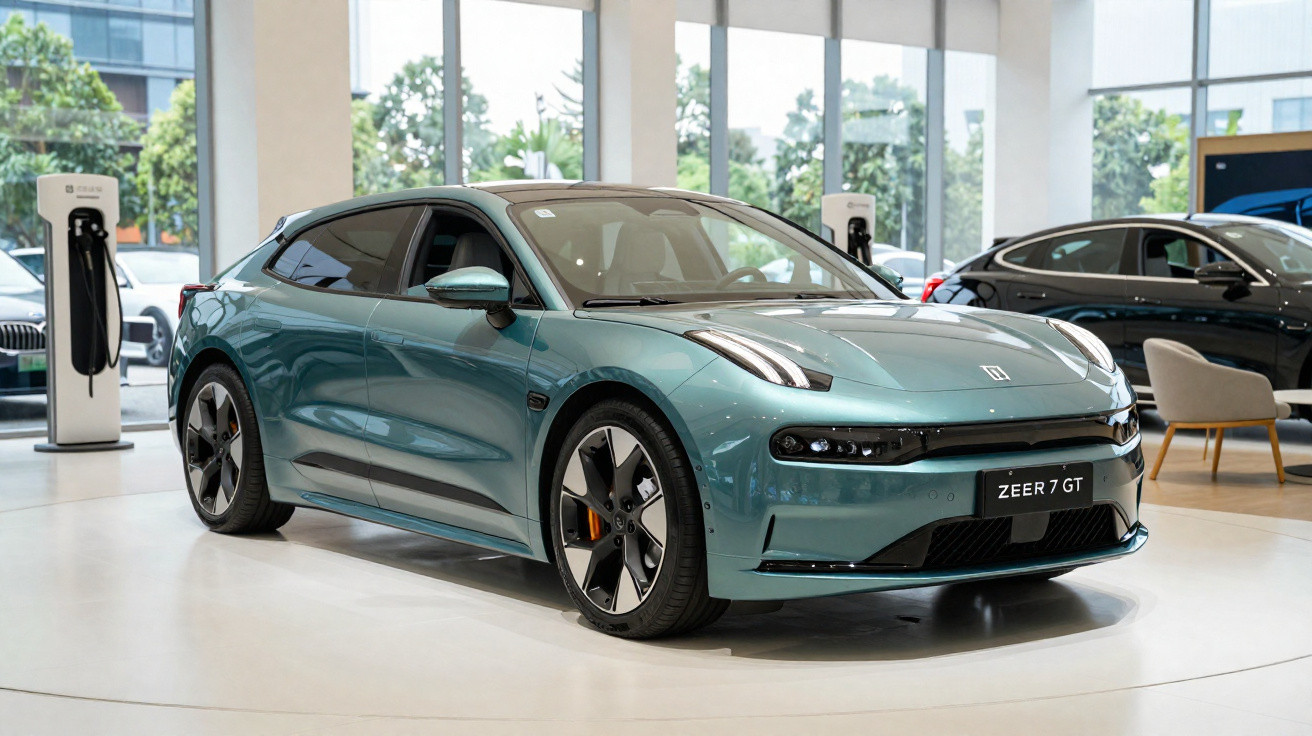
Zeekr is bringing the 7 GT to Europe as an all-electric estate that takes direct aim at BMW, Mercedes and Audi. This shooting brake blends a sporty look with a roomy cabin and strong technical figures - while undercutting many established rivals on price.
Who is Zeekr - and what are they planning in Europe?
Zeekr is part of China’s Geely automotive group, which also includes brands such as Volvo, Polestar, Lotus and Smart. Founded only in 2021, Zeekr initially focused on its home market and a handful of Northern European countries. By 2025, around 5,000 vehicles were already on European roads, mainly across Scandinavia and Eastern Europe.
The next move is Western Europe. Market launches are planned for Germany, Belgium and France. Four fully electric models are set to arrive from the outset:
- Zeekr X - compact SUV (C-segment)
- Zeekr 7X - family SUV (D-segment)
- Zeekr 001 - large SUV coupé (E-segment)
- Zeekr 7 GT - sporty estate / shooting brake (D-segment)
The 7 GT, in particular, is positioned as the halo model. It is the brand’s latest engineering work and is intended to demonstrate what Zeekr can deliver in the premium space.
Zeekr 7 GT design: estate practicality with sports-car style
Visually, Zeekr places the 7 GT firmly in the sporty shooting brake camp. The bonnet appears long, the rear tapers away low, and the overall proportions feel closer to a grand tourer than a traditional family estate.
“The 7 GT’s lines are clearly aimed at customers torn between a sensible estate and a sports car.”
Broad shoulders, pronounced wheelarches and a low silhouette are likely to appeal to drivers who might otherwise lean towards cars such as the BMW i5 Touring, Audi A6 e-tron Avant or a Tesla Model 3 Long Range with a large boot. Zeekr is trying to strike a balance between lifestyle design and everyday usefulness - a combination that tends to land well in the premium segment.
Cabin, space and everyday usability
With an estate car, what matters is how much real-world practicality you get day to day - and the 7 GT makes a strong case.
Plenty of room for rear passengers
Underpinning the packaging is a 2.92-metre wheelbase. That translates into generous legroom in the second row, especially compared with many mid-size SUVs. Anyone regularly travelling with taller passengers, or fitting bulky child seats, should notice the airy sense of space.
Huge boot with proper estate credentials
Boot capacity is quoted at 647 litres, expanding to as much as 1,737 litres when you fold the rear seats. That places the 7 GT in the territory traditionally occupied by long-distance executive estates.
- 647 litres with the rear seats up
- up to 1,737 litres with the rear seats folded
- flat load floor and a large tailgate with electric operation
That makes it a credible option for high-mileage business users carrying lots of luggage, as well as families dealing with pushchairs, dog crates or sports kit.
Infotainment and comfort: premium as standard
Even the entry trim (“Core RWD”) is fitted out generously. Zeekr appears to be avoiding stripped-back base models and instead presenting a high standard specification from the start.
“A 15-inch OLED touchscreen, panoramic glass roof, and front and rear seat heating are all standard.”
According to the spec sheet, key equipment includes:
- central 15-inch OLED display
- Apple CarPlay and Android Auto
- panoramic glass roof
- dual-zone climate control
- electric tailgate
- heated front and rear seats, plus a heated steering wheel
- 10-speaker audio system
- adaptive cruise control and a range of driver assistance systems
The approach is aimed at buyers who want a well-equipped car without having to work through long options lists.
Powertrain, battery and range: up to 646 PS
Zeekr will offer the 7 GT with two power outputs and two battery sizes. On paper, the numbers are striking for this class.
Power options
- 422 PS version (rear-wheel drive)
- 646 PS version (all-wheel drive, two motors)
That places the 7 GT in performance territory typically associated with higher-output variants from German brands. The more powerful model is likely to deliver acceleration that embarrasses full-blown sports cars, even if exact figures have not yet been communicated everywhere.
Batteries and range
- 75 kWh battery (entry version)
- 100 kWh battery (top version)
With the larger battery, Zeekr quotes up to 655 km of range (according to the locally relevant test cycle). That figure exceeds the BMW i5 Touring, which is listed with a maximum range of 602 km.
“655 kilometres of range: on paper, the 7 GT clearly outpaces the BMW i5 Touring.”
In real use, range depends heavily on route profile, speed and temperature. Even so, the headline number signals that long journeys should be possible without constant charging stops.
Charging: 22 kW AC and up to 480 kW DC
Charging technology is one of the 7 GT’s most eye-catching areas, combining a strong onboard AC charger with extremely high DC capability.
AC charging at home and work
A three-phase 22 kW onboard charger is standard. If you have access to a suitable wallbox at home or charging at the workplace, this allows noticeably quicker AC top-ups than many rivals that are limited to 11 kW.
Rapid charging on the road
For longer trips, the 7 GT is said to support up to 480 kW at DC rapid chargers. Under ideal conditions, Zeekr claims the battery can go from 10% to 80% in 13 minutes.
It is worth noting that such results depend on a charger that can actually supply that power, as well as excellent battery preconditioning and thermal management. Even if real-world performance is somewhat lower, the 7 GT still sits among the quickest-charging cars in its class.
Price and rivals: taking the fight to BMW, Audi and Mercedes
Zeekr is using Belgium as its first reference market in Western Europe, where the 7 GT starts at €49,990. For a fully electric premium car with a large battery option, substantial power and extensive standard equipment, that is an aggressively positioned entry price.
| Model | Power | Battery | Range (km) | Boot (L) | Rapid charge 10–80% | Base price |
|---|---|---|---|---|---|---|
| Zeekr 7 GT | 422 / 646 PS | 75 / 100 kWh | up to 655 | 647 – 1,737 | 13 min (up to 480 kW) | €49,990 (Belgium) |
| BMW i5 Touring | n/a | n/a | 602 | n/a | n/a | significantly higher |
| Denza Z9 GT | n/a | n/a | approx. 500 | n/a | n/a | n/a |
“At just under €50,000, the 7 GT undercuts many European premium estates with similar technology by a clear margin.”
The final German pricing has not yet been confirmed. In practice, figures often land close to those in neighbouring countries, with minor differences possible due to taxation and incentives.
What makes the 7 GT interesting for German buyers
For drivers in the German-speaking market, the Zeekr 7 GT brings together a mix of strengths that is unusual in this segment:
- sporty estate shape with a large boot
- electric drivetrain with long range
- very fast charging capability
- generous standard specification
- pricing clearly below German premium manufacturers
At the same time, questions remain around servicing, the workshop network and residual values. Many customers will not yet know Zeekr at all. The brand will need to earn trust over time - much like Hyundai, Kia or Tesla managed to do in recent years.
What do terms like shooting brake, V2L and a 22 kW onboard charger mean?
The term “shooting brake” originally comes from the UK. It describes a sporty estate with a low roofline - visually closer to a coupé than a traditional family load-lugger - which is exactly how the 7 GT is positioned.
V2L (“Vehicle-to-Load”) refers to the ability to feed electricity back out of the car’s battery. That can be used to charge e-bikes, run tools, or power electrical kit while camping. For many owners, it can be a genuinely useful day-to-day feature, especially where there is no mains socket close by.
A 22 kW onboard AC charger is particularly relevant in Europe because three-phase AC connections are widespread. If you can take advantage of that capacity at home, it reduces stationary charging time compared with 11 kW systems and increases everyday flexibility.
Comments
No comments yet. Be the first to comment!
Leave a Comment