
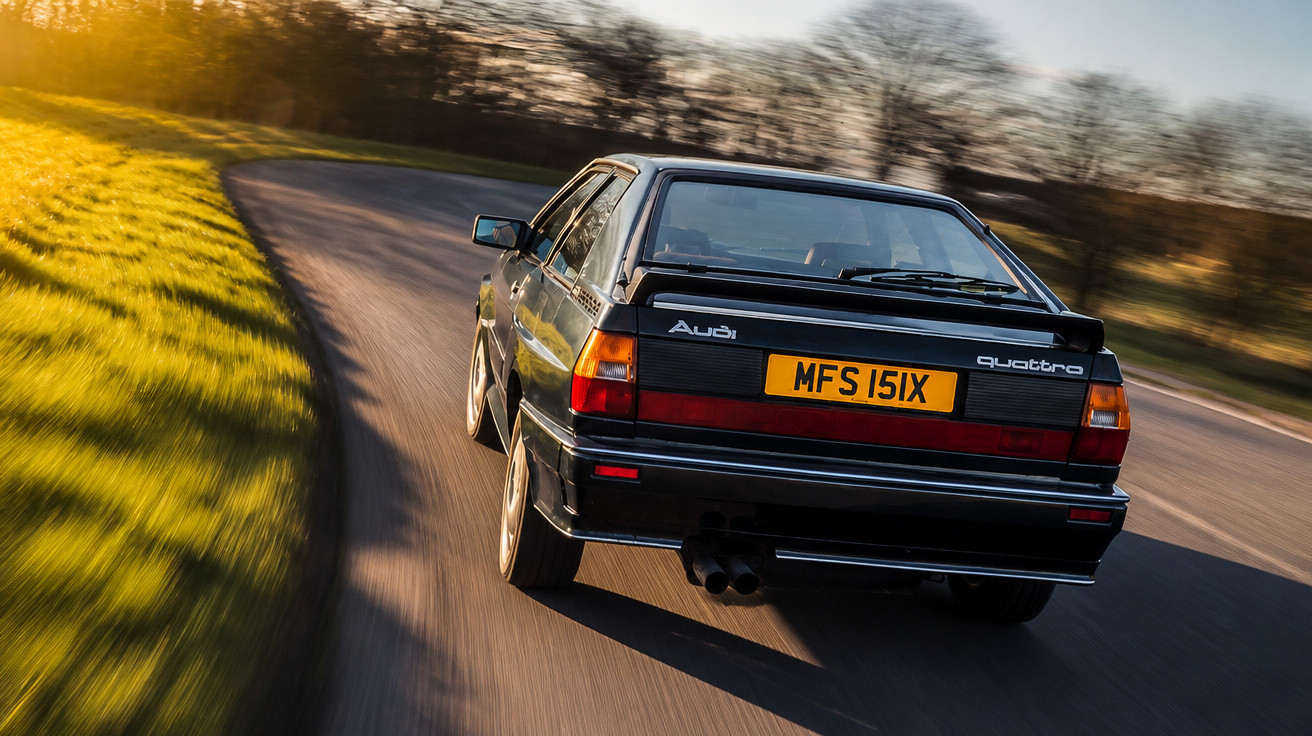
Fast Audis carry a curious reputation these days. For every home run - the R8, the RS6, that brilliant mid-Noughties RS4 - there seem to be twice as many near-misses. Park them next to the most incisive German alternatives and plenty of RS models can come across as slightly detached.
First impressions of the Audi Quattro
Maybe everyone should be made to drive one of these before sampling any new RS. Because the Quattro doesn’t feel any more outlandish - and, with its peerless stance and glittering motorsport history, that realisation is enough to make my stomach drop. I’ve wanted to drive one for years, and the fact it isn’t a frightening, theatrical homologation monster like some of its peers leaves a faint sense of disappointment.
Words: Stephen Dobie // Photography: Jonny Fleetwood
[Image: Feature photograph - right-aligned]
Talk to anyone who clearly remembers this car’s debut - at the 1980 Geneva motor show - and it becomes obvious, very quickly, that I’ve sunk into the gloriously retro seats with the wrong assumptions. In my mind, it’s all yellow-and-white rally cars firing snow skywards in rooster tails. In road-car form, at least, the truth is quite different.
How the Quattro changed performance cars
This is where the usable performance car really begins: the sort you get into whatever the weather or road surface, driving without a second thought for how conditions might worsen. If you’re anything like me, you grew up when the market was flooded with cars built on that idea - especially Japanese rally replicas - and you now take fast four-wheel-drive machinery as a normal part of the landscape. Yet every cut-price leased Golf R owes something to the understated grey coupe sitting here, and even a brief dip into the back story shows how bold and radical the concept really was.
Before the Quattro, four-wheel drive was something you associated with mud and ruts. Bringing it to the road - specifically for brisk, teeth-clenched driving - must have sounded absurd at a time when everyday Ford Escorts were still stubbornly rear-wheel drive. The Quattro’s late-Seventies development hack underlines the point: a plain Audi 80 saloon with the drivetrain from a VW Iltis military vehicle crammed in. It was rough as an artefact, but its dogged ability on snow persuaded the financial decision-makers to sign off the cheques.
[Image: Feature photograph - left-aligned]
The production car was a different proposition, of course. When the Quattro arrived in March 1980, it featured centre and rear differentials, locked by cables connected to a pair of pulleys tucked neatly between driver and passenger. If you’re used to Sport buttons and Drive Select dials, it looks outright comic now. And if we weren’t faced with unseasonably warm, dry tarmac, I’m not sure I’d be able to stop myself fiddling with them.
The Quattro remained on sale for 11 years, and its mechanicals developed as it went - but it always kept the same core recipe: a turbocharged five-cylinder engine, four-wheel drive and a manual gearbox. Yes, it helped redefine turbo use as well. By 1991, the engine had 20 valves, the instrument panel had gone digital, and a then-new Torsen differential sat underneath it all.
But the car here is an early example, first registered in 1981: 10 valves, analogue instruments, and an older-school layout that doesn’t even have ABS (which, for what it’s worth, arrived on Quattros a few years after launch… and at first could be switched on and off via a dashboard button). The chrome-edged quad headlamps and orange indicators make it feel a world away from later versions - arguably to its benefit - while those spectacular blistered arches exist because the tracks were widened.
Its 2.1-litre engine now looks modest on paper at 197bhp and 285Nm. Fiesta ST numbers, perhaps, but it’s only hauling roughly Fiesta ST mass, so it gathers speed more keenly than you might expect. It’s more comfortable, too. There’s room for five (just about) and even a heated seat (singular). On the motorway it’ll lope along at under 3,000rpm, and it suppresses wind and road noise better than plenty of modern cars.
[Image: Photo carousel]
I’ve deliberately started with the mundane, because it frames what follows. On scruffy roads the Quattro doesn’t stumble, and the grip is so evenly portioned it feels close to unshakeable, no matter how clumsy you are with it.
Yes, the engine sits ahead of the front axle, but the Quattro doesn’t bulldoze into corners in the way overexcited period road tests sometimes suggested. Nor does it snap into oversteer if you do something daft. Forty years ago, a car that dependable in all weathers must have felt like a total revelation - and it’s remarkable how well its dynamic character has survived.
You don’t need to handle it with any more reverence than a new RS. It does respond to good manners, though: brake smoothly, match revs on downshifts, and don’t try to rush the gearchange - that feels like the right and proper way. But you’re not inching about on dreadful tyres, searching for traction from another era. This is a seriously capable machine - almost too clinical, if you live for little stolen moments of mischief.
[Image: Feature photograph - right-aligned]
Rally wins, Stig Blomqvist, and the road car feel
In rallying, the Quattro was an outright phenomenon, with two drivers’ titles and two manufacturers’ championships on its record. The second of each came in 1984, with Stig Blomqvist (pictured) driving.
“It was difficult to believe the difference between two- and four-wheel drive,” he tells me. “I remember the first time in Ingolstadt when I took a test run in the car on some dirt roads. It was incredible. But it wasn’t difficult to adapt, because I came from FWD cars and the approach was similar. Just with a lot more traction!”
Most of all, he praises the Quattro’s dependability. “People say it was expensive but if you looked across the whole season, it wasn’t. We were quite a new, young team and the guys were really into it, they were excited to work on the car. The only small problem we had was to get the engine mapping right for different altitudes.”
Of course, he had a road car as well, which he kept in Sweden. “After that I didn’t want to have a 2WD car anymore. I eventually gave it back, but a friend of mine bought it later. I’m trying to buy it back now, but not with any success yet. Somehow I will try to convince him.”
[Image: Feature photograph - left-aligned]
The longer I spend understanding the Quattro, the more I’m hoping Stig gets his reunion. For all the stubborn traction underneath, there’s still plenty of scope for the driver to play a part. A short, stubby gearlever in the centre of the cabin helps. The five ratios are widely spaced, and if you get slack with your shifts you’ll sink under 2,500rpm and into a small pocket of turbo lag.
There are no flattering paddles here to cover your mistakes, but that’s precisely what keeps you engaged - where an RS3 or RS4 might tempt you to slide the selector into D and mentally drift off. Pinging through hedge-lined bends at night, Eighties-spec main beam trying its best to pierce the dark, you keep the revs up while that spine-prickling five-cylinder note slices into the quiet - and it’s hard not to picture yourself on a private special stage.
What you’re left with is a car that delivers uncanny everyday performance, yet needs a little encouragement before it feels playful - and it has more in common with a modern RS than I ever expected. This is the template for the fast Audi, and for the usable performance car, full stop. It may be 40 years old, but if you can look past the set-square styling, the quirky differential pulleys and the near-total absence of airbags, it could (almost) have launched convincingly at Geneva 2020. Global virus notwithstanding...
Comments
No comments yet. Be the first to comment!
Leave a Comment