
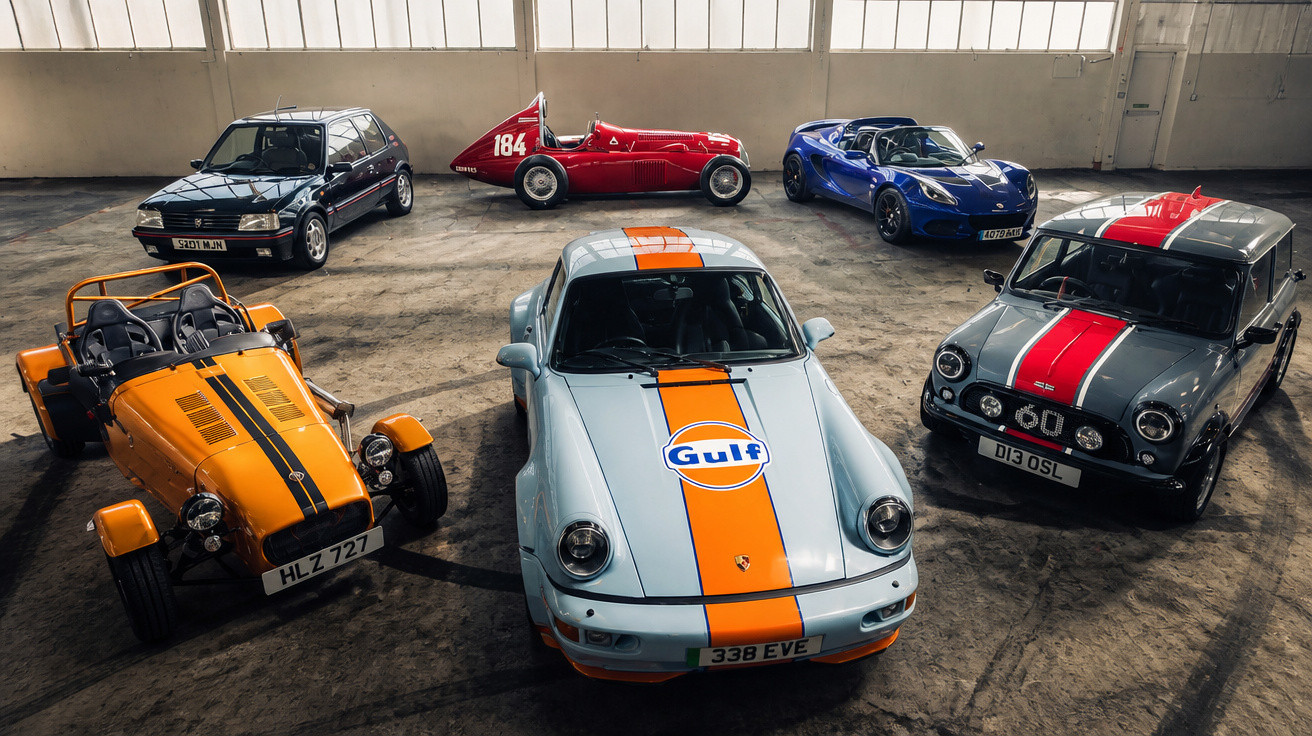
There’s a name for it, though I’ve yet to settle on one: the crotch tickler. Or perhaps the nadger masher. Whatever I call it, there’s a hefty bit of metal flailing about between my legs, and it keeps me just that little bit tense. Supposedly, it’s connected to the rounded knob in my right hand (behave) and that’s how you change gear - but with the wind roar, spray and engine chunter, I couldn’t tell you what ratio I’m in or even how quickly I’m travelling.
And I genuinely don’t care. I’m sideways at every opportunity, grinning like an idiot, convinced I’m some swashbuckling GP ace from the 1930s. Welcome to Memory Lane, where even mild genital torture devices get the thumbs-up - and where flaws aren’t merely tolerated, they’re part of the appeal.
Why retro is everywhere right now
There’s a simple reason retro styling is ripping through the car world faster than chlamydia at Fresher’s Week: age brings character. Sometimes it’s obvious in the design; sometimes it’s baked into the engineering. Either way, character is that hard-to-define quality you can’t measure on a spec sheet, yet you can’t stop thinking about once you’ve parked up. It’s the thing that starts conversations, splits opinion, and leaves a warm glow long after the drive.
So while we slide towards an autonomous EV future, it’s no surprise people are desperate for one more hit of the old stuff.
That’s exactly why our gathering of ageing rockers is the best-attended event. Even narrowing the field to six took a serious bout of whittling, given just how much retro-flavoured metal is pouring into the market: restomods, better-than-new rebuilds, ancient shapes still sold as brand new, and full-on EV conversions designed to wind up the purists. We’ve got all of it - including a MkII Mazda MX-5 that fancies itself as a historic F1 car, and can be built in your bedroom.
Tipo 184 (MkII Mazda MX-5): the DIY historic racer fantasy
We may as well begin with the Tipo 184, because it’s the one your eyes keep returning to - flicking between that torpedo-like bonnet and the wasp-stinger tail. It comes from Ant Anstead and the team at Dowsett Cars, created to be an affordable, approachable project build for the average punter.
For around £20k (plus a donor MkII MX-5 stripped of its engine, transmission and suspension), you can buy the kit and put one together yourself in just a few days - depending, of course, on your mechanical competence. That’s an awful lot of historic race-car theatre for money that isn’t completely ruinous.
It isn’t without its oddities. Getting in is more like mounting a horse than entering a car: you step onto the rear suspension, hurdle the hot exhaust, then drop into a seat that somehow feels both strangely high and bolt upright. The huge wooden steering wheel wedges itself between your knees, your head sits well above the largely token fly screen, and the scrote-slicer dominates the space between.
From there, though, it starts to feel familiar: push-button start, three pedals, a five-speed manual, and that classic MX-5 sensation of being eager at full throttle without ever being properly fast.
Photography: Jonny Fleetwood
Image carousel (themed)
What you do gain is a wonderfully period growl - the exhaust note ricochets past and behind you - and a driving experience that’s about as far removed from a modern car as you can get. Initially it’s clumsy: learning how it steers, hunting for third, trusting you won’t barrel-roll through Hammerhead. Then it clicks and becomes pure joy, as you realise it’s desperate to mess about.
All at once, Stirling Moss’ line makes sense: the steering wheel simply aims the car at the corner; the throttle does the actual steering. It’s a ridiculous car. In the context of what else is here, it barely makes sense at all. And yet I catch myself wanting to sign up for next year’s one-make series on the spot.
But we need to move on - because it’s time for an argument.
Everrati Signature: EV conversions and a very expensive 964
At first glance, the Everrati Signature looks like another neatly executed Porsche 964 restomod. In reality, it’s a full electric conversion. Gasp, etc. Shocking maybe - but the engineering feels honest and properly thought through. Everrati even weighs each donor car individually so the battery placement can replicate the original’s arse-heavy weight distribution as closely as possible.
It’s rear-wheel drive, makes 500bhp, and does 0–62mph in four seconds - which means it shifts like Stig off a shovel. It weighs 1,350kg and offers a 150-mile range.
The build quality is pleasing, too - not in Singer territory, but still a cut above most. The steering wheel is satisfyingly chubby, there’s Alcantara everywhere, an official Porsche classic DAB radio sits in the dash, and the seats are unexpectedly squidgy. Even the two pedals are offset in an authentically Porsche way.
Most crucially, it behaves like a normal car: power it up, select D, get on with your life. In faster corners it hangs on gamely, and it’ll happily drift and donut whenever you ask.
And yet. The fake exhaust pipes that pump out fake noise feel like they’re courting ridicule - it’s electric, so own it and lose the pipes. The Gulf livery also strikes me as a bit naff... but each to their own.
The biggest snag is the price: £250k. We’re increasingly trained to accept these enormous numbers without blinking, but stop for a second - for that you could buy a new 911 GT3 and a Taycan 4S Cross Turismo, and still have a Toyota GR Yaris’ worth of change. It’s a fascinating thing, but the sense of character is being buffed away, and for me that’s a deal-breaker.
Lotus Elise Final Edition: a modern classic that still shines
The Lotus Elise, though - here in Final Edition form - is as bright and sparkly as it ever was. Across three generations and 25 years, it swapped Rover power for Toyota engines and, along the way, put on a fair bit of weight: from 725kg in the mid-Nineties (when it had trick brakes, no airbag and no air-conditioning) to 930kg in this guise.
The fundamentals remain spot on. You get an aluminium tub, a mid-mounted 1.8-litre supercharged 4cyl engine producing 240bhp, rear-wheel drive, a manual gearbox, 0–62 in 4.5 seconds, and 147mph flatout.
“There’s a robust argument for all just packing up, and giving the Elise the win right here and now”
That still reads like plenty for a sports car, and in reality it’s more than enough. Everything feels tied together - steering talking to brakes, throttle chatting with the gearbox. Even in streaming rain, it wraps you in confidence, letting you drive it however you fancy: loose and daft, or neat and precise.
It feels like an extension of your own thinking - a direct neuron pathway. I’m sure it wouldn’t be the easiest thing to live with day to day, but I’m equally sure the payback would justify it: an unreliable yet utterly lovable other half. Emira, meet gauntlet.
Honestly, there’s a strong case for calling it now and handing the Elise the win on the spot. But another old-timer, dressed in fresh threads, has other ideas.
Caterham 170R: purity, but with a power question
At 440kg, the 170R is the lightest Caterham ever. Put it this way: one well-specced LR Discovery weighs the same as six of these. It’s also the kind of car where skipping pudding could realistically improve performance for the drive home.
The engine needs all the help it can get. It’s the same 84bhp three-cylinder you’ll find in the 160, but here it’s paired with all the lightweight carbon bits from the 620R - hence the boost in power-to-weight ratio to 170.
Every Caterham is pure; this one feels like mountain-fresh, triple-distilled Evian with an oxygen chaser. On appearances it nails the brief: an aero lip instead of a windscreen, a stubby short-throw gearlever, the awkward squeeze to wedge your lockdown paunch into the seat, and feet threaded into the pedal box.
Thanks to the scrawny tyres, grip limits arrive hilariously early, and the engine thrums away gamely - but there’s a mismatch between the car’s intent and its output. It’s desperate to excite you, yet somehow blocked from delivering the full thrill it’s promising. Put it in the file marked brilliant idea, but needs more grunt.
Mini Remastered Oselli Edition vs Peugeot 205 GTI 1.6: restomod reality check
If what you want is something compact, loud and easily chucked about - something that doesn’t need huge power to make you beam - there are other routes.
The Mini Remastered Oselli Edition comes from Silverstone-based David Brown Automotive, which has been producing high-end restomod Minis for several years. This is the performance-focused one: a larger 1,450cc A-series engine on twin SU carburettors, significant internal modifications, and 125bhp at 6,200rpm. You also get a limited-slip differential, AP Racing brakes, 13-inch wheels with wider tyres, adjustable Bilstein suspension, a five-speed manual gearbox, and a louder, freer-breathing sports exhaust.
The outcome, though, is… complicated. In the wet it’s bang up for it: handbrake turns purely because you can, sliding into corners then clawing its way back out, making an outrageous din absolutely everywhere. But once it’s dry, it feels softer than the spec sheet suggests, with a delay between steering input and the front end actually responding that’s simply too long.
It balances on a knife edge between being brilliant fun and feeling like a missed opportunity - and after two days at the wheel I still can’t decide which side it falls on. Then the price lands, and for me it’s a hard no. The four-seat version costs from £118,000, the two-seater starts at £130,000… and no, it’s not 1 April.
I understand it: “value” is slippery, varying wildly with bank balance and background. And yes, £45k for what appears to be a standard Sorrento Green Peugeot 205 GTI 1.6 that’s been given a quick once-over with Turtle Wax doesn’t sound especially sensible either. But stick with me.
Where the Mini’s development spend feels like it’s largely gone on Pioneer headsets, stitched leather and pinstripes, Tolman Engineering has poured its attention into the parts of the 205 that actually matter. There’s a reconditioned engine with a lighter flywheel, a Motec ECU and 132bhp, a new stainless steel exhaust, Bilstein dampers, Eibach springs, LED lights all round, brakes from the 306 GTi6… and the list keeps going.
What you’re left with is a better-than-new version of an all-time hot hatch icon - improved, but also preserved, so future generations can still understand what real zip and tactility feel like. You sit too high with the wheel in your lap, looking out through acres of glass past skinny pillars, simply lobbing it about and loving every moment.
The engine buzzes away up front, the heavy steering wheel fidgets in your hands, and every time you jump on the brakes the sunroof shade slides forwards with perfectly timed comedy and period-correct shoddiness. It’s magnificent: a full-fat time machine to a golden age.
If there’s one I’d take home and keep forever - the antidote to copy-paste EVs - it’s the Peugeot.



Comments
No comments yet. Be the first to comment!
Leave a Comment