
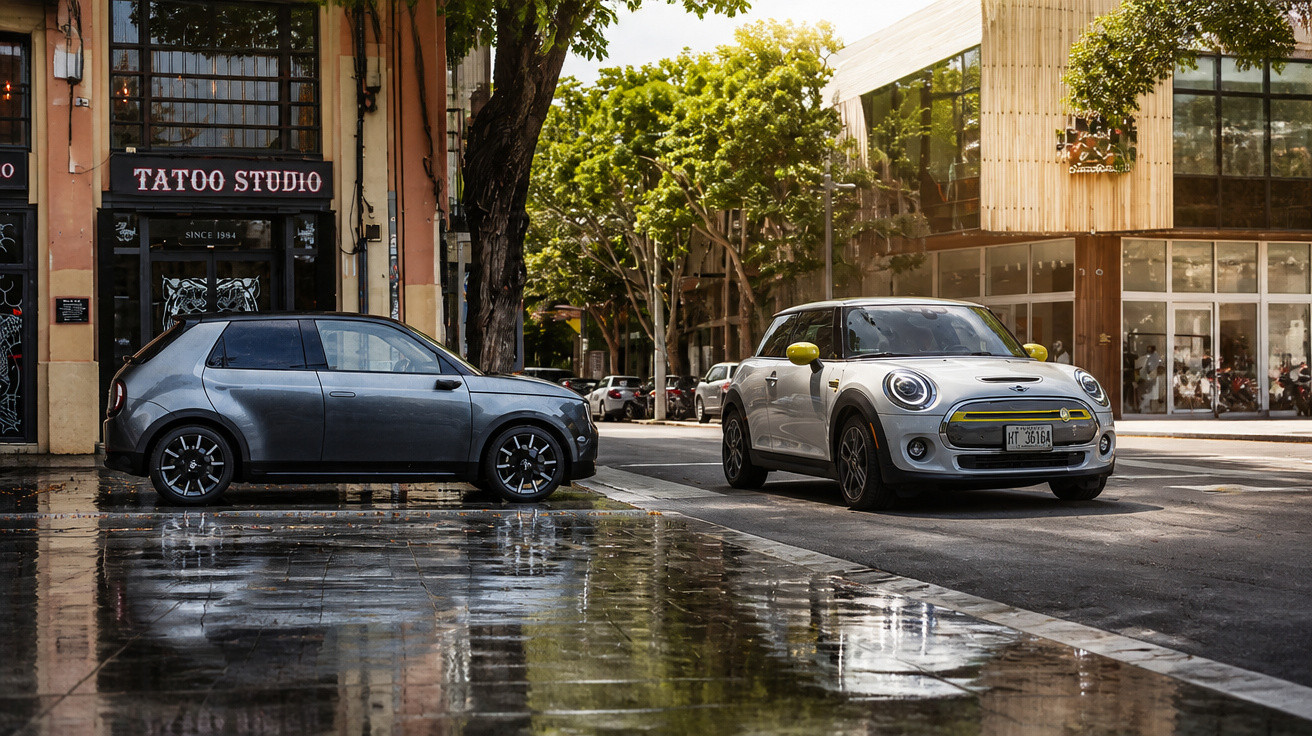
I’ve heard of car makers doing wild things to prove what their tech can do, but Honda effectively timing our drive with the nastiest storm the Costa Blanca has had in 30 years purely to show off the rain-shedding coating on its new wing cameras? That’s taking commitment to another level.
Yet even Storm Gloria - and the knowledge that Mr Kew is somewhere in Miami in a Hawaiian shirt, porn-star sunglasses and channelling his Scarface daydreams while I’m wading about near Benidorm - can’t puncture my good mood about this tiny car. This is the Urban EV Concept that turned into a myth, the myth that became a prototype, and the prototype that’s now become the smallest, most covetable thing since the Suzuki Jimny. And yes, I want one.
Words: Jack Rix and Ollie Kew // Photography: Mark Riccioni
This feature was originally published in an earlier issue of Top Gear magazine
(Image: themed carousel)
Honda e: design appeal, pricing and standard kit
Plenty of other people will want one too - including many who’d previously have sworn they were allergic to electric cars. Smart design has that effect. Still, a cute face can only carry you so far (sorry, Ollie): there are a few obstacles to clear before you sign up to Honda e life.
Honda has kept the footprint roughly “Fiat 500 plus a bit” and limited the battery to a tidy 35.5kWh, but pricing starts at a punchy £26,160 for the 134bhp version, climbing to £28,660 for the 152bhp, higher-spec Advance model. That figure already includes the £3,500 government sweetener. To explain costs that outstrip the bigger, longer-legged VW ID.3, Honda has packed the car with goodies.
Even the base car comes with camera wing mirrors and a camera rear-view mirror, the ability to rapid charge at up to 100kW DC (quoted as 30 minutes), an app that can pre-condition the cabin and keep an eye on the car while it’s charging, a long list of driver-assistance tech, and what feels like several acres of displays. It’s all finished in a gently retro mix of colours and materials that’s clearly intended to match the impish exterior.
Honda e practicality: cabin space, boot capacity and real-world range
If you’ve swallowed the price, the next question is room. In the back it’s only just sufficient for me to sit behind me - but “me” is 5ft 8in (173cm). The boot is modest: 171 litres with the rear seats in place (about the same as a Fiat 500), although it expands to 861 litres with them folded, which is respectable provided you can live with it as a two-seater. Honda’s judged it carefully: it’s only just practical enough to make sense if your heart is already set on it.
Then there’s range. Honda quotes 137 miles (about 220km), or 125 miles (about 201km) if you step up from 16s to 17s - so think roughly 100–110 miles (about 161–177km) in everyday use. That’s not brilliant beside 200-miles-plus (322km+) VW ID.3s and Peugeot e-208s, but Honda says it’s deliberate. This is meant to be a city car, so why burden it with more battery than the job requires? As one lyrical engineer explained: “If you want to design an iPhone, why would you make an iPad just to get a bigger battery in there?”
(Image: big read, left)
Honda e on the road: performance, handling and regen
Still reading? Good - you’re interested. Now for the fun bits. Both versions produce the same torque, 232lb ft (315Nm), so the 0–62mph (0–100km/h) gap isn’t dramatic: 9.0 seconds versus 8.3. More relevant is 0–30mph (0–48km/h), for which I don’t have official figures, so I’ll file it under “pleasingly nippy”.
From rest it darts off eagerly, and Honda deserves credit for its accelerator calibration: it doesn’t head-nod or surge, it just builds speed smoothly and urgently no matter how on/off your right foot is. Rear-wheel drive (crucial to the 50:50 weight split) will cheer the Ari Vatanens among you, and I can confirm that a firm squeeze of throttle on a wet, cobbled roundabout in Valencia produces flamboyant oversteer - and a strong desire for a change of trousers. That’s with the traction control still switched on.
Back to the calmer business of sliding through city congestion: it’s excellent at that as well. The variable-ratio steering (3.1 turns lock-to-lock) is light and immediate, nowhere near as frantic as a Fiat 500, and the turning circle is a comically tight 8.6m - only a whisker more than a London black cab. It’s a hefty supermini at over 1,500kg, but instant torque helps disguise that, and the low centre of gravity means it doesn’t flop about in bends; it simply rocks gently from side to side. It feels agile and keen in the way you’d expect - but it also has a level of polish and adult composure you might not.
The fully independent suspension rounds off rough roads with the ease of something larger, and the quietness in the cabin - even at and beyond 60mph (97km/h) - is a giveaway that Honda has deliciously over-engineered it. With a blank-sheet opportunity and everyone watching, Honda clearly decided not to cut corners.
There are more settings to prod, too: Normal and Sport modes (the latter mainly exists to make the throttle keener than it needs to be). Far more useful is the one-pedal mode, which increases regen enough that you can come to a stop without touching the brake pedal. You choose between three progressively stronger levels using the paddles behind the steering wheel. It’s a tidy setup.
The camera pods replacing door mirrors are also clever on paper - narrowing the car, trimming drag and wind noise, and promising all-weather visibility - but in reality they’re a bit pants. Positioned low and aimed too far at the ground, they provide a cracking view of the rear wheelarch and not much of the car behind you. The rear-view screen brings similar issues: it takes valuable seconds for your eyes to refocus from the road ahead to a digital display just 12in from your face. And every vehicle looks like it’s aggressively tailgating you. Maybe they just wanted a better look inside...
(Image: big read, right)
Honda e lounge-style interior: screens, connectivity and clever touches
Honda describes the cabin as “lounge-style”. Fair enough - assuming your lounge contains retro furniture and six televisions. With squidgy fabric front seats, a rear bench and broad slabs of faux-wood trim, Honda has nailed a modern, retro-leaning, architect-drawn feel that doesn’t resemble anything else. As for screens: two six-inch displays for the wing mirrors, an 8.8-inch instrument cluster behind the wheel, the rear-view display, and then the main event - two 12.3-inch displays side-by-side in the centre (including an Elon-baiting aquarium mode). Each one has six shortcut buttons along the outer edge, can run different apps simultaneously, and lets you swap those apps with a single press.
USB ports are scattered everywhere - two in the front and two in the rear - plus there’s a 12V socket, a 230V AC outlet and an HDMI input. In theory, that means you can plug in an Xbox and play on the central display. Add the built-in Wi-Fi hotspot (free for the first year, then subscription-based) and you can game online while the car charges. Who knows - running low on battery might become the best part of your day.
To be honest, I’m completely sold. Obvious, isn’t it? But there’s another, more familiar route to doing the trendy city-EV thing. Your move, Tony Montana…
--
Say hello to my little electric friend.
Mini Electric: launch-day irony and design details
The absurdity of flying across the Atlantic for the launch of a zero-emissions car built in Oxford isn’t lost on me. Nor is the timing: we’ve arrived in Miami on its most miserable day in a generation. So it’s less Hawaiian shirt, more thick-knit jumper - and the Mini Electric’s 32.6kWh battery instantly gives up a couple of miles of range to power the window demisters: 128 to go.
Here’s another small, retro-flavoured EV. It’s not as adorable as the Honda, though, is it? Like Ronaldo, the Mini has expanded since its glory days, and as it’s grown it’s gradually become less cute. There are twee Brexit tail-lights and doe-eyed headlamps, but the plug-in Mini skips the old-school chrome filler cap. The grille is half-heartedly blanked off. You can opt out of the fluorescent yellow accents. And those plug-socket-pattern wheels only really land for Brits because they mimic a UK three-pin plug: they’re optional. You get 16s as standard because slimmer tyres help squeeze out a bit more range.
Even the naming is muddled. Globally it’s the Mini Cooper SE. In Britain it’s the Mini Electric, yet it still wears Cooper S badges. There’s only one power output and it matches the 2.0-litre petrol Cooper S: 182bhp, sent to the front wheels. It’s slower than the regular hot hatch from 0–62mph (0–100km/h), needing 7.3 seconds, but from 0–30mph (0–48km/h) it gets moving in under four seconds.
(Image: big read, left)
Mini Electric vs Honda e: platform compromises, weight and value
There is one major distinction between Jack’s Hello Kittymobile and my Lilliput Lane cottage-on-wheels, but it’s not as decisive as you might think. His panda cub is a bespoke, wheels-up EV: new platform, new packaging, and it’ll never be asked to accommodate a combustion engine. It isn’t a Jazz wearing a Comic-Con outfit. The Mini, naturally, begins life as a petrol car that’s been converted. The engineers have effectively transplanted BMW i3 technology - bespoke, brilliantly packaged, and not exactly a sales smash - into a tighter, more compromised body we already know sells in huge numbers. It’s less courageous than the Honda. But in the fight to normalise EVs, this could be the iPod to the Honda’s Zune. [The Honda’s what? – ed] Exactly.
And here’s the rub: despite being made from fresh, organic, farmer’s-market ingredients rather than reheated leftovers, the Honda doesn’t really cash in on its theoretical advantage.
The Mini is lighter: at 1,365kg it’s 145kg heavier than a petrol Cooper S, yet it’s still the same again lighter than the Honda. Even though it sits 18mm higher (to create space for batteries low in the chassis), its centre of gravity is lower than that of a regular Mini. You can also feel that it’s better balanced across all four tyres.
It’s quicker as well. It’s three-door only, so climbing into the rear seats is a bit of a squeeze, but at six foot (6ft/183cm) I can just about slot in behind six foot me. Tough luck, Jack. Boot space is better too: 211 litres. And while prices creep beyond £30k for the top-spec 3 model shown here (Harman-Kardon audio, reversing camera and leather seats included), the entry-level Mini Electric 1 begins at £24,400 after the government backhander. So you get a faster, roomier car with 10–20 miles more real-world range, for around two grand less. That doesn’t flatter the Honda’s ambitious clean-sheet approach. Game, set and match point to the Anglo-Kraut.
Mini Electric cabin and driving: tech, regen and traction control
But the Mini gives it straight back in the interior. Can a retro cabin go stale? Right now the Mini sits in a strange no-man’s-land between cool and kitsch. The underlying basics are still spot-on: the seating position is low and straight-legged in proper sports-car fashion, with a chunky steering wheel reaching out to meet your hands. However, next to the Honda’s John Lewis TV-department wall of screens, the Mini’s oblong display awkwardly wedged into the circular surround where the giant speedo used to live looks simply wrong. The display itself is brilliant - crisp, quick, and controllable via touch or BMW iDrive. That’s genuinely best-of-both-worlds for typing versus swiping. But visually, it’s just odd.
There’s also an uneasy blend of strong tech and slightly cosplay details. It uses the i3’s one-pedal regen, but switching between maximum energy capture and coasting isn’t done via paddles; it’s handled by one of the toggle switches you operate without really seeing. The new digital screen behind the wheel is excellent, but it only shows speed and trip information - no nav map, no phone media, and none of the Honda e’s little Easter eggs.
The Mini’s party trick has always been an honest one: handling. You accept a slightly rowdy ride in exchange for alert, puppy-like eagerness in corners, backed up by grown-up refinement. The Electric feels different - you can sense the dampers straining under the added heft as they work to keep the body controlled... but they succeed. And while it isn’t quite as throwable as the petrol version, you have to focus hard to spot the difference. This is a properly complete EV, not merely a drag-race novelty. Better still, thanks to the fiendishly smart traction control borrowed from - yes - the i3, wheelspin is prevented predictively when you floor it, rather than being tidied up afterwards with wasteful dabs of brake. I may not be a roundabout drift king like Jack, but I will make it back to the airport without a 3.5hr wallbox recharge.
And on the way I can actually see what’s behind me, because I’ve got normal mirrors rather than selfie cameras. That sums this car up: it might lose the cuteness contest, yet it could win the sales war against Honda’s precious little gem. The Mini is proven. Some of its hardware has been battle-tested in the far more radical BMW i3, while the things you look at and touch are familiar crowd-pleasers. And history suggests those are the tactics that get you through bad weather.
Comments
No comments yet. Be the first to comment!
Leave a Comment