
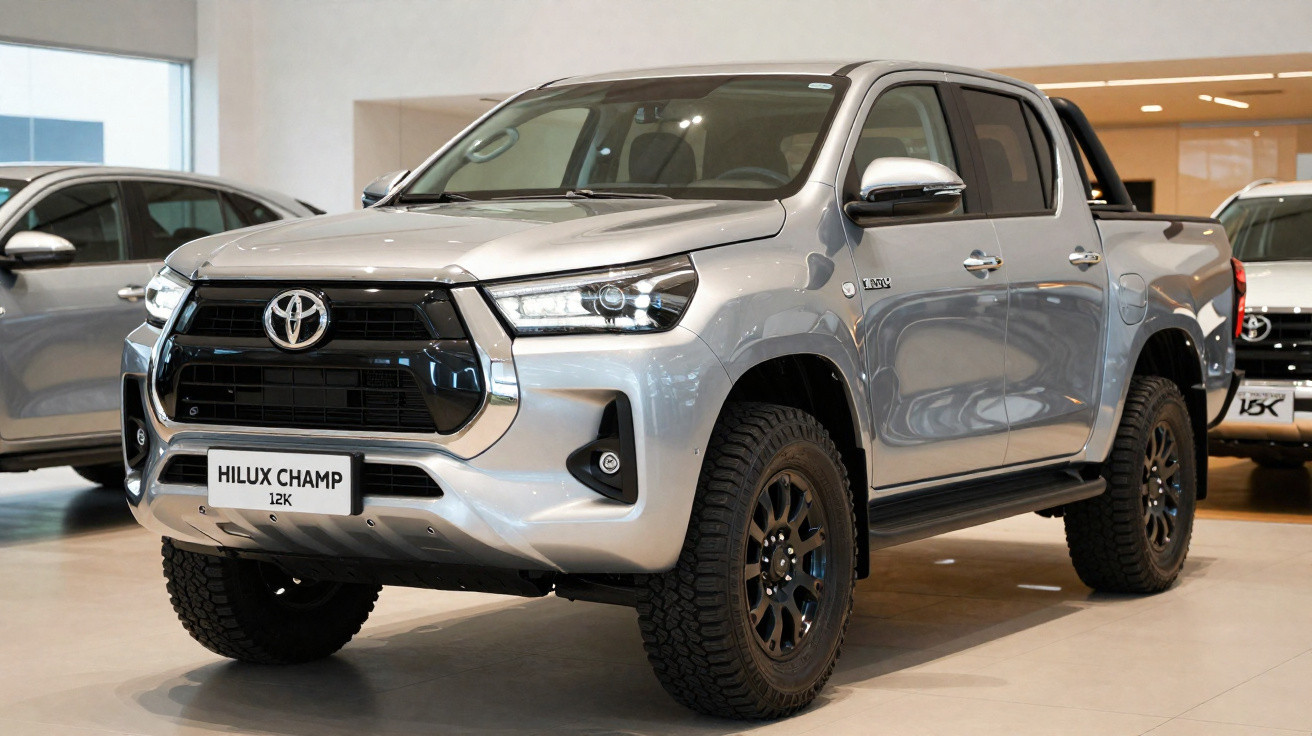
Imagine this. A modern pick-up that keeps what matters in a commercial vehicle, offers huge scope for customisation, relies on proven solutions and comes with an affordable price tag. Sounds appealing, doesn’t it?
Toyota’s Japanese engineers clearly thought so too. Working to a brief much like that, they created the Toyota Hilux Champ - essentially a “low cost” take on the well-known Toyota Hilux.
Before you reach for the chequebook, though, note that this pick-up will not be sold in Portugal - we’ll explain why a little further on. Even so, the Hilux Champ is a worthwhile engineering exercise and well worth a closer look.
Cutting costs is the rule
The Toyota Hilux Champ was developed with a calculator on one side and a spreadsheet on the other. That’s no exaggeration: cost control sat at the heart of the concept from the very beginning.
Toyota management’s instruction was straightforward: build a cheap product that, at the same time - and this is where it gets tricky - still meets all the obligations expected of a vehicle of this type.
Underneath, it uses the IMV (Innovative International Multi-purpose Vehicle) platform, the same one as the Toyota Hilux. That means it shares the same suspension and running gear, and depending on the version it can be rear-wheel drive (rear axle) or four-wheel drive.
The bodywork takes its cues from the lessons of the historic Toyota Land Cruiser Series 70 range, whose production also has a Portuguese link. As a result, straight lines dominate - easy to shape and, of course, cheap to manufacture.
But the savings go further. For instance, the side windows, windscreen and rear glass are all flat, with no curvature at all, reducing manufacturing costs and even keeping repair bills down if a pane breaks.
Inside, every component is made using hard plastics or rubber. Luxury? There’s little to none.
The load bed is not included either; as we’ll see later, it isn’t the only thing that’s not supplied as standard on this pick-up. On one hand, that makes it easier to adapt; on the other, it helps keep the price below €12,000 - although the original goal was to stay under the psychological €10,000 threshold.
A combustion engine, naturally
The Toyota Hilux Champ will be offered exclusively with internal combustion engines. For now, there are three options: two petrol units and one diesel, carried over from other Toyota models that share the same platform.
Choosing these four-cylinder engines with no electrification is easy to justify: they’re simple to maintain, inexpensive to build and have already proved themselves in the market.
Why the Toyota Hilux Champ leaves Portugal and Europe out
It’s precisely this pick-up’s simplicity and frugality that ends up undermining any expectation of it being sold in Europe. In other words, what counts as a strength in Asian markets (especially South East Asia) is viewed as a weakness in Europe.
First, because the combustion engines offered for this pick-up do not meet European emissions regulations.
Those rules not long ago caused another casualty in our market: the Mitsubishi L200 had to leave the European market because it didn’t meet the minimum requirements. In Portugal, that announcement triggered a frantic rush for the last units available in the country.
Then there’s safety. This pick-up also falls short of European requirements. Both the anti-lock braking system (ABS) and the airbag system appear only on the options list.
Two limitations that won’t affect this pick-up’s commercial success in countries such as Thailand, Indonesia or India.
Back in Europe, at a time when average car prices keep climbing, it’s still refreshing to see a product born with such a simple yet equally noble purpose: helping thousands of people get their businesses moving.



Comments
No comments yet. Be the first to comment!
Leave a Comment