
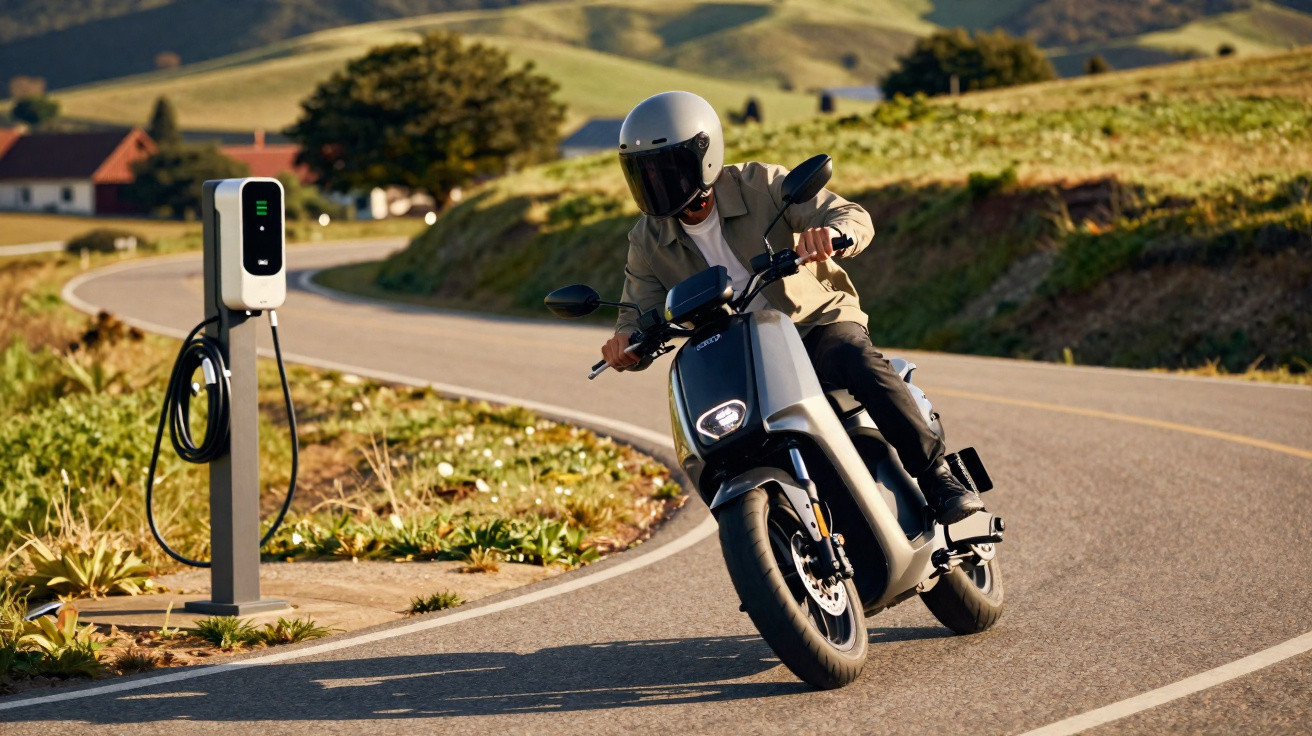
The challenge was a big one, but Honda’s engineers have turned the WN7 into a genuinely convincing electric motorbike-one that could well persuade some riders to make the switch.
Test ride by Théo DUPERRET
Traditional manufacturers’ offerings are almost non-existent in the electric motorbike market. Honda is a rare exception-and it has just let us ride its first electric motorcycle, the WN7.
As we’ve known for a few months, the bike is offered in A1 (125 licence) and A2 versions from the factory, because it produces 18 kW of nominal power (reduced to 11 kW in the 125 version). It’s clearly designed as an accessible gateway for the widest possible audience, from everyday commuters to occasional weekend riders.
A technical platform never seen before at Honda
At the heart of the bike sits a 9.6 kWh battery, delivering a usable real-world range of roughly 100 kilometres, depending on route and how it’s ridden. Over 67.5 km, we saw the charge drop from 100% to 22% while riding at a “Sport” pace. A colleague who rode more gently finished with 37%, showing just how much riding style can materially affect range. From a tech standpoint, there’s no major breakthrough here: it’s an air-cooled LG lithium-ion battery.
What is new for Honda is the way that battery is used: it forms a structural part of the motorcycle’s frame. Plenty of rivals have adopted this approach, but no Honda model had been built like this before the WN7. It’s a new capability-and a well-executed one-because the sensations at the bars are very much in line with what you’d expect from a more conventional bike in the range. On top of that, the motorcycle is assembled without welds, with visible aluminium joints and impressively finished textures.
Lower down the quality ladder, a few glossy-finish panels look less convincing, including the charge-port flap hinge, which has noticeably too much play. It’s not a major concern, because overall fit and finish still sit a notch above many competitors-but you can tell Honda has trimmed costs in a few places to stop the price from running away.
An ageing dashboard, but cutting-edge electronics
You might expect a huge display like the one on the Honda CUVe Connected, but that isn’t the case. A 5-inch TFT screen sits in the centre of the handlebars and doesn’t exactly wow with its modernity, as it’s the same unit used across Honda’s broader line-up. That said, it’s clear and sensibly laid out, with multiple views available for Sport mode and straightforward navigation via a backlit joystick on the left switchgear. Honda’s RoadSync system lets you connect a smartphone, but don’t expect Android Auto or CarPlay. It feels a bit “basic” for a bike that leans so heavily into technology.
To keep the 100 Nm of torque in check (torque on the level of a 900 cc bike), you get traction control (switchable off) and a premium ABS setup (with a gyroscope, effectively) that’s more commonly found on pricier motorcycles. True to its safety-first reputation, Honda also includes features such as automatic indicator cancellation and automatic hazard lights under very hard braking. There’s also a speed limiter-more of a gimmick, but it’s there.
Less convincing is the USB-C socket placement under the seat. You’ll need a dedicated cable, routed permanently through the provided channel up to the bars.
In town, a confident and reassuring machine
While the bike’s 217 kg kerb weight might sound intimidating, the approachable seat height (80 cm from the ground) and the slim waist between your knees make it easy to feel at home. Within the first few metres, it’s obvious the weight distribution has been carefully tuned, because the bike remains stable even at walking pace. Throttle control is accurate, and the “Eco” mode proves genuinely useful in urban riding.
The bar-end mirrors look good and inspire confidence, though they’re not ideal for filtering; visibility through them is strong, however. Up front, the twin-disc braking delivers an excellent sense of security, even if a reflex grab can easily bring the ABS into play.
B-roads are its real playground
Because the bike tops out at 129 km/h (or 120 km/h in the 125 version), it’s best suited to secondary roads, where it feels extremely planted through fast, sweeping bends and turns in with an ease that contrasts with some bikes that run a more upright fork angle.
In A2 form, the 68 horses don’t compare like-for-like with a petrol engine. What we can say is that the electric motor launches hard from a standstill. From the saddle, you feel briskly fired forward in near-total silence thanks to helical-cut gearing and a belt drive. As is typical-and unavoidable-with electric motors, the shove tapers off as speed rises, but there’s still enough left at 90 km/h to handle any situation.
Honda has managed to make the WN7 feel natural and intuitive. Finding your rhythm comes quickly, and you can ride at pace without being caught out by unexpected reactions. The rear brake, slightly subdued, is operated by foot like most motorcycles. It’s also worth noting that regenerative braking means you can ride using engine braking alone. That engine-braking effect varies with riding modes and can also be adjusted manually using the “+” and “–” paddles reachable by your left hand. Crucially, you can change the level of engine braking while you’re moving-very handy.
CCS2 rapid charging, a genuine game-changer
With a CCS2 connector, there’s no need to carry a cable. You can plug into the DC rapid chargers found across the car-charging network. Honda claims the bike can go from 20% to 80% in 30 minutes. That’s a major differentiator versus rival models, which at best tend to offer Type 2 charging-more restrictive and far slower.
In practical terms, the promise is being able to cover 80 km out, charge during your lunch break, and then head back the other way without stress. The same goes for popping out to run an errand or stopping quickly for a coffee with a detour, provided a rapid charger is nearby. Right now, the Honda WN7 is the cheapest motorcycle on sale with a CCS2 socket.
A high price tag, with no government support
Where car drivers have benefited from environmental bonuses for years, motorbikes have been largely overlooked. At present, there’s no support available to bring the cost down. So you’ll need to pay 14 999 €-or 199 € per month after a 1710 € deposit-for the WN7. That figure may make you wince compared with petrol bikes, but it does make sense in the context of today’s electric market and Honda’s overall package, especially CCS2 rapid charging.
The bike comes with a 6-year, unlimited-mileage warranty (including the battery) and needs relatively little maintenance: checks of wear items (brakes, tyres) every 10,000 km, plus fluid changes and belt replacement at 40,000 km. With Honda’s brand strength behind it, this could be an electric motorbike that holds its value over the medium term. So, who’s ready to take the plunge?
Honda WN7
14 999€
Overall score: 7.3
| Category | Score |
|---|---|
| Design and finish | 8.0/10 |
| Performance | 7.0/10 |
| Comfort and handling | 7.0/10 |
| Range and charging | 7.0/10 |
| Value for money | 7.5/10 |
What we like
- CCS2 rapid charging
- Road holding
- Quiet running
- Braking
- Overall quality
What we like less
- Seat is too firm
- Plastic-looking details in places
- Range can sometimes feel tight
- USB socket under the seat
- Ageing screen, no CarPlay / Android Auto
Comments
No comments yet. Be the first to comment!
Leave a Comment