
I keep having this recurring dream: the chief engineer behind the latest, utterly pointless 800bhp supercar is in front of me, enthusiastically listing its party tricks. “Zero to 150mph in seven seconds, 230mph top speed, Inconel headrests, blah blah.” And I’m standing there with the vacant stare of someone who has simply stopped caring.
In the dream I cut him off and say: “Here are the keys to an Alfaholics GTA-R. Go and drive it. Then come back and try to tell me your car doesn’t feel like a huge, overfed lump of turd compared with that little sliver of perfection - and that these supercars aren’t missing the point entirely, because they’re no fun to drive.”
Then I wake up, go to work, and nothing changes. Another unpronounceable manufacturer unveils another unusable contraption, and people hand over far too much money for the privilege.
- Words: Chris Harris // Photography: Mark Riccioni*
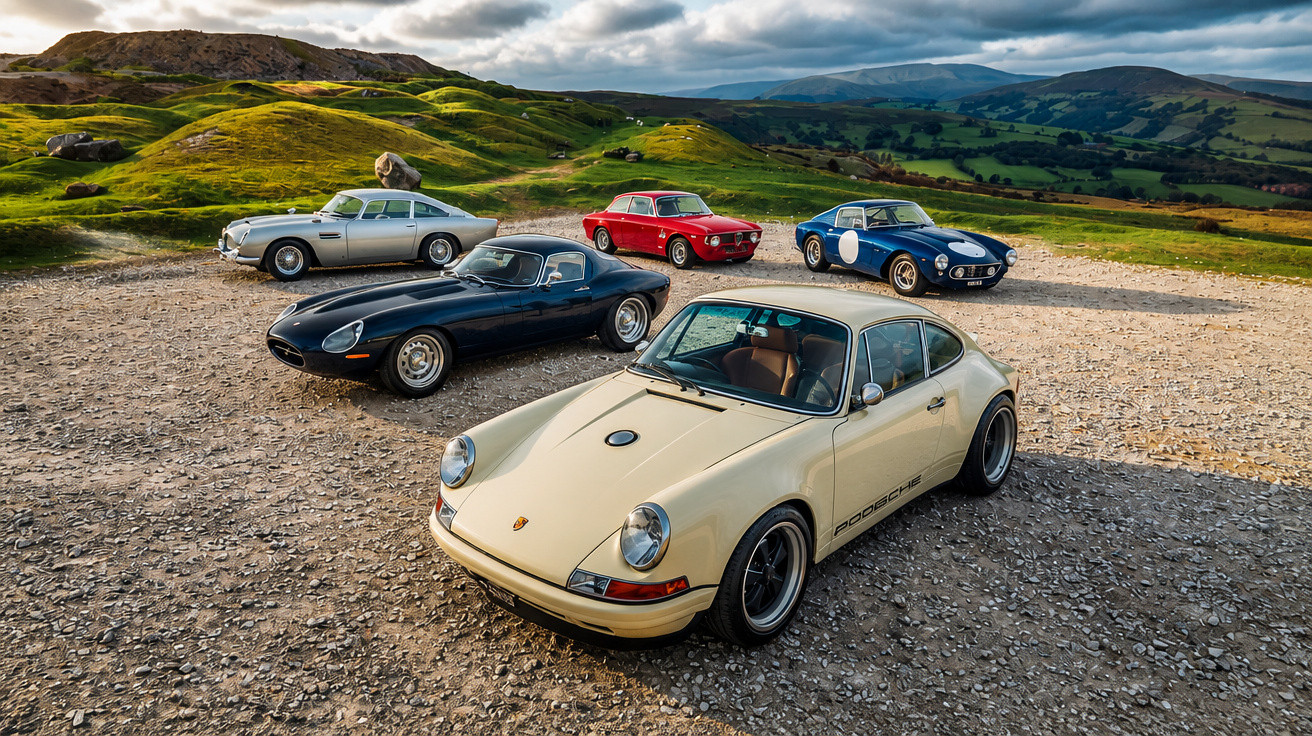
Out of nowhere, though, the restomod world arrives. Like Excalibur rising from the water, it sets out to cut down the idiotic hypercar trend by reminding us what we actually love about driving - and what a genuinely desirable car should look like. And then the clever ones drop the pretence entirely and simply build new versions of old cars, because, frankly, they look and sound far more interesting than the new nonsense currently being shoved at us. Just look at these five machines: who honestly cares about the latest Bugatti Punani when you can breathe in this sort of beauty?
[Carousel - themed]
Singer 911: the benchmark restomod
Start with the Singer - partly because, faced with this line-up, it’s genuinely hard to decide where to begin. What began in a dank warehouse, fuelled by one man’s slightly unhealthy fixation with rear-engined sports cars and modelling clay, has turned the reimagined 911 into an industry in its own right. Restored-and-modified Porsches are everywhere now, but Singer is still the daddy - and with good reason. It’s the best.
Built around a Porsche 964, the Singer stands apart here because it isn’t trying to be a perfect copy of something that already existed. (You could argue the spectacular Eagle Low Drag isn’t either.) At its core, the Singer is a restored car engineered to out-drive something modern, while delivering a level of finish and detailing you won’t find elsewhere - even though, yes, it still looks like a Porsche.
Every car is different, and they take their names from the place they were first delivered. This one is called Somerset. The workmanship is jaw-dropping: the paint has that deep, wet look; the door latch gives exactly the right old-911 clank; and then you open the door and the cabin hits you. Woven leather inserts in the seats, showy nickel-plated hardware everywhere, and a thin-rimmed Momo Prototipo waiting in your hands. The daily dilemma for any Singer owner must be deciding how long to stand there gawping at it as an object - and when to finally turn the key. Somehow, it’s even more satisfying to drive than it is to stare at.
[Large image left - themed - 1]
At around 1,150kg with 400bhp, it’s properly quick - modern GT3-quick - and startlingly nimble. It’s also the only car here with power steering, which immediately makes it feel more contemporary. The Singer trick, though, is how it fuses old-school control weights and sensations with very modern pace. And the sound? Absolutely sublime. I could happily spend months in it, but today time is tight - and that GTO Engineering 250 SWB is giving me the look.
GTO Engineering Ferrari 250 SWB: a faithful Sixties experience
Here’s a mildly contentious take: I reckon the 250 SWB is the best-looking Ferrari of the 1960s. The GTO is the ultimate prize and people pay lunatic money for one, but the SWB’s shape is what really gets me. This blue car is so outrageously pretty - the way it sits on those cross-spoke wheels, the way that rear bodywork seems to finish with such delicious abruptness - that I’m not sure I can bring myself to drive the bloody thing.
The guiding idea is purity: get as close to the original as possible. So, for £850,000, GTO will build you an exact replica of the original car - which means 320bhp, 1,050kg, and none of the clever add-ons intended to make it feel newer. In this company, that might sound like a drawback, because the others tend to add a layer of modern dynamics or frippery, and the SWB can initially feel a touch… flat.
That’s largely because we’ve trained ourselves to expect anything with a V12 to shriek past 8,000rpm, bark through daft valved exhausts, and accelerate like a stabbed rat. But this is a brand-new old car, and it simply isn’t that fast. The onus is on you, the driver, to recalibrate - and once you do, you’re in for something special.
The seating position is glorious. The low-backed bucket seat gently squeezes your ribs; the gearlever - a long aluminium wand sprouting from the transmission tunnel - needs a firm hand; and it only really behaves if you heel-and-toe properly on downshifts and make decisive, clean upchanges. The dials might be among the most beautiful instruments ever fitted to any car. And why on earth doesn’t Ferrari revive the old-style key you twist and then push to fire the engine? It’s miles better than a plastic button.
The 250 SWB is so beautiful I’m not sure I can bring myself to drive the bloody thing
The plain truth is that the GTO Engineering car delivers an authentic Sixties Ferrari driving experience - one that a Ford Fiesta ST would comprehensively demolish in almost any real-world scenario.
But as we said right at the top, the march of outright performance isn’t especially compelling when you’re at the wheel of something so soulful and so lovely that the outside world suddenly feels welcoming. Offer me this or an SF90 and I don’t need to spell out which one I’m taking.
Eagle E-Type Low Drag, Aston Martin DB5 and Alfaholics GTA-R
Was the Eagle E-Type the original restomod? Henry Pearman has been making Jaguar’s most famous sports car drive far faster than it has any right to for years. Only a handful are completed annually - and there will be even fewer Low Drags, because they take an age to build - and they cost, brace yourself, £780,000.
If, like me, you’ve always carried that awkward little suspicion that the E-Type isn’t quite as beautiful as everyone insists - and that a few subtle adjustments might improve it - then congratulations. This thing is gorgeous: shapely, muscular, and brilliantly judged. It’s a smart blend of Sixties cool and modern muscle-car menace, and I think it finally delivers on the promise of the Brown’s Lane phallus.
It’s terrific on the move as well. Race teams have been extracting 400bhp from these straight-sixes for years, but in a lightweight road car it lands even harder. This isn’t really a B-road scrapper; it’s a missile you aim vaguely towards Cannes and let the nose guide you there along the best N-roads France can offer. The gearing makes third gear absolutely savage - easily able to live with the Singer - and even alongside a Colombo V12, this is unquestionably the best-sounding car of the lot.
Inside, it’s properly plush, the air conditioning is respectable, and even with the slightly grim JLR retro music streamer, Eagle has somehow made it feel worthy of the asking price. As I did with each of these stunning objects, I climbed out of the Eagle, looked back at it, and tried to think what nearly-new car I’d rather have for the money. A Porsche 918? No chance.
[Inline galleries - themed - 0]
The price of Aston Martin’s tribute to the most famous Bond car of them all is hard to swallow, even next to an E-Type nudging a million quid. This costs £3.3 million, and you probably had to buy several other Astons just to get the chance to order one. When it was announced, I laughed at how absurd the whole idea was and couldn’t see the point. Then the Aston Martin bloke used the remote special-features controller to trigger the smoke screen, followed by the oil slick function - and I realised I might have been a bit quick to judge.
It is, without doubt, the finest way I’ve ever seen money wasted. The commitment to the full 007 fantasy goes as far as a sat nav display that rises like the Sixties radar screen behind the central speaker grille, complete with bespoke hardware that looks period-correct while still working as navigation. I’m grinning like a child just writing this rubbish.
What’s it like to drive? Who cares - just look at it. Fine, I’ll tell you. It’s much closer in spirit to the Ferrari: a faithful replica of an original DB5. So you get a 282bhp 4.0-litre straight-six, it leans far more GT than hard-edged sports car, you perch oddly high, and the gearlever is about as thick as a dandelion stem - and I felt wonderfully special driving it. Which, really, is the entire point.
[Large image left - themed - 0]
And then there’s the little Alfaholics car - possibly the greatest giant-killing driving experience of the lot. If you adore step-front Alfas you’ll declare it the most beautiful car ever made, but even non-Alfisti will have to admit it looks sensational. It’s less of a pure styling exercise than some of the others, yet it’s still packed with minimalist touches, and every material feels first-rate.
On the road, it offers something the others simply can’t: it’s so light and so responsive. The bodyshell is massively stiff; the suspension has been honed through years of racing; and the dampers are outrageously good. I haven’t driven many cars that are this quick on a dry UK B-road - and I haven’t driven any that are this entertaining when you dial the speed back.
That 2.3-litre four-cylinder on throttle bodies is genius work. With a spot-on driving position and that fantastic gearlever, the question becomes unavoidable: would I rather have this at £240,000 or a 488 Pista? You can probably guess. There isn’t a single modern sports car - save perhaps a GT3 Touring - that gets close to what these cars deliver. Don’t even start asking which one wins; they’re all sublime.


Comments
No comments yet. Be the first to comment!
Leave a Comment