
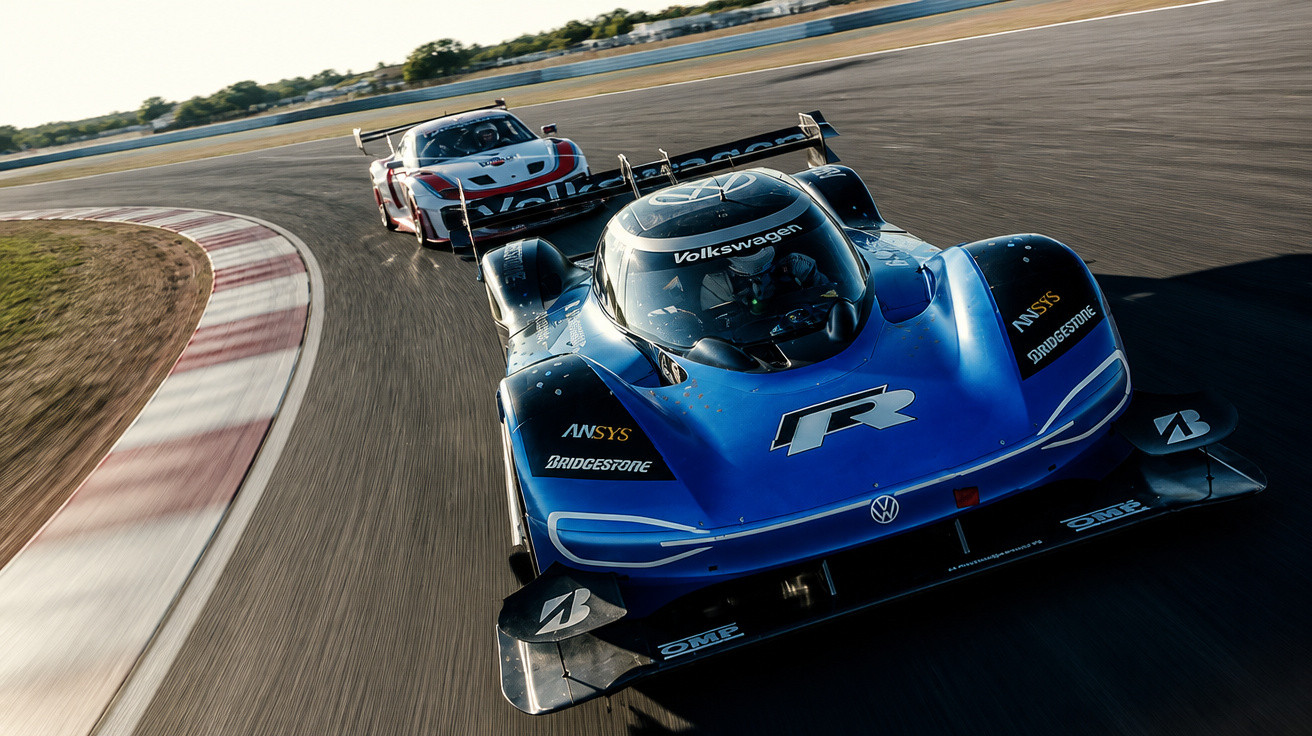
Unlimited motorsport, reborn in the Volkswagen ID.R
Ever since the Can-Am series fizzled out in the mid-Seventies, the notion of truly unlimited motorsport has felt like a tantalising dead end.
Volkswagen’s answer-built to sell a new technology often accused of being neither quick nor thrilling-was the ID.R. It’s the most deranged electric car ever created, Rimac included, because it can shuffle a driver’s internal organs in a way you usually associate with a Formula One car.
Words: Chris Harris // Photography: Richard Pardon
VW ID.R: the acceleration that resets your senses
In a straight line-at least from zero to 125mph (201km/h)-this electric VW could well outrun a contemporary F1 car. From a standstill to 125mph (201km/h) takes under five seconds. By the time your brain has processed the brutality of this 4WD-aided assault and issued a forceful instruction to your voice box that some sort of verbal eruption is warranted, you’ve already smacked into the 150mph (241km/h) limiter. You haven’t even managed to say the ‘K’. It’s the hardest-accelerating car I’ve ever driven.
(Image placeholder)
It’s also the one that most successfully intimidates. Access is via a hatch in the roof, then you wriggle down into the carbon tub. Just inches from your right arm are cables and connectors that look thick enough for a power station, plastered with warning stickers depicting what appear to be people being electrocuted. The cockpit and steering wheel are scattered with buttons and toggles, most of which aren’t really for the occasional pilot like me.
Start-up begins with energising the low-voltage system, followed by a pause while the high-power circuit primes, backed by the whoosh of cooling fans-then you press a button marked ‘drive’. There’s a single gear and just two pedals.
Brakes, downforce and Portimão: where the ID.R turns unreal
The wildest part is that the ID.R’s headline-grabbing quality isn’t simply the shock speed from 670bhp and 1,100kg. No-the cornering and braking are best described as bonkers. The brake pedal is eerily communicative: you can genuinely feel the pads biting into the carbon-ceramic discs. And the grip-slick tyres combined with levels of downforce you rarely encounter-was more than my neck could tolerate for more than two laps of Portimão.
Luckily, the ID.R will only manage three flat-out laps on one charge, which spared me the humiliation of squeezing back up through the roof and inventing an excuse about a dodgy back.
Combustion power has no real comeback for the pairing of instant EV torque with 4WD. The performance is ferocious: even on a circuit you know, the straights are reduced to brief, violent bursts, and you find yourself annoyed at braking too soon-even though you’re stamping on the middle pedal 50 metres later than you’ve ever dared.
(Image placeholder)
High-speed corners feel like they’ve been imported from a different universe. Volkswagen says it’ll pull over 4g (and more under braking) and, as with any machine capable of that, you’re left astonished that grip actually increases as the speed climbs.
There’s a huge, undulating left-hander at Portimão where a McLaren P1 was only just flat at 120mph (193km/h). The ID.R went through 25mph (40km/h) quicker. Because the car was designed to break the Pikes Peak record-where outright speed isn’t especially high-drag wasn’t a pressing concern. So rather than relying on clever underfloor ground effect, Volkswagen simply bolted on enormous wings that start pressing the car into the tarmac at far lower speeds.
(Image placeholder)
Noise, records, and what an “unlimited” EV tells us
The soundtrack surprised me as well: a wheezing, tearing noise that fits the ID.R’s single-minded habit of turning up at places like Pikes Peak and the Nürburgring to break records.
So what does an unlimited EV project like this say about where motoring is heading? It says electric cars will be fast-far faster than the fun-sponges who see this technology as the death of performance cars would ever want to accept. It also underlines that range will remain a serious constraint for a while yet. Still, you have to respect Volkswagen for building something this extreme.
Porsche 935: the retro racer that suddenly looks almost sensible
Next to anything other than the ID.R, Porsche’s 935 would come across as ludicrously overdressed. Here, though, it ends up looking merely punchy.
The craftsmanship is outstanding. Too often, manufacturers rummage through the back catalogue for profit and end up trampling on the legacy of an old hero. Yet it’s hard to see how you could rebody a GT2 RS to pay tribute to Porsche’s Seventies racing icon, the 935, and do it better than this. I was sniffy when it first appeared, but in the metal it’s glorious-details such as the strip of LED brake lights set into the trailing uprights of the rear spoiler make you grin at the sheer obsession poured into the thing.
On track, does it feel like a GT2 RS on slicks? Of course it does. You notice the traction benefit immediately, and the gearbox has been sharpened up-so much so that the shifts are genuinely indistinguishable from a proper pneumatic race transmission. And the engine note is pure Porsche, only turned up a few notches because the 935 never needs to meet road-legal noise rules.
(Image placeholder)
That Knight Rider-style steering wheel is a touch gimmicky, but the rest of the cockpit is-if you’re wired like me-a nerd’s paradise of Porsche motorsport data readouts and repurposed GT road-car switches. The fit and finish are properly high-end. The seat is a full-on Carrera Cup race item, yet it still slides on runners for practicality, and the wheel keeps the full adjustment range you get in the road car.
Do those wings create meaningful downforce you can actually feel? Not particularly. If you want a track Porsche 911 that really starts bending your face above 100mph (161km/h), Manthey’s GT2 RS MR is the smarter choice-although my judgement may have been slightly distorted by the neck-pummelling the ID.R had just delivered.
Power won’t disappoint anyone, and the handling errs on the side of safe understeer-until it doesn’t, because 553lb ft of torque can change the attitude whenever it fancies. The GT2 RS’s huge carbon-ceramic brakes are easily up to stopping the 935, and Porsche remains the benchmark for giving non-steel brakes impeccable pedal feel.
For me, the 935 is the backwards-looking Porsche that corrects the sin of naming the four-cylinder Boxster the 718. Whoever signed that off ought to be barred from Zuffenhausen for a few years. But that’s a different tale.
Specifications
VW ID.R
Price: £God knows
Engine: electric motors, 670bhp, 479lb ft, AWD
Performance: 0–62mph in 2.25secs, 150mph
Weight: 1100kg
Power to weight: 609bhp/tonne
PORSCHE 935
Price: £750,000
Engine: 3.8TT, flat-six, 700bhp, 553lb ft, RWD
Performance: 0–62mph in 2.7secs, 211mph
Weight: 1380kg
Power to weight: 507bhp/tonne
Comments
No comments yet. Be the first to comment!
Leave a Comment