
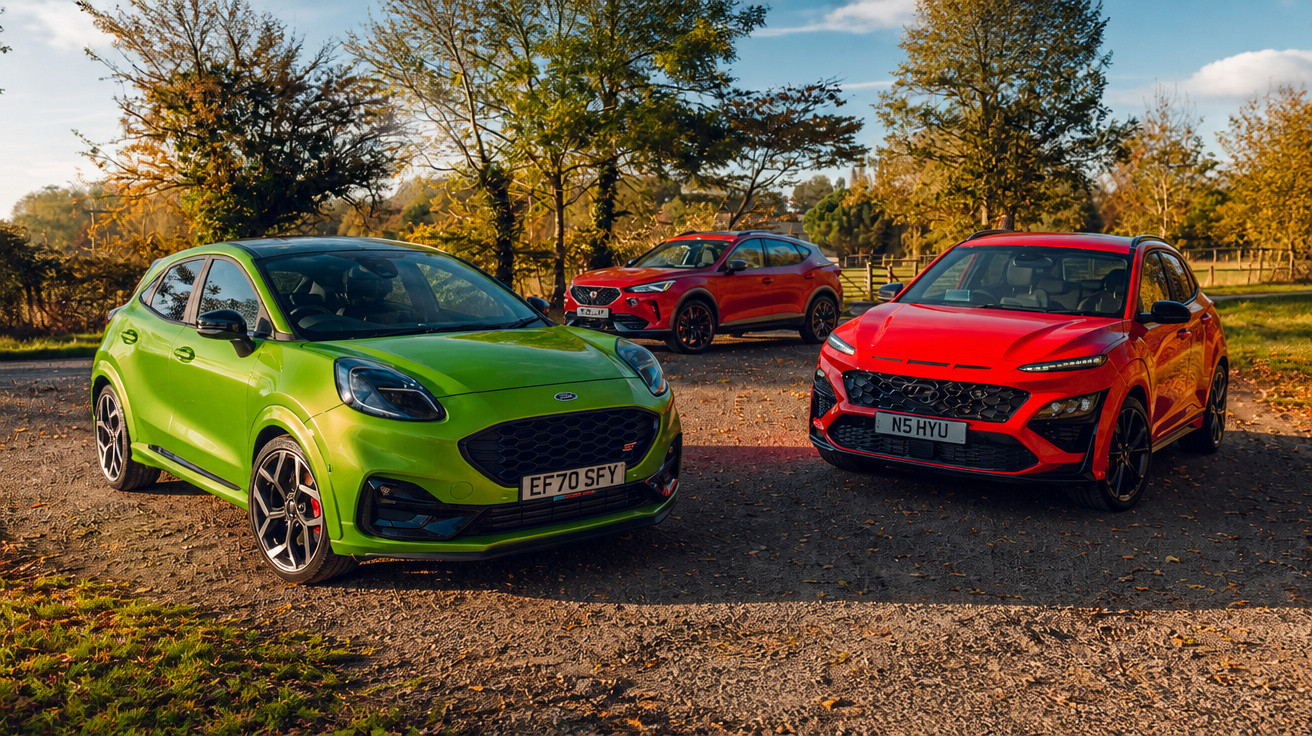
Why performance crossovers start on the back foot
If you stop to think about it, performance crossovers begin life carrying a whole list of built-in drawbacks. Lift the centre of gravity and they’re forever battling to stay composed: taller bodies need tighter control, and pitch and yaw show up sooner and with more force. Aerodynamics take a hit, fuel economy suffers, and they’ll never quite be as entertaining as something that wasn’t born out of compromise.
And yet they keep arriving. Audi has the SQ2, Volkswagen has the T-Roc R, and here are three more. So people clearly want them, even if the concept doesn’t make a great deal of sense.
Hyundai Kona N vs Ford Puma ST vs Cupra Formentor
Hyundai Kona N: a brilliant idea, executed like a dare
The Hyundai Kona N is the clearest example of something that shouldn’t really work. You’ll come to that conclusion after about 50m, because the ride quality - even in its softest setting - is ‘sporty’ in the way that edges into ‘grim’. Switch to ‘N’ mode and it starts picking out ridges and dips other cars glide over, bucking and tramlining as though someone has jammed wooden blocks into the springs and filled the dampers with concrete.
Lean on the throttle with anything more than gentle intent and the front axle starts hopping across imperfect tarmac, the steering wheel writhing as it loses an argument with the torque trying to get through the e-diff and a suddenly very overworked front end. Then the grip arrives, the 276bhp 2.0-litre four-cylinder borrowed from the i30N hatch builds boost, and the Kona slingshots itself down the road like… well, like an i30N, only with more ride height and a shorter wheelbase.
By most normal measures it’s a bit of a shambles: thirty-five-and-a-bit grand buys you a fully loaded small SUV that seems to believe it’s a gravel rally car. And still, it leaves an impression. Whether that’s a good impression is another matter.
Ford Puma ST: the one that behaves like a hot hatch
Drive the same stretch of road in the Ford Puma ST and it honestly feels like you’ve changed planets. Yes, you’re down by about 80 horsepower and you’re shifting your own gears with a manual, but the Ford’s suspension at least appears to have been designed with human spines in mind. It rounds off bumps the Kona thumps straight through.
The three-cylinder’s warbling soundtrack can feel a touch theatrical (some of it is piped in through the speakers), but it does the job as encouragement. The first impression is exactly what you’d hope for: it’s essentially a slightly taller Fiesta ST, right down to how it squirms under heavy braking and the lively whiff of lift-off oversteer if you attack a corner with enthusiasm. It’s also £5k cheaper than the Hyundai before options, yet it delivers similar everyday usefulness with a far more polished driving experience.
(Image gallery)
Cupra Formentor VZ2: the sensible control car
Then there’s the Formentor - the Cupra acting as our control sample, the almost-sensible alternative that restores a bit of normal logic. It has the most power, courtesy of a familiar VW 2.0-litre turbocharged four-cylinder, sent through a slick seven-speed paddleshift gearbox and front-biased all-wheel drive.
On the road it feels confident rather than riotous, keen without being frantic. It’s larger and it costs more, so the question is whether the smaller SUVs do enough to tempt you away from spending a little extra each month for a calmer, slicker, more traditional hot-hatch-style blueprint. And one that rides properly. Against the Kona N, this thing might as well have the ride comfort of a Phantom.
Practicality, kit and day-to-day usability
The Cupra is also the most usable. It has a big boot, and you can fit adults around 1.83m (6ft) in the rear without too much complaint. This VZ2 car is generously equipped: nappa leather electric seats, a leather-trimmed dashboard and a heated steering wheel, plus all the other bits you get on the lower trims, all of it feeling robustly assembled. It helps that it looks cracking in Desire Red (a premium metallic paint option), with the Cupra-specific two-tone finish managing to be both sharp and understated. The proportions are strong, and even with decent interior space it never comes across as unwieldy or over the top.
The Puma feels noticeably slimmer, though not particularly taller. Boot space is good, rear passenger room is merely okay, and the middle rear seat is really more of a perch for smaller people than somewhere you’d choose for a long trip. Equipment is clearly thinner than in the other two, although the ST does bring a good stereo, SYNC3 touchscreen infotainment and Recaro seats as standard.
There’s also a warranty-approved £675 Mountune upgrade that lifts output to 256bhp if you fancy it - and we would, mostly because even though the Puma gives away roughly 80bhp to the Kona N in standard form, the chassis feels like it could easily cope with more.
"Play with the various modes and you’ll find... a great deal of very tongue-in-cheek fun."
How they drive: finesse, force and fireworks
It’s no shock that the Puma carries the flavour of a tall Fiesta ST, but what’s impressive is how it still delivers that playful, slightly on-tip-toes attitude - especially under braking - that makes it such a laugh. It can feel like it’s about to swap ends like a 205 GTi, but in reality it’s simply rotating a touch; push beyond the sweet spot and it just tidies itself up and carries on. Of these three, it’s the one with genuine handling talent.
That isn’t to say the Kona N can’t go quickly through a corner - it absolutely can - but it does it with a wide-eyed, spit-flecked intensity you normally associate with a very cross dog. There are loads of modes, ranging from merely firm to genuinely eye-rattling, but there’s also a huge amount of deliberately cheeky fun that’s basically impossible to dislike.
Hit the N button for maximum attack and the previously calm digital dials “catch fire”, turning into a rev counter and a selection of oil-pressure and lap-time displays. Press the daft red NGS button (N Grin Shift) and the Kona grabs the lowest gear it can, then overboosts to 286bhp for 20 seconds.
The eight-speed paddleshift has three distinct shift strategies (and it’s excellent), there’s an eLSD, adaptive dampers and a properly juvenile boy-racer exhaust note. And there’s a frankly ridiculous amount of equipment for £35k - the Kona N effectively comes in one bauble-laden trim level, with fancy paint as the only real option.
Rear space, though, is dreadful. Unless they’re very small, anyone sitting back there (almost over the rear axle) will assume you’ve got something against them.
Which performance crossover is actually the one to have?
So: three cars, three very different personalities, three price points, and all filed under the fuzzy banner of ‘performance crossover’. But which is best?
As we’ve said, quick crossovers tend to exist in a no man’s land between what customers expect and what engineering can comfortably deliver. Buyers want speed and handling, but also height, comfort, practicality and strong mpg. Engineers respond with a weary look and try to persuade marketing to choose two.
In pure box-ticking terms, it’s the Cupra Formentor in 310 guise that covers the most ground. It’s quick, reassuring, handsome, and works as a genuine all-in-one for practicality and performance. It achieves that by being physically bigger and costing more, so there’s no real surprise there.
(Image gallery)
It’s also, by a small margin, less entertaining than the other two when you’re charging along a good road. Not by much - the Formentor is still enjoyable - but it feels like the adult in a room full of teenagers. It’s the one you’d choose if you could afford it and needed to live with it for three years, and the appealing lease deals seem to support that.
But this is Top Gear, and sensible isn’t automatically the path to victory; how much you want to drive the thing still counts for a lot.
On pure driving feel, the Ford Puma ST is the sweetest. It’s compact, has a cheerful, characterful engine, a manual gearbox (still a proper laugh), and a handling/ride balance that simply makes sense. The awkward bit is the niche it sits in: if you want a truly brilliant hot hatch, the Fiesta ST at £22k still serves up more outright silly grins, and if you want a practical small SUV, a non-ST Puma with a few options makes more financial sense. There’s also a new Focus ST on the way, coming in at just under £34k. You really have to want this size and shape to commit - though it’s worth noting the Puma is a decent chunk cheaper than either of the other two here.
"This is Top Gear, and sensible doesn’t necessarily get you the win..."
Which brings us to the Hyundai Kona N. And it’s absurd.
Here’s a car so fundamentally mismatched to its intended role that it arguably shouldn’t exist at all. The rear seats are tight, the boot is only modest, and the front axle is overwhelmed in almost any scenario. The original Honda NSX had 276bhp. So did the R32 Nissan GT-R. And the Mitsubishi Evo. A Kona shouldn’t.
It rides like it’s recently and terminally wounded its own suspension, and some of its settings will shake your eyeballs loose. It’s loud, it’s demanding, it’s physically tiring, and it can be a bit irritating. Some of it is cheesy, some of it is childish, and none of it is remotely apologetic - and that’s exactly where the charm lives.
The Hyundai Kona N probably won’t top many other magazines’ group tests. But it wins Top Gear’s, because sometimes dropping a huge engine into something that has no business carrying a huge engine is reason enough. The fact Hyundai seems to be chuckling behind its corporate hand only makes it more endearing. It’s a deeply flawed cartoon of a car that, somehow, against all logic, comes together. Objectively, it’s a bit rubbish. Subjectively, it just makes you laugh. And in a segment that doesn’t make sense in the first place, that’s plenty.
Photography: Mark Riccioni
Comments
No comments yet. Be the first to comment!
Leave a Comment