
Xpeng has, since entering Europe, followed a clear plan: sell only fully electric cars. That approach has now shifted.
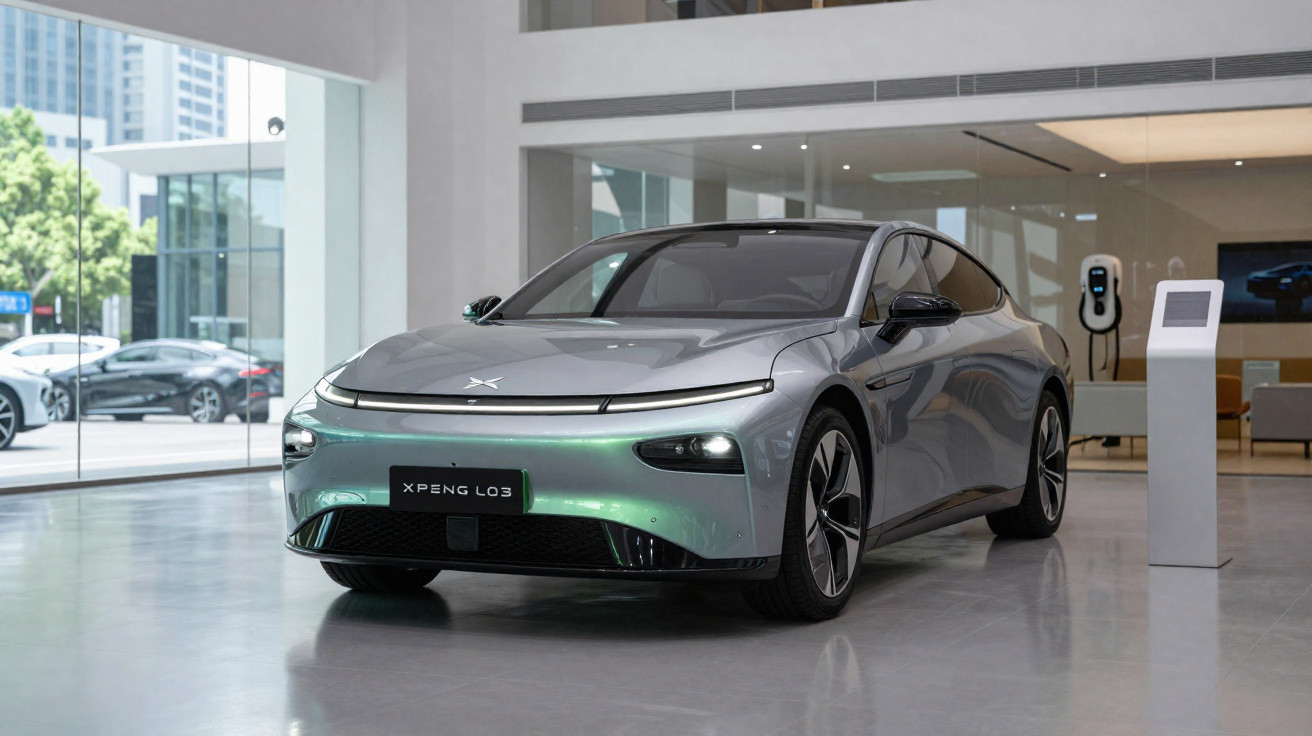
Unveiled in Munich at the Xpeng Global Brand Event-attended by Razão Automóvel-the new Xpeng L03 will be the brand’s first model offered in Europe featuring a petrol engine.
Before you panic: Xpeng is not switching to pure combustion models. Instead, the Chinese manufacturer is bringing its electric vehicles with a range extender (EREV) to Europe, led by the new L03 in PowerX form.
In practice, the wheels are still driven solely by an electric motor. The internal combustion engine operates only as a generator, recharging the battery and extending range.
The new entry point to Xpeng
In the European line-up, the Xpeng L03 sits below the G6 and is set to become the company’s most affordable model on the continent. It is just 11 cm shorter than the G6, yet it is intended to serve a notably different purpose.
While the G9 remains the range flagship and the G6 takes the role of “technological pioneer”, Xpeng itself positions the L03 as the car designed to democratise its technology. Put simply: it is the Xpeng aimed at reaching more buyers.
That positioning also places it alongside models-named by the brand itself-such as the Volkswagen ID.4, Skoda Elroq and BYD Atto 3. Even so, its lower, more arched profile is meant to look less conventional and closer to an “SUV-coupé”.
The styling was created under the leadership of JuanMa López, formerly responsible for Ferrari exterior design. Key details include pronounced wheel arches, frameless doors, semi-flush door handles, and a new rear light signature integrated into a full-width mask across the body.
Up front, each headlamp uses more than 400 LEDs, and the cameras are built into the mirror mounts. An active grille and multiple air channels also help the L03 achieve a drag coefficient (Cx) of 0.228-an excellent figure for this type of vehicle.
Space and technology have not been overlooked
Despite the falling roofline, Xpeng says the cabin remains spacious. The boot provides 367 litres (VDA) of capacity, expanding to 1131 litres with the rear seats folded. For the first time in an Xpeng, the rear bench splits 40:20:40-see the full gallery below:
Inside, buyers can choose between light grey and dark grey themes, following the brand’s familiar minimalist formula. The centrepiece is a 15.6” display with 2.5K resolution, paired with an 8.8” instrument cluster and a head-up display with a projection equivalent to 26.8”.
The XOS 6 operating system brings native Google Maps integration, voice commands and over-the-air updates. The front seats can be specified with heating, ventilation and massage functions-equipment that is uncommon at this price level.
On Ultra versions, the Xpeng L03 gets three in-house developed Turing processors, delivering a combined 2250 TOPS. These underpin the VLA 2.0 driver-assistance system, although the availability of certain functions still depends on each market’s legislation.
Choose between electric and more than 1000 km of range
The fully electric Xpeng L03 line-up will use LFP batteries of 58.3 kWh or 71.2 kWh, with WLTP ranges spanning 440 km to 520 km.
Rear-wheel-drive versions produce 180 kW (245 hp), while the AWD Performance model reaches 285 kW (387 hp) and completes 0–100 km/h in 4.5s.
Despite using a 400 V architecture, DC rapid charging reaches 193 kW with the smaller battery and 236 kW with the larger one. Under ideal conditions, charging from 10% to 80% takes around 20 minutes.
The headline addition, however, is the L03 PowerX. This variant pairs a 37.25 kWh LFP battery with a 1.5-litre, four-cylinder petrol engine, supplied by a 42-litre fuel tank.
The petrol engine does not drive the wheels. Its sole job is generating electricity, while propulsion comes from a rear electric motor delivering 180 kW (245 hp) and 280 Nm.
Xpeng claims 215 km of electric range and more than 1000 km of combined range. Once the battery is depleted, the stated consumption is 5.5 l/100 km. The PowerX accelerates from 0–100 km/h in 6.8s and tops out at 180 km/h.
When does it arrive?
The Xpeng L03 PowerX is expected to reach Europe during 2026, becoming the brand’s first range-extender model sold on the continent. The fully electric versions will follow later, likely still before the end of the year.
Final pricing has not yet been confirmed, but Xpeng is indicating a figure well below €40,000 for the purely electric L03, with the PowerX version expected to start slightly above that threshold.



Comments
No comments yet. Be the first to comment!
Leave a Comment