
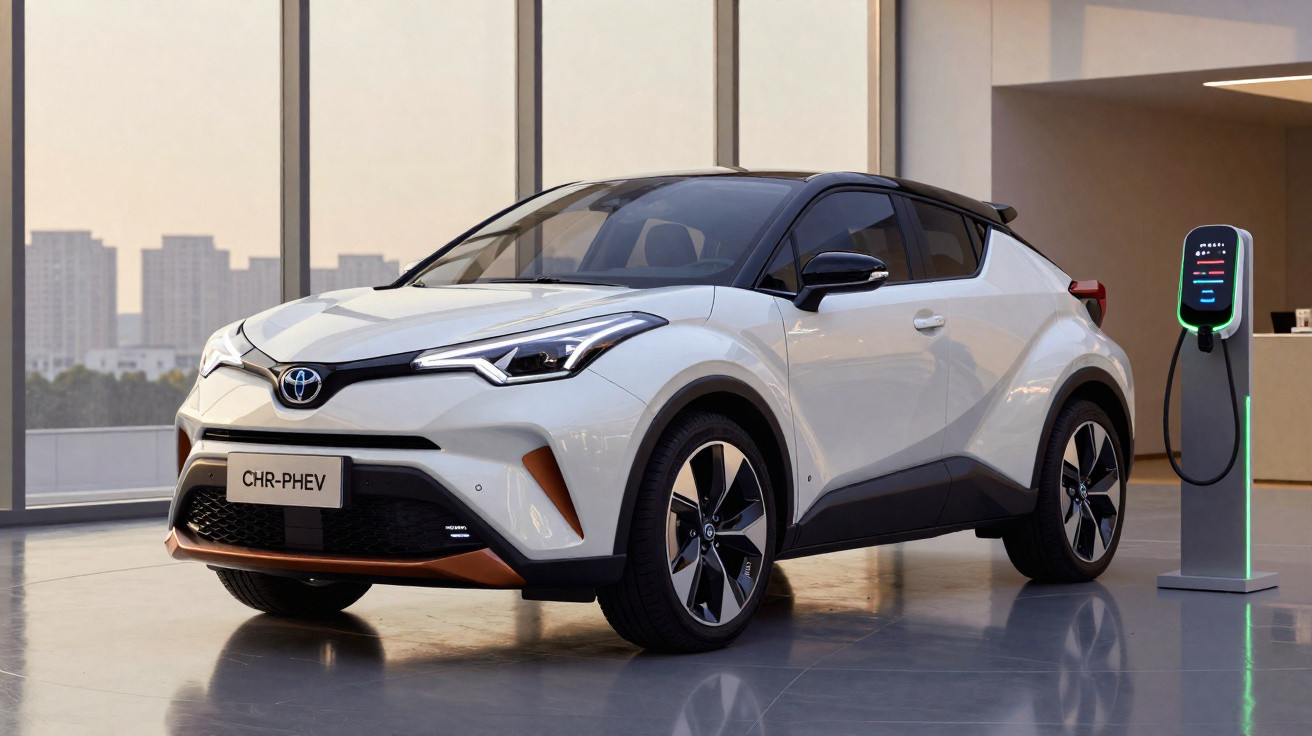
Low consumption and high efficiency, but the price could “push” the new Toyota C-HR PHEV towards company buyers and away from private customers. Or maybe not?
After the hybrid (full-hybrid) version arrived in Portugal in November 2023, Toyota is now rolling out the C-HR in plug-in hybrid (PHEV) form - one that can be charged from the mains.
Built around the same plug-in hybrid set-up we already know from the new Toyota Prius, the C-HR PHEV delivers genuine all-electric range, while also bringing extra power and stronger performance.
But is that enough to justify the price gap between the new C-HR PHEV and the C-HR hybrid with 140 hp we already knew? We drove it in Marseille, in the south of France, to find out:
From the outside, if it weren’t for the “PHEV” badge on the tailgate and the additional charging flap, it would be almost impossible to tell this plug-in version apart from the conventional hybrid C-HR.
That is hardly a criticism, because the exterior design remains one of the strongest selling points of the latest C-HR - which is currently one of Toyota’s most important models in the European market.
Boot capacity has dropped
If the exterior is essentially unchanged versus the hybrid we already know, the cabin follows the same pattern. Aside from a few extra physical controls on the centre console and some PHEV-specific menus within the driver display, everything is broadly the same.
And that is good news. When I first drove the new-generation C-HR, I said - and wrote - that, for me, it had Toyota’s best interior at the moment. A few months on, I can only underline that view.
There are soft-touch materials across the top of the dashboard, solid finishing, and precise assembly - exactly the level of execution we have come to expect from the Japanese brand.
On top of that, this C-HR includes touches we normally associate with more premium-leaning cars, starting with the huge panoramic roof with thermal treatment.
What about space?
Even with a larger battery than the standard hybrid, rear-seat space is not reduced, and it will comfortably accommodate people up to 1.85 m.
Even so, the rear seats still feel a little snug, although they remain perfectly adequate for everyday use.
The boot is where this plug-in hybrid variant takes a hit - not because of the battery (which is “stowed” beneath the cabin floor), but because of where the onboard chargers are positioned, as one of them sits under the boot floor.
As a result, luggage capacity in the PHEV is limited to 311 litres, compared with 388 litres in the 140 hp hybrid.
This quirk widens the gap between the C-HR and the Corolla Cross even further. The former is increasingly aimed at buyers who want something more sophisticated and more engaging to drive, while the latter is ever more the archetypal family car: roomy and versatile.
The most powerful in the line-up
As mentioned earlier, the C-HR PHEV uses the same plug-in hybrid system as the new Toyota Prius, combining a petrol engine (four-cylinder, naturally aspirated, 2.0 l) with an electric motor mounted at the front.
The petrol unit produces 152 hp and 190 Nm of maximum torque. The electric motor delivers 120 kW (163 hp) and 208 Nm. Together, the system offers 223 hp of maximum combined power and 208 Nm of maximum torque, sent exclusively to the front wheels.
With these figures, this C-HR is the quickest and most powerful of the range, capable of sprinting from 0 to 100 km/h in 7.4s and reaching a (limited) top speed of 180 km/h.
On the road, those numbers are easy to feel: it doesn’t take many kilometres to realise it has noticeably more shove than the 140 hp hybrid we drove a few months ago in Ibiza.
Even so, the overall character is familiar, because the power delivery remains very progressive and smooth, and the transitions between electric drive and the petrol engine are extremely well managed.
Since we’re talking about calibration, Toyota’s engineers also deserve credit for the brake-pedal tuning and the way the gearbox’s B mode operates - it is consistently very pleasant.
Up to 66 km of electric range
Equally striking is the drivetrain’s efficiency, starting with electricity use: during this first drive, I was repeatedly seeing around 10 kWh/100 km.
At that pace, it would even be possible to beat (by a large margin) Toyota’s claimed 66 km electric range, given the 13.8 kWh battery.
Naturally, that also has a very positive effect on petrol consumption which, over this initial test - around 150 km covered - sat at roughly 2.3 l/100 km.
For me, this is the C-HR’s biggest argument: it is a true consumption champion. It not only allows you to cover several dozen kilometres in electric mode, but it also returns very low fuel use once the battery charge is depleted.
Firmer suspension
From behind the wheel, it is also obvious that the C-HR PHEV’s suspension is set up more firmly than the 140 hp hybrid. That is not particularly surprising, given there is a 215 kg difference between the two versions.
Even so, the suspension does a good job of smoothing out rough road surfaces, while also helping the C-HR retain a very capable dynamic balance.
A version aimed at company-car customers
The entry point is the Business trim, although the C-HR PHEV can also be ordered as Square Collection, Lounge and GR Sport Premiere Edition.
Aimed at the company-car market - though also available to private customers - the Business version stands out by including 18″ alloy wheels, a 12.3″ digital instrument cluster, an 8″ multimedia screen, heated front seats and steering wheel, dual-zone automatic climate control, a reversing camera, parking sensors and intelligent adaptive cruise control.
Sitting at the top of the Toyota C-HR PHEV range is the GR Sport Premiere Edition, which adds sports seats in leather and Alcantara, 20″ wheels, a head-up display system, a JBL sound system with nine speakers, and the Night Sky Plus roof.
And the prices?
The new C-HR PHEV is available from 46 020 euros (incl. VAT) for the Business version. However, Toyota expects the Square Collection - priced from 47 890 euros - to account for the largest share of sales.
Compared with the 140 hp C-HR HEV, the difference in entry-level pricing is around nine thousand euros. For private buyers, the hybrid may still be the most suitable option - especially as its consumption is also very appealing.
For anyone doing short city journeys and able to charge daily at home or at work, the plug-in hybrid could prove the more compelling choice, despite the extra outlay.
For businesses, however, there is little doubt: the C-HR PHEV is the most valuable proposition, particularly once you factor in the tax benefits these models still qualify for.




Comments
No comments yet. Be the first to comment!
Leave a Comment