
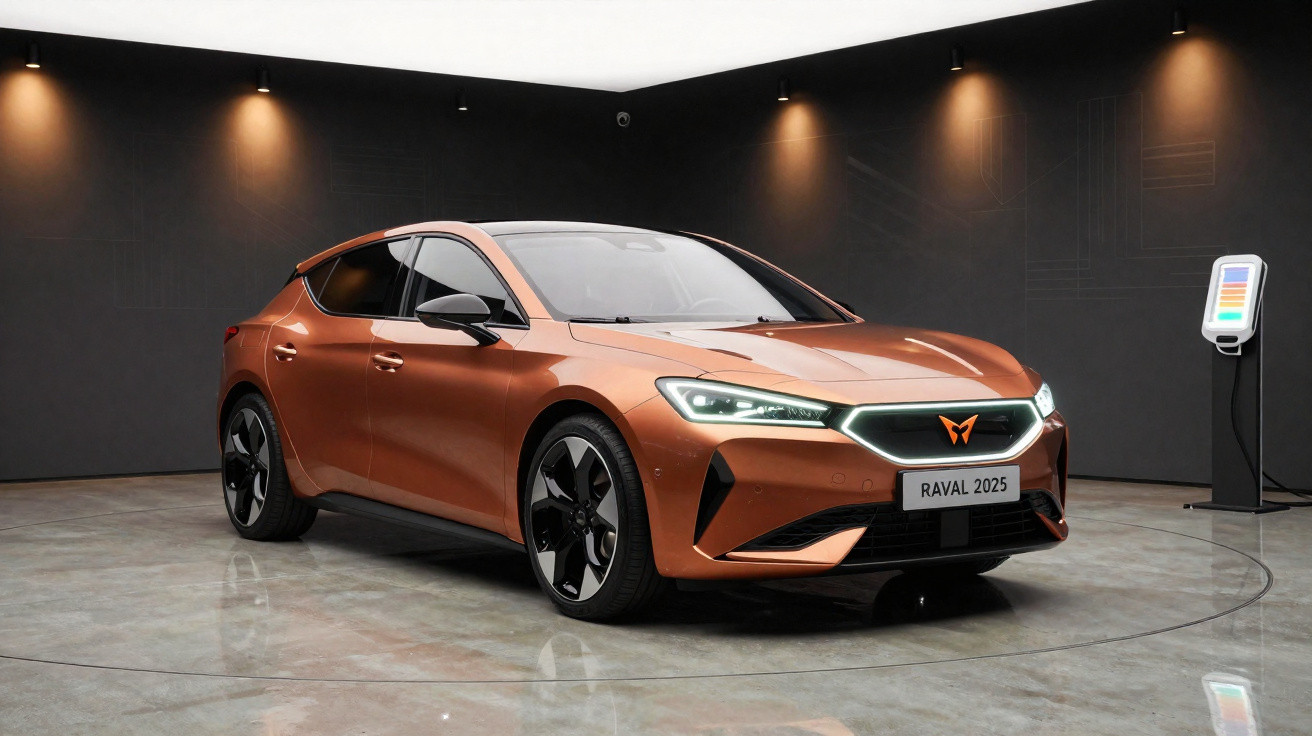
CUPRA is currently enjoying a genuine purple patch. After a landmark 2025 in which it set new sales records - driven by the Formentor and the Tavascan - the brand is now gearing up to take on the segment that could shape what comes next: affordable electric cars.
The spearhead of that push already has a name: Raval. After years of build-up (first teased as the Urban Rebel concept), CUPRA’s most budget-friendly model is finally close - and we’ve already driven it in "ultra-secret" conditions.
The public reveal is still a few weeks away, yet we’ve already spent time behind the wheel of a fully camouflaged pre-production car - and the early signs were very promising. Take a look:
CUPRA DNA
Even with heavy camouflage masking the final production surfacing, the Raval’s stance is unmistakable. It’s short (4,03 metres), broad, and carries an assertive posture that immediately separates it from the more restrained Volkswagen Group models that sit on the same underpinnings.
With the Born, it often felt as though CUPRA’s designers had to accept certain compromises - the end result being something like a Volkswagen ID.3 wearing a smarter "outfit". Here, though, the team appears to have had the creative space to express the brand’s DNA in full.
That deserves applause - especially because this will be the first model in a fresh wave of small urban EVs from the Volkswagen Group, all developed by CUPRA and SEAT in Martorell, Barcelona (Spain).
This new "batch" also includes cars such as the Volkswagen ID.Polo (which Diogo has already driven), the Skoda Epiq (see the first video look), and the Volkswagen ID.Cross. We’ve only seen them in camouflage so far, but it’s easy to predict the Raval will be the most aggressive-looking of the lot.
Its sharply defined creases, the slashed lighting signature, and the lower ride height (15mm less than the ID.Polo) give it a stronger presence and a more "rebellious" attitude - a neat match for the values of the young Spanish brand, for whom this model should be a significant addition to the range.
The interior stays "hidden"
Inside, I saw little to nothing. CUPRA deliberately covered everything that wasn’t essential for driving: the steering wheel, the instrument display, and the driver’s seat. Everything else was concealed beneath black fabric.
Even so, it’s already clear that the Volkswagen Group has done its homework and finally moved on from the tiny 5” infotainment screen used in the first generation of the group’s EVs - a display that was notoriously hard to read.
In its place is a set of instruments with completely new graphics that are far easier and more pleasant to glance at. It may sound minor, but it noticeably improves the driving experience - helped along by a strong driving position.
Of course, the car I drove was the VZ, the most powerful and sporty version in the line-up, which means you’re treated to sportier seats with excellent lateral support. I won’t pretend that doesn’t make a difference, particularly if you enjoy a more dynamic style of driving.
One thing that did stand out during this first encounter was the limited rearward visibility. It’s true that this is a compact model, and that never helps, but in this area CUPRA could (and should) have done better.
Platform debut
The Raval will have the honour (or the responsibility, depending on your view) of launching the latest evolution of the MEB architecture, called MEB Plus.
Among the headline changes are front-wheel drive (previously it was rear-wheel drive) and a semi-rigid rear axle. CUPRA pairs this with its familiar chassis control system, adding welcome versatility to the package.
In this respect, I think the Raval may suit a broader range of scenarios than, for example, "rivals" such as the Alpine A290 or Abarth 600e. It stayed composed at higher speeds on mountain roads, yet remained comfortable at lower, city-friendly pace.
It feels very settled on the road, the brake pedal calibration is well judged, and the progressive steering delivers an interesting feeling of what’s happening at the front axle. That is exactly what you want to see (or feel!) in a model with sporting DNA - whether it’s electric or combustion-powered.
Two versions to choose from
For now, the Spanish brand has confirmed only two variants: one with 115 kW (211 cv) and another with 166 kW (226 cv). The latter is the VZ - the very version I drove during this trip to Barcelona.
As for the battery, CUPRA still hasn’t published specifications. However, a quick look at the Volkswagen ID.Polo technical sheet suggests the NMC battery will have 52 kWh of capacity, delivering up to 450 kilometres of range in the less powerful version.
Are we stopping here?
Probably not. If we keep using the ID.Polo "sibling" as a reference, we find a second battery option - LFP, with 37 kWh - which is paired with less ambitious outputs of 85 kW (116 cv) and 99 kW (135 cv).
I suspect CUPRA could announce something similar for the Raval sooner or later, particularly because it is targeting a notably ambitious entry price for its small EV: from 26 000 euros.
Whether that happens is something only time can confirm or disprove. What I can say at this stage is that the Raval looks set to become the best electric car in the Volkswagen Group - or at least one of the best.
It’s true that we’ll only be able to drive it without camouflage, and for longer, in a few months’ time - but the first indications could hardly have been more positive.
Comments
No comments yet. Be the first to comment!
Leave a Comment