
- Add Zona Militar to Google: Why add us? Get the latest from Zona Militar in your Google feed.
- Join the WhatsApp channel: Join our official WhatsApp channel and receive the news instantly.
Following major progress on the engine being developed for the future sixth-generation fighter under the Global Combat Air Programme (GCAP), the United Kingdom, Japan and Italy have completed a further round of design reviews that moves the programme closer to building, and then ground-testing, a technology demonstrator. The milestone is a key step towards confirming the architecture of the powerplant that will propel the aircraft.
👉 Read also: Russia’s Armed Forces could be reinforced with 30,000 soldiers and new ballistic missiles supplied by North Korea
GCAP propulsion system: design reviews and component testing
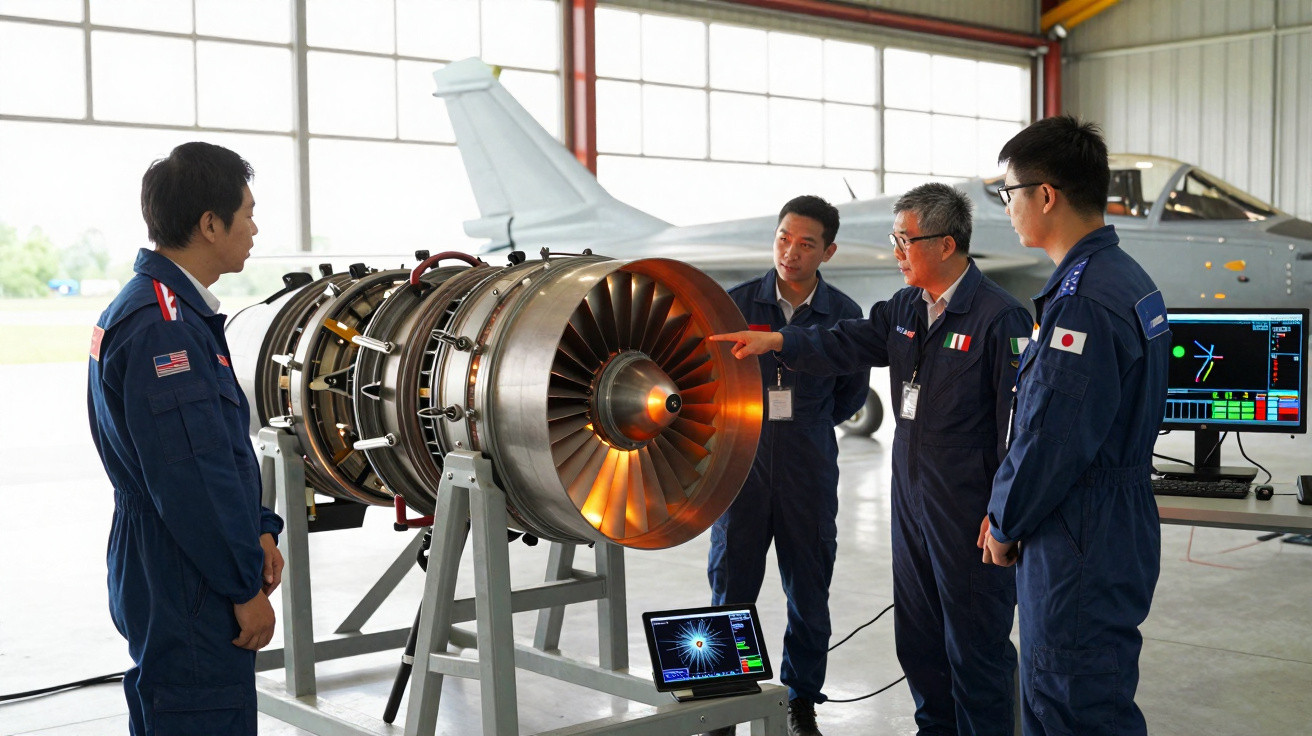
Work is being led by a consortium made up of Rolls-Royce (United Kingdom), IHI Corporation (Japan) and Avio Aero (Italy), which is responsible for developing the GCAP power and propulsion system. Having cleared the latest technical reviews, the effort is now moving towards final approval of the demonstrator engine’s design, while production of its parts continues.
So far, more than 100 tests have been completed on reduced-scale components. The results will underpin future ground trials and provide critical data for developing the final, operational powerplant.
The engine demonstrator and the Reading collaboration centre
The demonstrator is central to lowering technological risk before an operational engine enters production. Beyond proving new engineering solutions and how the different sub-systems fit together, it will help refine tools, manufacturing processes and ways of working, with the aim of shortening design and development timelines for the future powerplant.
In parallel, over the past year the consortium opened a collaboration centre in Reading, United Kingdom. Specialists from all three companies work there alongside representatives from the GCAP Agency and Edgewing, strengthening international coordination across the project.
You might be interested
- The United Kingdom accelerates development of technologies for its future sixth-generation fighter with an investment of nearly £1 billion
- The Spanish Navy’s Centinela patrol vessel carries out a surveillance operation in the Alboran Sea
“Flying power station”: energy and thermal demands beyond thrust
A standout feature of the new propulsion system is expected to be its ability to go well beyond simply generating the thrust required to drive the fighter.
As Phil Townley, Rolls-Royce Director of Future Defence Programmes, explained, the engine has been conceived as a true “flying power station”, able to handle the high electrical and thermal loads that next-generation sensors, electronic warfare systems and future high-power weapons will impose on the aircraft. This capability will be decisive in sustaining the performance targets expected of a sixth-generation platform.
Industrial cooperation and long-term strategic value
The participating companies also emphasised the strategic importance of industrial cooperation. Edoardo Curti, who leads Avio Aero’s Defence unit, said the progress achieved marks a significant milestone in strengthening a long-term partnership between the three manufacturers.
Noriyuki Nakamura, a technical advisor at IHI Corporation, noted that the programme will bring together Japanese aero-engine technologies with the experience of its European partners to develop the “heart” of the next generation of combat aircraft. He added that it will also support the training of specialist talent and the growth of new industrial capabilities.
Edgewing contract, 18-month design push and the 2035 target
These developments come just weeks after the governments of the United Kingdom, Italy and Japan awarded Edgewing a second international contract worth £4.6 billion to continue work on the future sixth-generation fighter.
That agreement will enable progress over the next 18 months on the aircraft’s detailed design, while multiple industrial consortia continue to develop critical components, including the propulsion system.
With the goal of bringing the new aircraft into service around 2035, GCAP is pursuing parallel development of the platform, sensors, communications and the engine-required to deliver both thrust power and the electrical generation capacity demanded by future combat systems.
Images used for illustrative purposes.





Comments
No comments yet. Be the first to comment!
Leave a Comment