
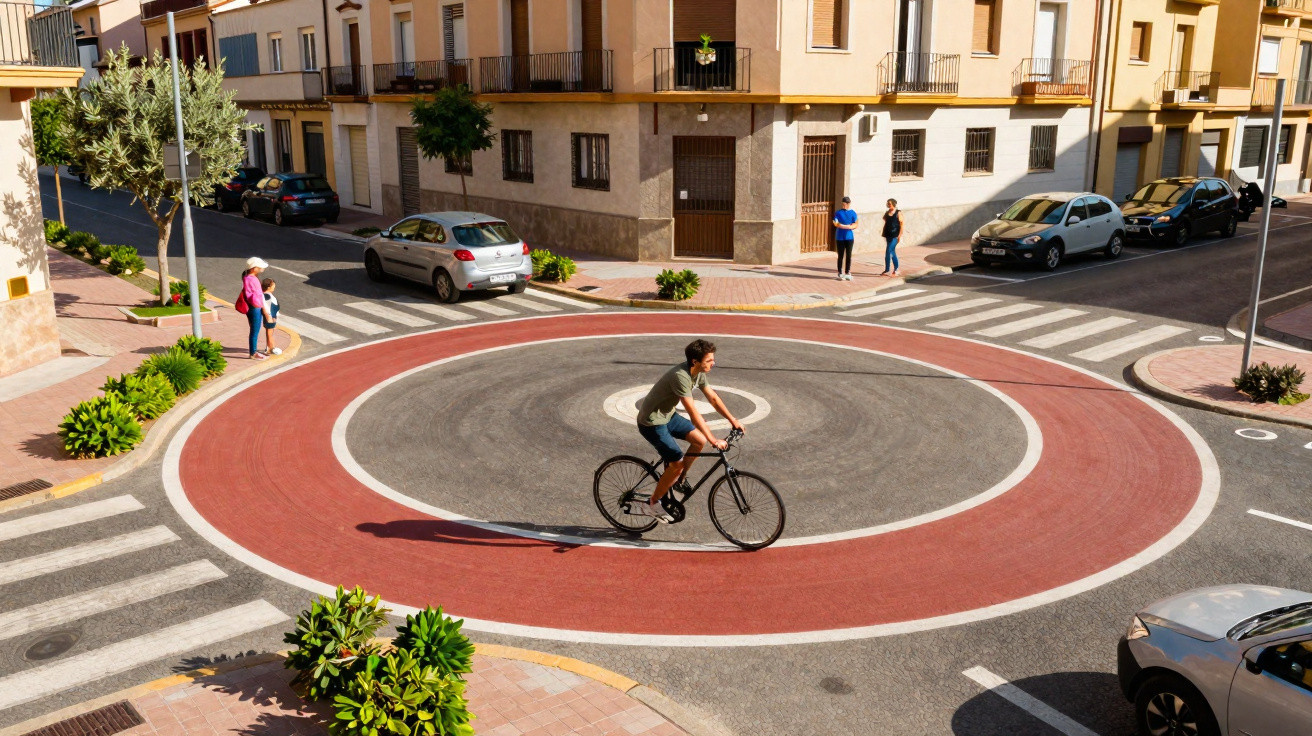
An inspiring piece of innovation is now being taken up by a number of local councils.
Cycling has surged in France over the past few years. Unfortunately, that rise has gone hand in hand with a significant number of crashes and genuine road-safety challenges for cyclists. One potential step towards reducing the risk is the introduction of the “Dutch-style” roundabout. In a recent piece, Le Journal du Geek looked back at this layout, which has already been trialled in several towns.
How the “Dutch-style” roundabout works for cyclists
In practical terms, the right-of-way rules are different: cyclists benefit from a priority cycle lane around the roundabout, meaning they are given priority both when entering and when leaving it. The design also aims to keep traffic streams apart, separating motor vehicles from cyclists and pedestrians.
As our colleagues point out, the circular cycle track is positioned outside the carriageway reserved for cars, and cycling movement is often two-way. On approach, drivers must give way to any cyclists and pedestrians they encounter, and the same obligation applies when exiting the roundabout.
Subscribe to Presse-citron
Trials in France highlighted by Le Journal du Geek
Le Journal du Geek rightly mentions several examples of “Dutch-style” roundabout trials, including sites in Rennes, Clermont-Ferrand and Bures-sur-Yvette. These places are frequently held up as benchmarks for cycling infrastructure.
The Spanish example
As a reminder, authorities regularly try out new ideas to make roads safer. We recently mentioned an experiment in Spain where fluorescent road markings are being used to replace traditional white lines.
Standard white lines are already designed to reflect headlights thanks to microbeads mixed into the paint. Even so, this approach has limits-particularly at night, on poorly lit roads, and in wet weather.
With the Spanish system, the paint includes pigments that absorb light energy during the day and release it after dark. Put simply, these markings remain visible in darkness, even without headlights.
Early trials carried out across the border are intended to assess real-world visibility over longer distances and in the rain, as well as how well the surface stands up to mechanical wear. In any case, the cost of such a programme would quickly become a key question, so any rollout would need to justify itself with meaningful safety benefits. More information on this can be found in our previous article here.
What do you think of these road infrastructure ideas? Feel free to share your view (calmly) in the comments.



Comments
No comments yet. Be the first to comment!
Leave a Comment