
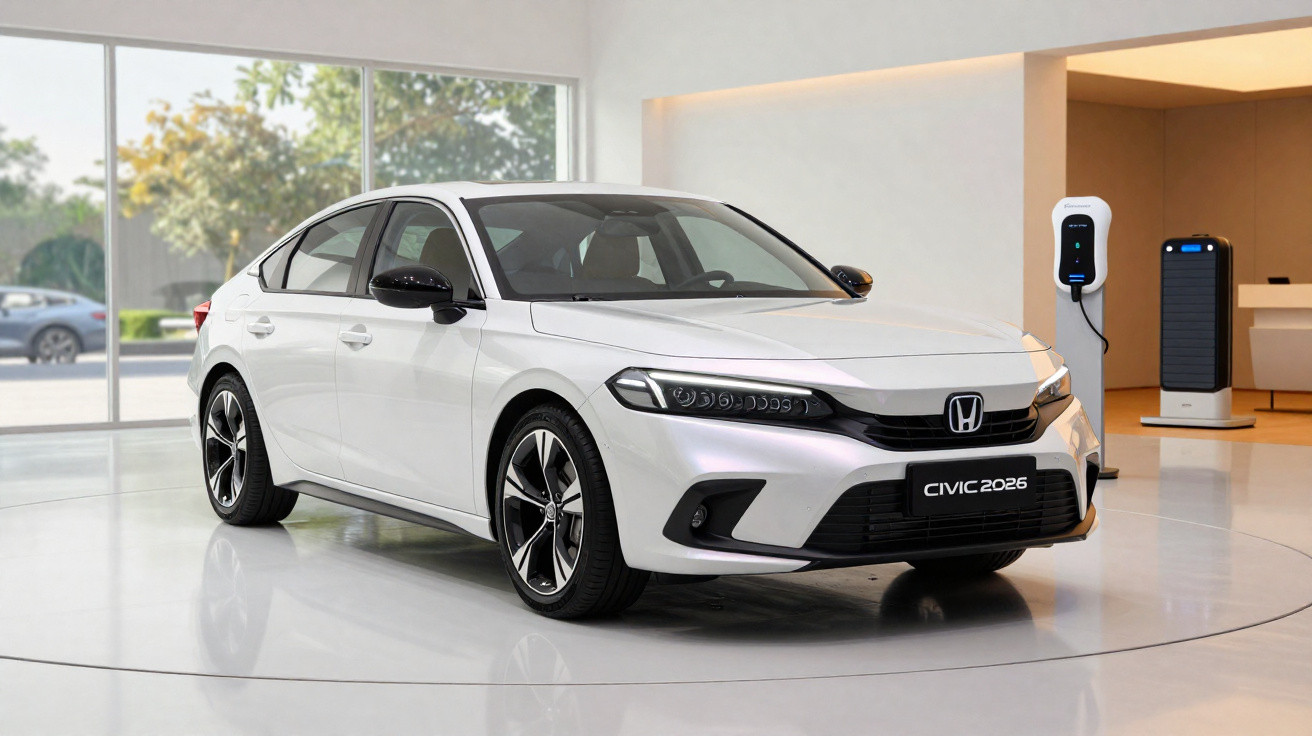
The Japanese marque is quietly preparing a new Civic that’s intended to be lighter, cleaner and more rewarding to drive, yet still easy to live with day to day. Underpinning that ambition is an all-new modular architecture created from the outset for electrified drivetrains - and Honda believes it can remove 90 kg, improve real-world shove and cut fuel consumption all at once.
A new platform built around electrified power
After a long run of steady revisions, Honda is essentially hitting reset with the twelfth-generation Civic, expected in 2026. The headline change is largely out of sight: a new platform designed to accommodate hybrid, plug-in hybrid and, later on, fully electric versions.
Rather than reworking an older petrol-first base, the structure has been re-engineered so the battery pack sits centrally in the floor, the track is wider and suspension pick-up points are cleaner and more optimised. Those fundamentals can alter both the Civic’s cornering character and the amount of usable space in the cabin.
Honda targets about 90 kg of weight reduction on the new hybrid Civic versus today’s equivalent, without stripping equipment.
Known internally as the “Global Small Modular” base, the platform is meant to underpin multiple body styles for different regions. In practice that points to a five-door hatchback for Europe, likely a saloon for Asia and North America, and the possibility of a sportier offshoot later.
Weight loss without going bare-bones
Taking 90 kg out of a modern family hatch is a serious challenge when customers still want large displays, plenty of sound-deadening and comprehensive safety tech. Honda’s plan relies on improvements across several areas:
- Wider use of high-strength steel where it matters in the bodyshell
- Repackaged hybrid components, including smaller motors and inverters
- Simplified wiring looms and electronics to remove overlap
- Lighter seats with slimmer, but stronger, seat frames
Weight distribution is also being treated as a core handling tool. By making the centrally mounted battery pack contribute structurally, while reducing mass towards the front, engineers are aiming for a more even balance - which should mean crisper turn-in and steadier behaviour in sudden avoidance manoeuvres.
Hybrid powertrain: more frugal, more responsive
Honda’s current e:HEV set-up - a naturally aspirated 2.0-litre petrol engine working with an electric motor - is already known for strong real-world efficiency. For the 2026 Civic, the concept is expected to be developed rather than replaced.
The petrol unit is tipped to move to a higher compression ratio and lower internal friction. Alongside a more effective cooling system and updated control software, Honda is targeting sub‑4.5 l/100 km on the WLTP combined cycle - an ambitious figure for a family-sized hatch that doesn’t require plugging in.
The next Civic hybrid aims to use less fuel than many city cars, while offering motorway performance closer to a traditional 1.5‑litre turbo.
On the electric side, the primary traction motor is expected to become more compact yet deliver more assertive torque surges, helped by improved power electronics and a mildly uprated battery. The on-road benefit should be noticeable: smoother getaways at junctions and more confident overtaking, particularly from 40–80 km/h (25–50 mph).
Plug-in hybrid and full EV on the horizon
Honda is not yet signing off the full specification publicly, but the platform has been designed to support a plug-in hybrid Civic with a bigger battery and the ability to charge at home. Done properly, that version could manage 60–80 km of EV-only driving - enough to cover many daily journeys without using any fuel.
Looking further ahead, a battery-electric Civic remains a realistic prospect. That model would likely borrow technology from the Honda e:Ny1 SUV, but in a lower, more aerodynamic shape. The emphasis is expected to be on practical, usable range rather than headline-grabbing numbers, leaning on efficiency rather than simply adding a larger, heavier battery to keep cost and weight in check.
| Version | Powertrain | Main focus |
|---|---|---|
| Civic hybrid | 2.0 petrol + electric motor | Low consumption, everyday usability |
| Civic plug‑in hybrid | Petrol + larger battery, charging port | Electric commuting, long-range flexibility |
| Civic electric | Battery-only, no engine | Zero tailpipe emissions, city-friendly running |
Driving feel: keeping the Civic’s dynamic DNA
For long-standing Civic enthusiasts, the crucial question is what this efficiency-led approach means for handling. Honda is keen to underline that, beyond weight reduction, steering feel and body control remain central targets.
With the battery mounted low in the floor, the centre of gravity should sit lower than in an equivalent petrol-only model. Together with wider tracks, revised suspension geometry and stiffer mounting points, the Civic should roll less through corners and respond more quickly to small steering inputs.
The goal is a compact hybrid that still feels eager and precise on a twisty road, not just tidy in the official tests.
Engineers are also working on how the hybrid system reacts to changes in throttle. Many hybrids can feel detached, with the engine holding a steady drone while road speed builds more slowly than expected. Honda is aiming for closer harmony between engine revs, vehicle speed and the driver’s right foot, so the Civic behaves more like a conventional automatic - only with lower fuel costs.
Interior tech and space gains
Switching to the new platform also delivers packaging advantages. With the battery housed under the floor and hybrid hardware pulled tighter towards the engine bay, there’s scope for extra rear legroom and a more usefully shaped boot, even with the rear suspension altered to suit the wider track.
In the cabin, expect a fully digital instrument display, a bigger central touchscreen and more capable voice control. Over-the-air updates are planned too, enabling Honda to refine energy management, driver assistance systems and infotainment features without a visit to the dealer.
Even with the extra technology, Honda is expected to retain physical controls for high-use functions such as temperature and audio volume - a practical nod to drivers who don’t want to dig through touchscreen menus while driving.
Why 90 kg less changes the hybrid game
A 90 kg reduction in a compact hybrid may sound like an abstract engineering win, but it affects everyday driving in several ways. With less mass to shift, the electric motor doesn’t have to work as hard when pulling away, extending the situations where the engine can remain off in stop-start traffic or at lower speeds.
At a steady cruise, a lighter car needs less power to maintain around 113 km/h (70 mph), particularly on gentle gradients. That can reduce fuel use and allow the hybrid system to call on electric assistance more frequently, rather than firing the engine for every slight incline or routine overtake.
Tyres and brakes can gain too. Less weight generally means reduced tyre wear under heavy braking and smaller heat spikes in the brake discs, which may make it possible to use slightly smaller, lighter hardware without eroding safety margins.
Real-world scenarios for drivers
Picture a roughly 48 km (30‑mile) commute combining suburban traffic, a ring road and a short motorway section. In today’s Civic hybrid, the engine already switches on and off to keep the battery charged and progress smooth. With the new platform and the lighter body, the same trip should allow longer electric-only stretches in town and fewer moments where the engine needs to jump in abruptly on the ring road.
Over a full year, even a relatively small 0.5 l/100 km improvement could add up to several tanks’ worth of fuel saved. For company-car users dealing with tight CO2 limits, that reduction may also help the car qualify for a more favourable tax bracket in some markets.
Key hybrid terms worth unpacking
Honda’s messaging around the next Civic mixes several electrification terms that can easily get muddled. A handful of definitions clarifies what the 2026 model is actually offering.
A “full hybrid” such as the Civic e:HEV can travel short distances on electric power alone but does not plug in. Its battery is replenished mainly by the petrol engine and by recovering energy under braking. A “plug-in hybrid” adds a larger battery and a charging port, enabling meaningful EV-only range and home charging, albeit with extra weight and complexity.
Modular platforms - like Honda’s new Civic foundation - are effectively flexible vehicle ‘skeletons’. They allow manufacturers to build different variants around shared hard points for engines, batteries and suspension. The payoff is lower development cost and a faster route to niche versions, whether that’s a sportier hybrid derivative or a pure EV.
For buyers, the mix of a lighter structure, more efficient hybrid components and the potential for plug-in and electric options translates into greater choice without switching brands. In a class packed with crossovers and aggressively priced new arrivals from China, that breadth could be vital for Honda’s next phase.
Comments
No comments yet. Be the first to comment!
Leave a Comment