
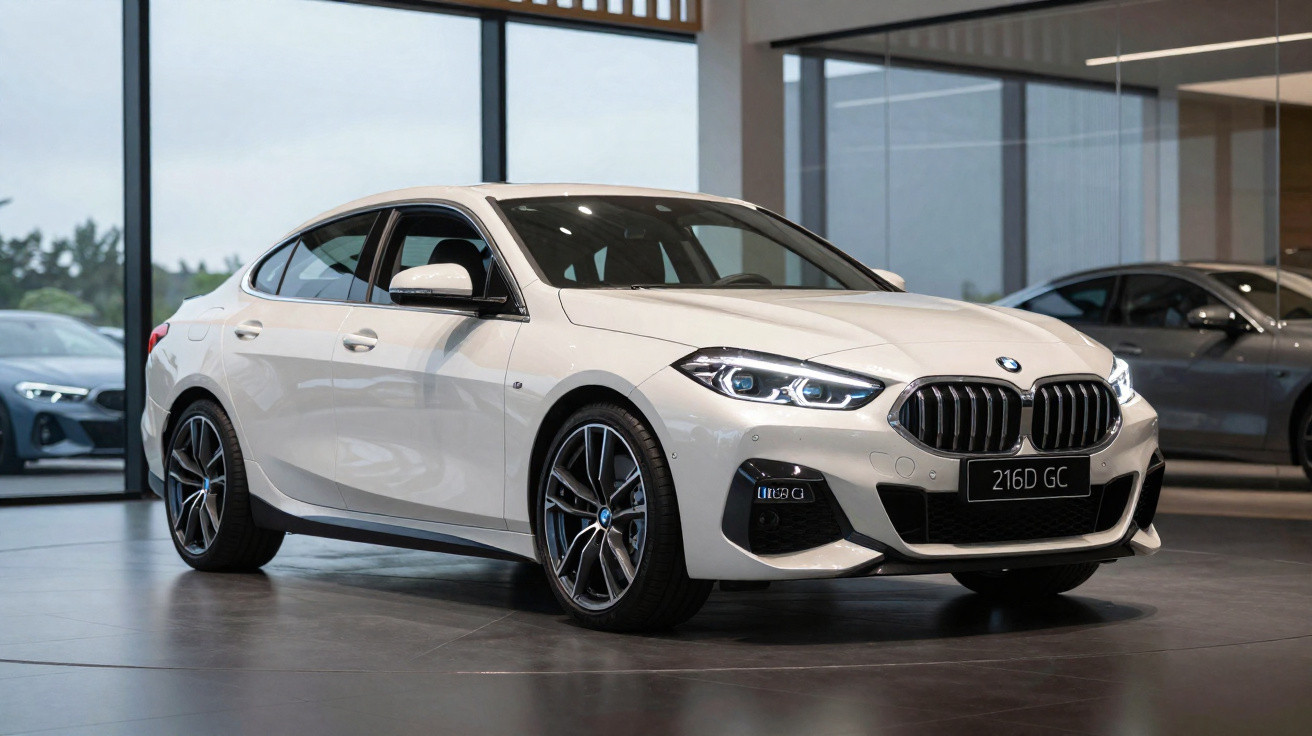
If, lately, just about every debate around BMW seems to revolve around how oversized its twin kidney grille has become, the 2 Series Gran Coupé, launched at the start of 2020, sparked arguments about far more than that: virtually its entire design.
Positioned as the natural rival to the Mercedes-Benz CLA, it didn’t arrive with an XXL kidney grille, yet it did bring proportions that were new territory for BMW. And, much like the 1 Series (F40) it shares so much with, it introduced fresh takes on the brand’s familiar styling cues-changes that, unsurprisingly, also drew criticism.
Still, the noise around how the 2 Series Gran Coupé looks tends to pull attention away from the rest of what it offers-areas where, in several respects, it outshines the CLA. That’s equally true of this tested BMW 216d Gran Coupé, one of the entry points into the range.
BMW 216d Gran Coupé: Diesel entry point
The 216d Gran Coupé sits as the gateway to the Diesel engines in the line-up. I’ll admit that, based on my last encounter with this 1.5 l three-cylinder-back in the previous 1 Series (F20)-my expectations weren’t particularly high. Even though it was capable, the old 116d didn’t feel especially polished, with too many vibrations that made its three-cylinder character obvious.
In this newer version, with its new layout (it’s now mounted transversely rather than longitudinally), it genuinely surprised me. Vibration levels are far better controlled; it feels more refined and even… smooth in everyday use. At the same time, throttle response and its willingness to climb through the rev range are clearly improved-(seriously) at times it came across more like a petrol engine, showing real energy as it reaches 3000 rpm and then pulling keenly up to and beyond 4000 rpm.
Only when you really “wake up” the BMW 216d Gran Coupé’s engine does a more noticeable shudder stubbornly remain.
If the engine impressed, the pairing with the dual-clutch gearbox-the only one available-was just as strong. Although I’m openly a fan of manual gearboxes, I don’t think one would suit this particular package better. It reacts quickly, seems to pick the right ratio at the right moment, and it’s genuinely hard to catch it out-it almost felt like it could read my mind…
In manual mode (there are no paddles, so you have to use the gearlever), it also proved pleasing and accurate to operate, as did its Sport mode (it doesn’t drop gears for no reason, and it doesn’t cling to a needlessly high engine speed when there’s no benefit).
OK… this all makes the 216d Gran Coupé sound like a rocket ship-it isn’t. With just 116 hp, it’s a modest figure, but the engine’s eagerness and accessibility, combined with a very well judged gearbox, make the 216d Gran Coupé just as credible a choice as the more powerful (and more expensive) 220d. What’s more, the three-cylinder showed a restrained appetite, returning between 3.6 l/100 km (steady 90 km/h) and 5.5 l/100 km (mixed driving, with plenty of town work and some dual carriageways).
Confident driving and handling
Its strengths don’t stop at the drivetrain. As I’d already found with the stronger 220d and the M235i, the 216d Gran Coupé also delivers convincingly on the dynamic side. It isn’t the most playful car in the class, but it’s far from dull either-as I mentioned when I first drove it a little over a year ago, the 2 Series Gran Coupé feels at its best at around 80–90% of its limits, where it seems to flow naturally along the road.
What stands out is the balance and cohesion in the way every control works-steering (a thinner-rimmed wheel would be welcome) and pedals alike-and in the responses they give you. In that respect it’s better than its arch-rival from Stuttgart, and that translates into a chassis that delivers effective, progressive behaviour.
Even with the sports suspension fitted and with us sitting in the optional sports seats, ride comfort remains at a good level, although the damping does lean towards the firm side. That said, it breathes with the road surface better than the CLA 180 d I tested previously, even at motorway speeds (the CLA had a small but constant fidget). The BMW also demonstrates strong stability and a high level of refinement on board, with effective sound insulation.
And what else?
Despite having four doors, the styling choices-particularly those linked to its coupé-like silhouette-bring compromises. Rearward visibility isn’t brilliant, and when you sit in the back, although access to the rear seats is reasonably straightforward, headroom is tight. Anyone around 1.80 m tall, or with a longer torso, will brush or touch the roof-a CLA, or even the 1 Series it shares so much with, does better here.
Otherwise, as we’ve already seen in several 2 Series Gran Coupé examples and in the 1 Series as well, the sense of solidity inside this BMW 216d Gran Coupé is at a high level-higher than its main rival. And the interior design, while more conventional, is easier to learn and ergonomically stronger than in other models that have decided to go all-in on digital controls.
There are still physical buttons for the most-used functions, so you’re not forced to dive into the infotainment system-although this one is among the best in the industry (it would be even better with fewer submenus). There’s room for improvement in areas such as the digital instrument cluster, which can sometimes be confusing to read, and I’d happily do without the “reverse” rev counter.
Is it the right car for you?
Its styling remains a talking point, but thankfully the 2 Series Gran Coupé’s qualities don’t begin and end with how it looks. Mechanically and dynamically, it’s more convincing than the equivalent CLA, and it also wins on perceived interior quality.
That said, it isn’t exactly a bargain. The 216d Gran Coupé is priced in line with the CLA 180 d, starting at 39 thousand euros, but our test car added another 10 thousand euros in options. Do you need all of them? Of course not-but some feel “essential” and arguably should be standard, such as the Connectivity Pack (which includes, among other features, mobile device connectivity, Bluetooth and USB, with wireless charging), which adds 2700 euros to the price.
Our M Sport version is also fairly expensive, but-returning to the styling topic we never really escape-you almost feel pushed towards it if you want the 2 Series Gran Coupé to have a bit more presence. These (incorrectly) labelled four-door “coupés” trade heavily on their sleeker image, and the M add-ons help a great deal on that front. It’s no coincidence that design remains one of the CLA’s biggest strengths versus the 2 Series Gran Coupé.


Comments
No comments yet. Be the first to comment!
Leave a Comment