
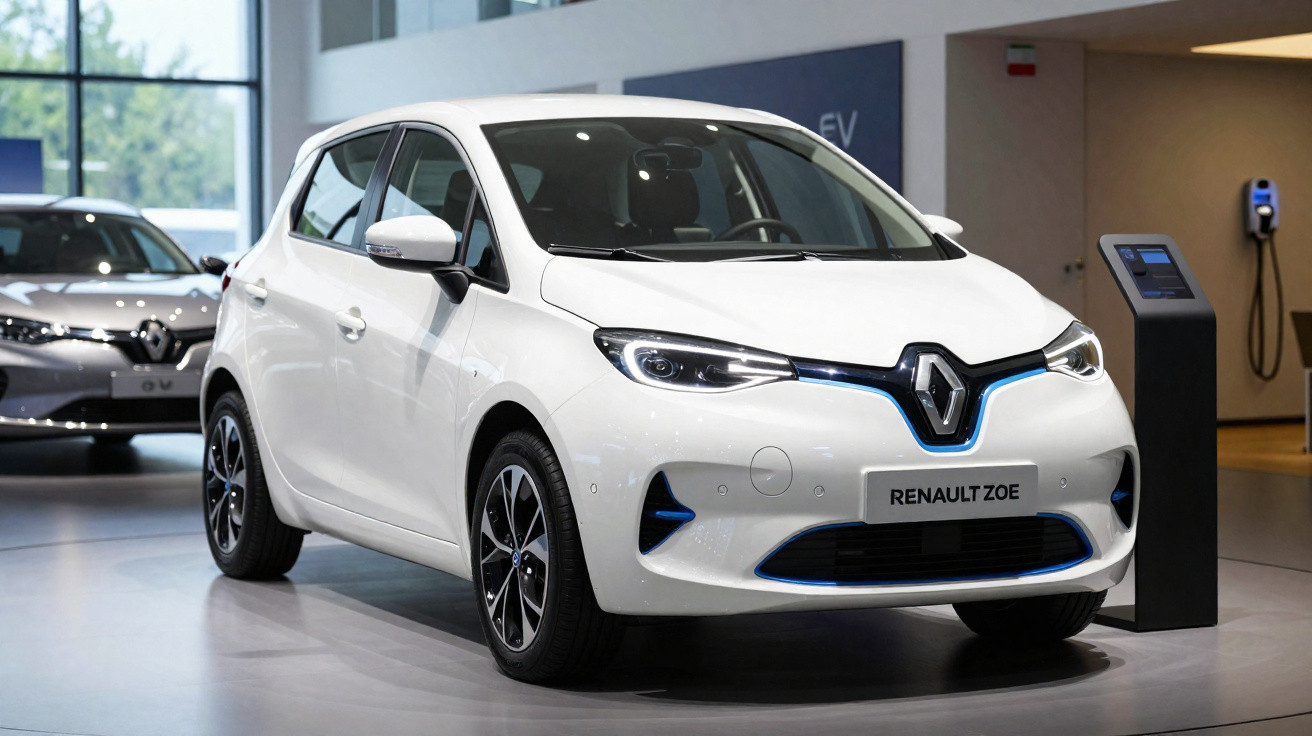
Renault picked Portugal as the setting for the international unveiling of its first purely electric city car, the Renault ZOE.
When I was invited to drive a city car that’s supposed to kick off a new era, I’ll admit I was sceptical. I’d never driven an electric car before. Everything I’d read or heard about EVs seemed to fall into two camps: either brilliant or terrible. By the end of the day, though, I handed the key back to Renault’s representative with a grin and the feeling that I’d fully bought into the idea of a near-perfect second family car. It was a fantastic day, and the Renault ZOE was entirely to blame. Let’s rewind.
Renault itself is the first to say this is, above all, a second car to keep in the garage. For me, “a second car for the garage” was always a Porsche or a Ferrari-classic or new, it didn’t matter. It just had to be thirsty, have an epic engine note, and unmistakable presence. The truth is, I don’t do the maths when I think like that. Keeping as a “second car” something I might only one day be able to afford is more indulgence than plan; it’s a dream, not reality.
We’d already previewed this Portugal launch here. Renault has struck an unusually neat balance: a second car you can actually afford, that makes no noise, costs (almost) nothing to run, and still has a distinctive look. At the same time, it rethinks what a “second family car” means-almost to the point of making it the first.
Unmistakable outside, almost perfect inside
The Renault ZOE looks like it’s powered by electricity-and, in many ways, it’s a celebration of zero emissions. Yet it avoids going overboard with sci-fi styling, and it certainly isn’t just some “badly crumpled sheet metal” solution like a number of EVs that have appeared over the years. It stands out.
Renault put the exterior design out to competition, and the end result reflects exactly what Jean Sémériva, the competition-winning designer, set out to achieve: a line of “purity and emotion”, inspired by a drop of water. The usual sceptics will say it’s all marketing. Fair enough-but in this case the words fit, and rarely is the marketing so accurate. Up front, the large Renault badge-now typical of the brand’s latest models-takes centre stage.
Still on the outside, the electric identity goes beyond the body shape. It’s easy to spot as an EV, with blue details scattered around: dark blue-tinted glass, rear lights that only turn red when braking or when the lights are on, and front lamps dominated by blue.
Inside, the atmosphere is thoroughly ZEN and appears to have been considered down to the smallest detail. On board, the mood is calm and serene, defined by light colours and a level of brightness that’s unusual in the supermini class. You quickly forget the chaos outside, and psychiatrists-and pharmaceutical companies-might want to worry: the Renault ZOE has a five-seat cabin with anti-depressant potential.
As a first overall impression, the cabin is let down by plastics that don’t feel as good as others in the segment. That said, they don’t completely disappoint-just enough to stop the interior from being flawless. The boot is larger than a Renault Clio’s and is among the biggest in the class, at 338 litres.
Intelligent, comfortable cabin
The plastics don’t score a 10, and that’s been a recurring theme for the French brand. Still, to deliver an accessible product, something had to give-and Renault is the first to admit that keeping to the €13,000 target (price before taxes) made this a necessary compromise. But what the Renault ZOE loses in plastics, it makes up elsewhere and, honestly, after a full day swapping between the driver’s seat and the passenger seat in the Renault ZOE, this detail fades into the background.
Passenger-comfort equipment is a real strength and sits well above the segment average, with plenty of genuinely new ideas. There’s a pre-heating system that lets you set the desired temperature via smartphone or computer before you leave; an air filter designed to make the cabin air cleaner and reduce elements that can trigger allergies; and an advanced climate-control system that keeps interior humidity within the correct range to help prevent dry skin.
When it comes to the balance between comfort and battery use, the pre-heating system is limited to 5 minutes when the Renault ZOE isn’t plugged in. Once connected to the mains, it draws only from the grid, saving the battery. As you can see, the Renault ZOE is effectively built around comfort.
In Zen trim-the version I drove-the Renault ZOE can be specified with the “Take Care By Renault” pack, which includes a toxicity sensor, a purifying and relaxing air ioniser, an active fragrance diffuser, and Teflon upholstery that resists water and stains. The Renault ZOE Zen also comes with a quick-clean kit: Renault-branded products designed specifically for the Renault ZOE’s plastics and upholstery. Yes, mums and dads of the world-children can play to their heart’s content. For anyone who doubted me when I said “Zen”…
Built around the driver and the drive
The instrument cluster is fully digital and easy to understand. It gives live information on battery status and driving style. The display colours change depending on how you treat the accelerator, with green and purple marking the extremes between economical driving and the opposite. Every time you lift off or brake, the battery “fills up” again-so much so that it can become addictive, which is clearly the point of the lights and graphics.
R-Link system? Yes, please
R-Link makes its full debut as standard equipment on the Renault ZOE-and it earns five stars. This system is essentially a tablet built into the Renault ZOE’s dashboard, bringing a range of functions that can turn the car into a mobile office or entertainment hub. Beyond being electric, the Renault ZOE leans even harder into its role as an everyday car. When stationary, it gives access to e-mail, Twitter and a suite of apps (50 at the moment). Through the R-Sound Effect app, you can even simulate the interior sound of a Clio V6 or a Nissan GT-R. Dreaming is allowed, and Renault itself jokes about the lack of engine noise.
You can play sudoku and other travel games to keep adults and kids entertained in rush-hour traffic. When you’re on the move, for instance, you can listen to information about nearby monuments, check fuel prices at surrounding petrol stations-a feature that’s only useful in combustion cars-use directory services, or view the weather forecast. The Euronews app delivers up-to-the-minute headlines, and if you want, the Renault ZOE will read the news out loud. For the superstitious who need to know if the stars are aligned, no problem: the Renault ZOE even has a fortune-teller in the centre console… OK, it’s just an app-an actual built-in fortune-teller would be inhumane… moving on.
R-Link also includes TomTom Z.E Live navigation, which is more than a GPS-it’s a genuinely practical tool when driving an EV in a world still dominated by combustion cars. TomTom’s system was designed to integrate with a Renault electric vehicle, and the Renault ZOE is connected to it: during navigation you receive updated data on how far you can travel, and if you enter a destination beyond your current range, the GPS identifies the ideal charging points to top up along the route.
Renault ZOE, everywhere
On the technology front, it’s worth highlighting-again-how much the Renault ZOE prioritises the relationship with the user. Wherever you are, using your smartphone or computer, you can check the car’s information: battery level, charging status, range, and the nearest charging points. Available as an optional extra, the My Z.E Inter@ctive pack also allows you to set the charging time and schedule a weekly plan based on electricity cost and CO2 emissions. With all this in place, being left stranded is almost impossible. After Facebook delivered games that hooked half the planet, surely the next one is the Renault ZOE. I can already picture happy Renault ZOE owners programming the time to “feed” the car…
Quiet, to the right degree
“Is it on?” I asked the journalist sharing the Renault ZOE with me. A small press of the accelerator answered that question. We took one of Renault’s suggested routes, already programmed into the GPS. Over more than 30 kilometres, I’d be sampling city driving, secondary roads with good bends at a quicker pace, and dual carriageway. Let’s do it.
Despite the total lack of engine noise, under acceleration the Renault ZOE produces a faint electric, spaceship-like sound so pedestrians aren’t caught out by a silent car arriving from nowhere. This system is called Z.E. Voice, is enabled by default, and activates between 1 and 30 km/h, offering three different sound profiles chosen by the driver. The sound cadence changes with speed and is managed electronically.
Dynamics and comfort impress
It’s pleasant to drive, and both ride comfort and cabin quietness score highly. The seats are better than those in the Clio IV, and overall I preferred the Renault ZOE to the Clio for comfort. The suspension is the main reason-and if you think Renault cut corners here, you’d be wrong. The front suspension is the same as the Renault Clio’s, while the subframe and lower suspension arms come from the Renault Mégane. And it doesn’t stop there: at the rear, the programmed-deformation flexible axle suspension is the most robust in the brand’s range, all so the Renault ZOE can properly manage the battery weight when cornering. On a winding road, the Renault ZOE is very capable and can genuinely be fun, accompanied by that subtle spaceship soundtrack.
Driving position needs work
Still comparing it with the Renault Clio IV, the Renault ZOE sits 35 mm lower, has wider tracks, and its body’s torsional rigidity has increased by 55%. With the batteries positioned low down, these traits give the Renault ZOE a chassis that feels ready for much more power. The driving position is high, and the steering wheel placement feels like a throwback-like the days of a less dynamic Renault Clio. It’s a detail that needs revisiting.
Balanced motor
The motor does the job, and performance-despite being a long way from that of a combustion city car-still convinces. With 88 hp (65 kW) and a maximum torque of 220 nm, I tackled the climbs of the city of seven hills without drama. Full torque arrives in less than a hundredth of a second, making the “gap” impossible for a human to notice. Maybe a true driving deity will write about the Renault ZOE and disagree; I’m sorry, but I couldn’t detect it. It’s not the most powerful car in the world, but it won’t embarrass you, and if ECO mode is engaged (as we already know from the Clio IV), pressing the accelerator hard for an overtake-or simply because you feel like it-switches ECO off. The motor doesn’t need any lubricants, significantly reducing its maintenance dependence.
Safety above all
Its dynamic abilities and the investment in passenger protection earned it 5 stars in the EURONCAP test, where it achieved maximum marks in side-impact tests. It also scored 32 points out of 36 under “adult protection” and ranked among the best in the B-segment for child protection. The Renault ZOE is also at the top of its category for “pedestrian protection”. During development, 90 units were literally destroyed in tests of all kinds. For a car intended to live in the thick of city movement, safety is essential.
Battery system
For anyone understandably concerned about battery longevity and warranty, Renault is clear: “The warranty is for life.” If the battery drops below 75% of its capacity, Renault replaces it at no additional cost. The Renault ZOE was tested to extremes: it covered more than 850,000 kilometres, and the electric motor underwent the equivalent of 20 years of use.
Renault says nothing was left untested with the batteries, which endured abusive trials-combustion, fire, immersion, drops, compression, short-circuiting, electrical overcharging… they even drove a nail into a cell to see what would happen next. Imagine the most feared torturer from Hollywood films or your favourite series-got it? OK, according to Renault, he’s the one who tested the Renault ZOE’s battery.
Environmental responsibility goes beyond day-to-day use of the Renault ZOE as a non-polluting electric vehicle. The batteries weigh 250 kg, with only 10 kg of material not recyclable, and Renault already has a worldwide structure in place to take back used batteries.
Range convinces, and technology helps
The quoted and type-approved range is 210 km. But time behind the ZOE’s wheel suggests that only in very, very ideal conditions can that figure be reached. At best, I saw an estimated 160 km of range, without restricting use or carefully rationing the right foot. Even so, it’s a strong number-especially because I never once found myself worrying about range. Renault admits that the 210 km figure is practically unachievable. In one press conference, a Renault engineer said battery progress is expected at 2 to 3% per year, meaning meaningful range gains will only become obvious over the long term.
The Renault ZOE also includes several features designed to manage battery consumption more effectively. The Range OptimiZEr system uses three battery-saving measures: special low-friction Michelin Energy E-V tyres developed for the Renault ZOE, regenerative braking and deceleration, and a heat pump. Alongside notable energy savings, the heat pump also warms the cabin far faster than traditional systems.
Charging has never been easier
One of the headline systems debuting on the Renault ZOE is the Chameleon charger, patented by Renault for this model. It’s “chameleon” because it allows the Renault ZOE to charge at different power levels on single-phase or three-phase supplies. The aim is to enable low and mid-power charging. Exclusive to the Renault ZOE, this charger helps preserve the batteries and extend their lifespan, while also reducing the electricity bill.
Charging times range from 30 minutes to 9 hours, depending on the charging point’s power. Using a 43 kW post-the most powerful at the moment-the Renault ZOE takes half an hour to charge 80% of its batteries, which is the maximum permitted during charging at these higher-power stations.
The Renault ZOE comes with a charging cable rated for 3 to 22 kW. The socket is located at the front, behind the brand badge, which conceals the charging port. Rapid charging stations have their own cable designed to handle the 43 kW. Once it’s properly connected, the cable locks in place and can only be released by using the hands-free card or a button on the left-hand side of the Renault ZOE’s steering wheel.
How much does it cost to own a Renault ZOE?
This question matters beyond the cost per charge, because that part is clearly low. Renault says a full charge costs no more than €2. Less than €2 for 160 kilometres is tempting. However, as I mentioned, costs go beyond charging. The batteries are rented for 79€ per month. The contract-3 years and 12,500 km per year-comes with the conveniences you’d expect from a rental agreement, including the “lifetime” battery warranty during the term. Even so, it isn’t all plain sailing.
The Renault ZOE is aimed at people who have a garage space or live in a house with a private garage. Beyond that requirement, the owner also has to buy and install a Wall-Box at the home charging location. The electrical grid still isn’t prepared to supply the Renault ZOE directly, and the Chameleon charger needs this Wall-Box to adapt… Renault is ready to handle, together with a specialist seller, the entire Wall-Box purchase and installation process for the Renault ZOE. The Wall-Box price depends on the supplier, but you should budget around €1,000 for the unit. The Renault ZOE starts at €21,750 (on-the-road price) and was due to go on sale in April in Portugal.
Summary
The Renault ZOE is the market’s first electric city car and, with no direct rivals, comparing it with “nothing” isn’t especially meaningful. From what I learned about the Renault ZOE-beyond everything I’ve already written and described-there are three negatives worth flagging: the quality of some plastics, the fact the rear bench doesn’t have a split-fold function, and the bag containing the charging cable which Renault chose-probably again under financial constraints-to place in the boot in full view. Ultimately, all of these stem from the final price Renault needed to hit to make this Renault ZOE viable.
Without trying to be a prophet, I believe the Renault ZOE will be well received in the Portuguese market. Its price is a little higher than diesel cars in the segment, but being electric and highly innovative will support sales-especially as fuel prices rise to levels many wallets struggle to follow. It may not deliver colossal sales figures, even less so in the times we’re living through, but it will certainly sell more than today’s existing EVs.
Razão Automóvel will still have the chance to test the Renault ZOE for a longer period and put its abilities under deeper scrutiny. The Renault ZOE aims to change families and begin a new era in the car parc. Will it succeed? No one knows, and only time will tell. But if this is the “second car” of the future, then the traditional weekend sports car might well become a third car for those able to spend that sort of money on cars.
This first contact was enough to show there’s still plenty to do before the electric car becomes an accessible reality for everyone, but the truth is that with the Renault ZOE we’re getting closer to that moment.
Text: Diogo Teixeira


Comments
No comments yet. Be the first to comment!
Leave a Comment