
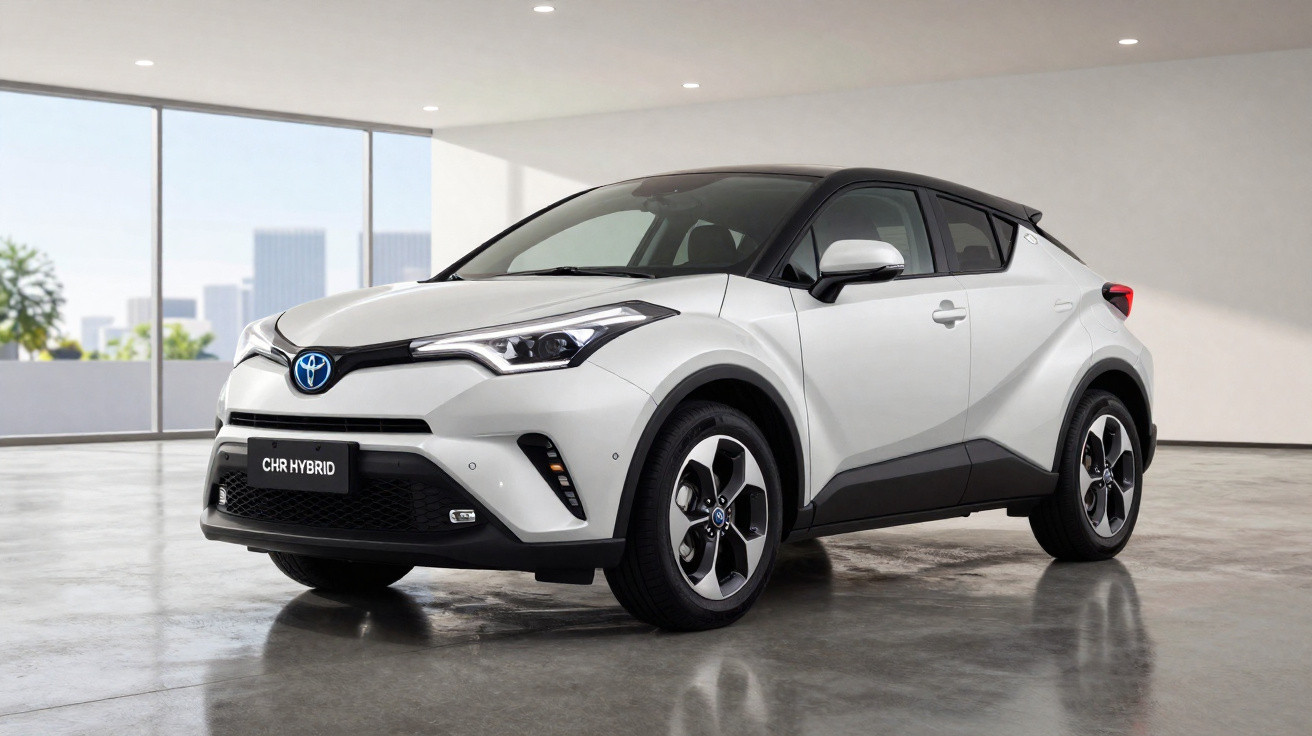
The Toyota C-HR proved that a dependable, fuel-sipping hybrid doesn’t have to be dull - but that standout styling comes with compromises.
The Toyota C-HR marked a turning point for a brand better known for dependability than design daring. Arriving in Portugal in 2017, this compact crossover ditched conservative lines for shapes you’d normally associate with a concept car - and it quickly became one of Toyota’s most significant European models.
In this guide, we focus on the C-HR 1.8 Hybrid with 122 hp: the most common version on the Portuguese market and, in our view, the best balance of running costs, toughness and purchase price. Motor CV data indicates this engine accounts for 84.9% of Toyota C-HR vehicles on Portuguese roads.
On Pisca Pisca, you’ll find examples from roughly €18,500, while newer, lower-mileage cars can sit around €30,000.
It changed little because it didn’t need to
The first-generation Toyota C-HR was sold from 2017 to 2023. Early on, the Portuguese line-up included the 1.2 Turbo (116 hp) and the 1.8 Hybrid (122 hp), but it was the hybrid that rapidly became the clear buyer favourite.
The facelift revealed at the end of 2019 and launched in 2020 introduced revised bumpers and lights, improved sound insulation, and suspension tweaks. The 1.8 Hybrid kept its 122 hp, but switched to a more compact lithium-ion battery.
The range also gained the 2.0 Hybrid (184 hp), delivering the performance the Japanese crossover had been missing. That drivetrain also underpinned the C-HR GR Sport, which arrived in 2021, adding its own styling details, 19" wheels and a slightly firmer set-up.
Don’t expect a genuine hot model - it isn’t one - but this version makes better use of the platform’s dynamic ability, as we confirmed when we tested it.
A design that has aged well
Chunky wheel arches, a tapering roofline and hidden rear-door handles still set the C-HR apart from most crossovers. Even early cars continue to look contemporary, which helps explain the model’s modest depreciation.
Before you buy, inspect the bumpers, side skirts and alloy wheels carefully. Limited rear visibility makes minor parking knocks more likely, while the 18" or 19" wheels are especially prone to scuffs and kerb rash.
Also check that the LED headlights, sensors and reversing camera are working properly. The windscreen houses the Toyota Safety Sense camera, so replacing it may require recalibration of the driver-assistance systems.
The exterior styling shapes the cabin
Step inside the C-HR and you’re met by an interior drawn with energetic lines, with the centre section angled towards the driver. It’s striking how much cabin design has shifted in just 10 years: you still get analogue dials here, and there are plenty of physical buttons for the main functions.
Overall, the materials up front feel pleasant, and build quality generally stands up well over time.
The biggest distinction between the two phases is the infotainment system. Pre-2020 cars have a sluggish unit with dated graphics and no factory Apple CarPlay or Android Auto. If connectivity matters to you, the updated model is the obvious choice.
Front space is adequate, but in the rear the small window area and high door line make it feel dark and slightly claustrophobic. And who decided the rear door handle should sit up by the roof? The 1.8 Hybrid boot offers around 377 litres, which is merely average for the class.
Built to save fuel, not to sprint
The hybrid system pairs a four-cylinder petrol engine running the Atkinson cycle with an electric motor and a planetary e-CVT transmission. Combined output is 122 hp.
This isn’t a conventional belt-driven CVT. There’s no clutch, alternator or traditional starter motor, removing several wear-prone components.
In town, the C-HR feels most at home. Pulling away is smooth, switching between petrol and electric power is almost unnoticeable, and regenerative braking helps keep fuel use down. The light steering also makes manoeuvring much easier.
On the open road, it can impress with tidy body control and accurate steering. The driving position sits lower than in many SUVs, and from behind the wheel the C-HR ends up feeling closer to a regular car.
The limitation shows when you ask for more power. On a climb or during an overtake, the engine quickly flares and holds a high revs as speed builds. That’s typical e-CVT behaviour, but it can become wearing if you’re used to a conventional automatic gearbox.
For relaxed driving, 122 hp is sufficient and consumption is low. On Spritmonitor.de (which logs real-world owner data), the average sits at roughly 5.2 l/100 km. If your driving is more urban than rural, dipping below five litres isn’t difficult. On the motorway, expect higher figures and it can exceed six litres.
Reliable, but not flawless
The C-HR’s hybrid system has an excellent reputation, and there are no widely known serious mechanical faults. Even so, don’t buy solely on the strength of the Toyota badge. Check the service history and request a diagnostic report for the hybrid battery, particularly if you’re looking at a high-mileage car that has done ride-hailing (TVDE) work or spent long periods standing.
The battery cooling air intake should be clean, as a build-up of dust, hair or objects can restrict airflow. On a test drive, make sure there are no warning lights on the instrument panel and that transitions between electric and petrol power happen without hesitation.
The 12 V auxiliary battery tends to cause more issues than the hybrid battery itself. It can discharge if the car is left unused for several days or only driven on short trips. It’s also worth checking for coolant leaks, correct operation of the electric parking brake, uneven tyre wear, and any noises coming from the suspension.
How much you should pay
The Toyota C-HR holds its value well. The brand’s reputation, demand for hybrids and the lack of major mechanical weaknesses mean even older cars are still far from cheap.
Based on Pisca Pisca/Motor CV data, a 2017 example is currently worth around €19,200. Prices rise gradually to about €22,000 for 2019 cars (the final year before the update). 2020 cars average €23,900, while 2023 examples climb to roughly €29,500.
Between a 2017 C-HR and a 2023 one, the gap is therefore approximately 35%. For cars built between 2020 and 2023, the difference is around 19%, reinforcing the idea of relatively contained depreciation.
Treat these figures as guidance rather than absolute truth. Mileage, specification, provenance, history and overall condition can shift prices by several thousand euros. When comparing similar cars, always favour the one with documented maintenance and completed recall campaigns.
What you may need to repair
Servicing on the C-HR 1.8 Hybrid is fairly straightforward. The engine uses a timing chain and the transmission doesn’t rely on a conventional clutch. The brakes also typically last longer thanks to regenerative braking.
Taking the most common issues into account - including the possibility of a battery replacement (the original warranty was five years, but could be extended annually up to a maximum of 10 years) - we’ve compiled the sort of costs you can expect for some of the most frequent components.
The C-HR has also been subject to recall campaigns covering, among other items, hybrid-system wiring, the fuel tank and fuel pump, the pre-collision radar sensor, a driveshaft, and operation of the eCall system.
Consult the Motor CV report to see the Toyota C-HR recall campaigns in detail:
Our pick
The most well-rounded choice is a Toyota C-HR 1.8 Hybrid from 2020 to 2022, ideally in Comfort, Exclusive or Square Collection trim.
The updated car keeps the 1.8 Hybrid’s durability, while adding better sound insulation, a more modern infotainment system and small comfort improvements. The 122 hp output is enough for town use, A-roads and light family duties.
A pre-2020 car can still be a sensible buy if it’s clearly cheaper and comes with an impeccable history. The 2.0 Hybrid (184 hp) is better suited if you do lots of motorway miles or care more about performance, but it costs more and has a slightly smaller boot (358 litres rather than 377 litres).
Among the alternatives, the Kia Niro Hybrid is more conservative, but repays with extra space and practicality; and the Hyundai Kauai Hybrid shares a lot with the Niro, including the hybrid system, yet sits closer to the C-HR thanks to its more expressive styling (for better or worse) and a more engaging driving feel. Its six-speed automatic gearbox is a plus, being more pleasant than the C-HR’s e-CVT.
Among non-hybrids, the "our" Volkswagen T-Roc is also a very strong option. It’s more understated and broadly agreeable to look at, but makes up for that with more room and greater versatility.


Comments
No comments yet. Be the first to comment!
Leave a Comment