
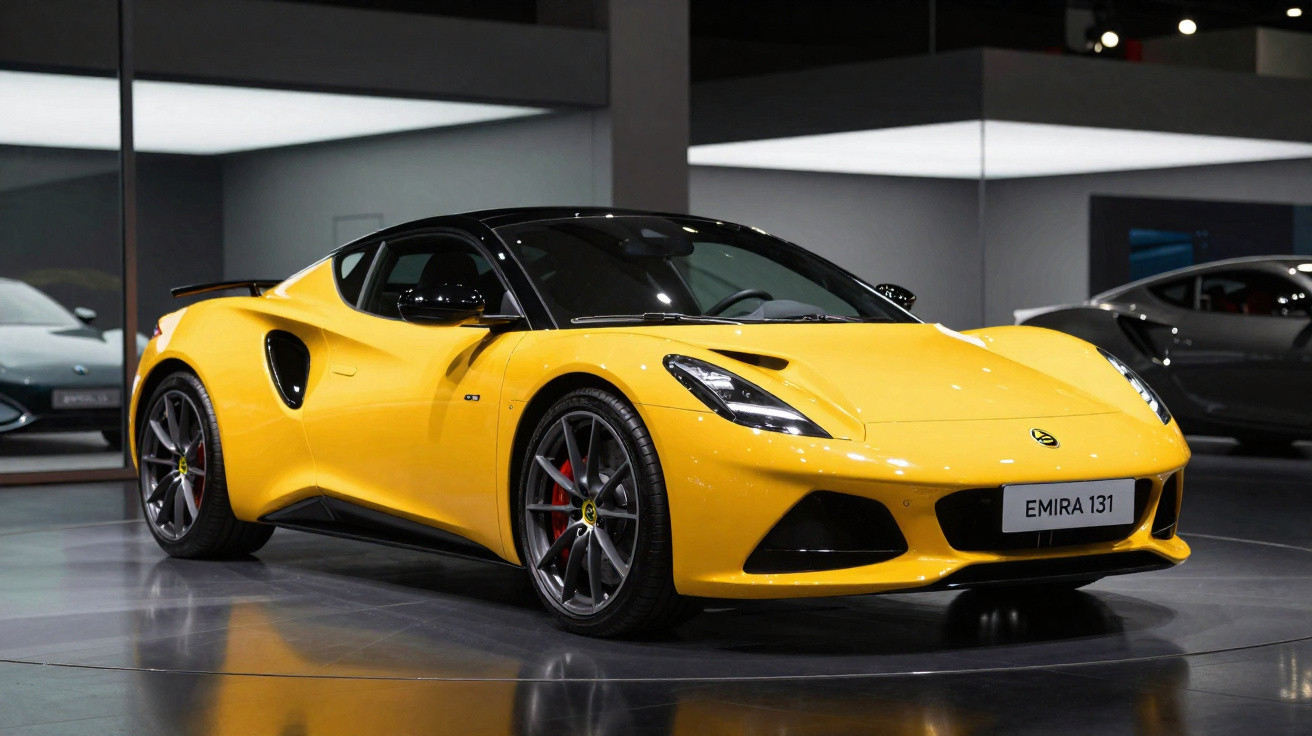
With any brand-new Lotus, there’s already plenty to applaud - the firm hasn’t introduced a genuinely new model in a decade - and that makes the arrival of the Emira (Type 131) even more significant.
Lotus says this will be its final model fitted with an internal combustion engine. From here on, every new Lotus will be electric, starting with the hyper-exclusive Evija.
In one move, the new Lotus Emira will step into the space left by the Elise, Exige and Evora - all due to end production during this year - and it lines up as a challenger to certain versions of the Porsche 718 Cayman, particularly the more powerful ones.
Lotus and AMG, an unlikely pairing
Lotus hasn’t yet published every final specification for its new sports car, but it is quoting outputs between 360 hp (365 cv) and 400 hp (405 cv), alongside a peak torque figure of 430 Nm. Whichever engine you choose, Lotus is promising 0–100 km/h in under 4.5s, always and only with rear-wheel drive.
One option is familiar, carried over from the Evora and Exige: Toyota’s 3.5-litre Supercharged V6, paired with either a manual or an automatic gearbox - both six-speed units.
The headline change, though, is the announced and brand-new four-cylinder engine: none other than AMG’s M 139 - described as the most powerful four-cylinder engine in the world - the same unit used in the Mercedes-AMG A 45. AMG now becomes one of Lotus’s technical partners, and the link between the two isn’t hard to spot given that Lotus is now part of Geely, which in turn holds a significant stake in Daimler.
That said, it won’t arrive with the 421 cv seen in AMG’s “45” models; instead, it’s expected to sit at the quoted 360 hp. This is the first time the M 139 will be installed in a mid-rear position, while keeping its transverse layout. Even so, that new placement demanded a range of changes, including the development of a new intake and exhaust system. For the M 139, the only gearbox offered will be AMG’s eight-speed dual-clutch transmission.
Sports Car Architecture. Evolution, not revolution
The changes aren’t limited to what sits under the rear cover. The new Lotus Emira debuts fresh underpinnings called the Sports Car Architecture - although, in technical terms, it’s a major evolution of the Evora’s platform. It continues to use the same approach of aluminium extrusions bonded with industrial adhesives, a technology Lotus first introduced on the Elise… back in 1996.
Although the new Emira is strictly a two-seater, it’s slightly longer and wider than the Evora (which even offered a 2+2 layout). It measures 4412 mm in length, 1895 mm in width and 1225 mm in height, and it keeps - interestingly - the same 2575 mm wheelbase as the Evora. The tracks are wider too, and Lotus says this translates into higher levels of stability for its sports car. Another new feature is the 20-inch wheels, standard across the Emira range.
This new architecture also makes getting in and out of the Emira far easier, while Lotus is also claiming more generous cabin space (especially headroom), enough to match - in the brand’s view - the benchmarks in its class.
A Lotus you can use every day?
It’s unusual to see a press release for a sports car - and a Lotus at that - place so much emphasis on day-to-day practicality and versatility. The Emira is positioned as one of the most usable Lotus models ever for regular, even daily, driving. That’s not only down to the improved access, but also its ability to carry luggage.
Behind the two occupants there’s a storage area with 208 l of capacity, while the boot located behind the engine bay can “swallow” 151 l (enough for a standard airline suitcase or a set of golf clubs), beating the combined capacity of a Porsche Cayman. There’s also a double cup holder, plus storage pockets in the doors.
While the exterior styling is new - and clearly influenced by the fully electric Evija - it still feels recognisably Lotus. Inside, however, the change in both design and technology is something the brand hasn’t done before.
With improved comfort and usability as the guiding principles, the new Lotus Emira brings noticeably more attention to trim materials, perceived quality and ergonomics, losing the more “hardcore” feel of some Lotus models with a sharper track focus. As with many modern cars, the dashboard design is dominated by two displays: one for the instrument cluster (12.3 inches) and another for infotainment (10.25 inches).
The technology offering - for both safety and comfort - is also striking, not because it’s groundbreaking in itself, but because it’s arriving in a Lotus, which isn’t what we’ve come to expect.
The Emira comes fitted with an “arsenal” of driver assistance systems - who would have thought it… - including adaptive cruise control, forward collision warning, traffic sign recognition, a speed limiter, lane departure warning and even lane change assist (!). This is only possible because the new Emira adopts a new electrical architecture taken directly from the parent company Geely, albeit adapted to Lotus’s requirements.
Comfort equipment is equally noteworthy. You get a multifunction steering wheel, a KEF premium audio system (with 10 channels), electrically adjustable seats as standard (!) with four-way adjustment (optionally 12-way), a rain sensor, electrically folding mirrors, parking sensors (optionally also at the front) and push-button start - yes, all of that in a Lotus.
"It is undoubtedly the beginning of a major transformation for Lotus, of which electrification is only one part."
Is it still as light as we expect from a Lotus?
There’s good news and bad news. On the one hand, despite everything that has been added to the sports car, it’s only five kilograms heavier (in its lightest form) than the Evora. On the other, that means the lightest version of the new Emira weighs 1405 kg (DIN), making it as heavy as the Porsche 718 Cayman GTS 4.0.
For the type of car it is - given its dimensions, the engines it offers and the equipment it carries - that isn’t an unreasonable figure (and it’s in line with many current hot hatches). Even so, for a Lotus, you can’t help but expect a lower number, particularly given its largely aluminium construction (whereas the 718 Cayman makes more extensive use of steel).
Handling with expectations running high
As well as a sensible kerb weight, Lotus is expected to deliver class-leading handling and a distinctive driving experience.
To reach that target, Lotus resisted the move to electric power steering, keeping the Evora’s hydraulic assistance instead to preserve the best possible feedback. The suspension uses double wishbones at both the front and rear, and buyers will be able to choose between two chassis set-ups.
The standard configuration, called Tour, is aimed at everyday use with a more compliant tune. Optionally, the firmer Sport set-up will be offered as part of the Lotus Driver’s Pack. Alongside the stiffer suspension, it also adds Launch Control and Michelin Pilot Sport Cup 2 tyres, replacing the standard Goodyear Eagle F1 Supersport.
When does it arrive?
The new Lotus Emira - the first product of the Vision80 plan and the last Lotus to be fitted with an internal combustion engine - is expected to launch next spring (2022). It will arrive first with Toyota’s Supercharged V6, with the M 139 four-cylinder from AMG following later. Lotus is aiming for the most affordable version of the Emira to come in below €72,000.
The new sports car will be built at the brand’s Hethel facility in the UK, at an optimistic rate of 4800 units per year - far more than the combined 1400–1600 units annually for the long-running Elise, Exige and Evora. The thinking behind that confidence is the Emira’s broader appeal, thanks to its focus on comfort and usability, with Lotus expecting it to bring in many new customers.


Comments
No comments yet. Be the first to comment!
Leave a Comment