
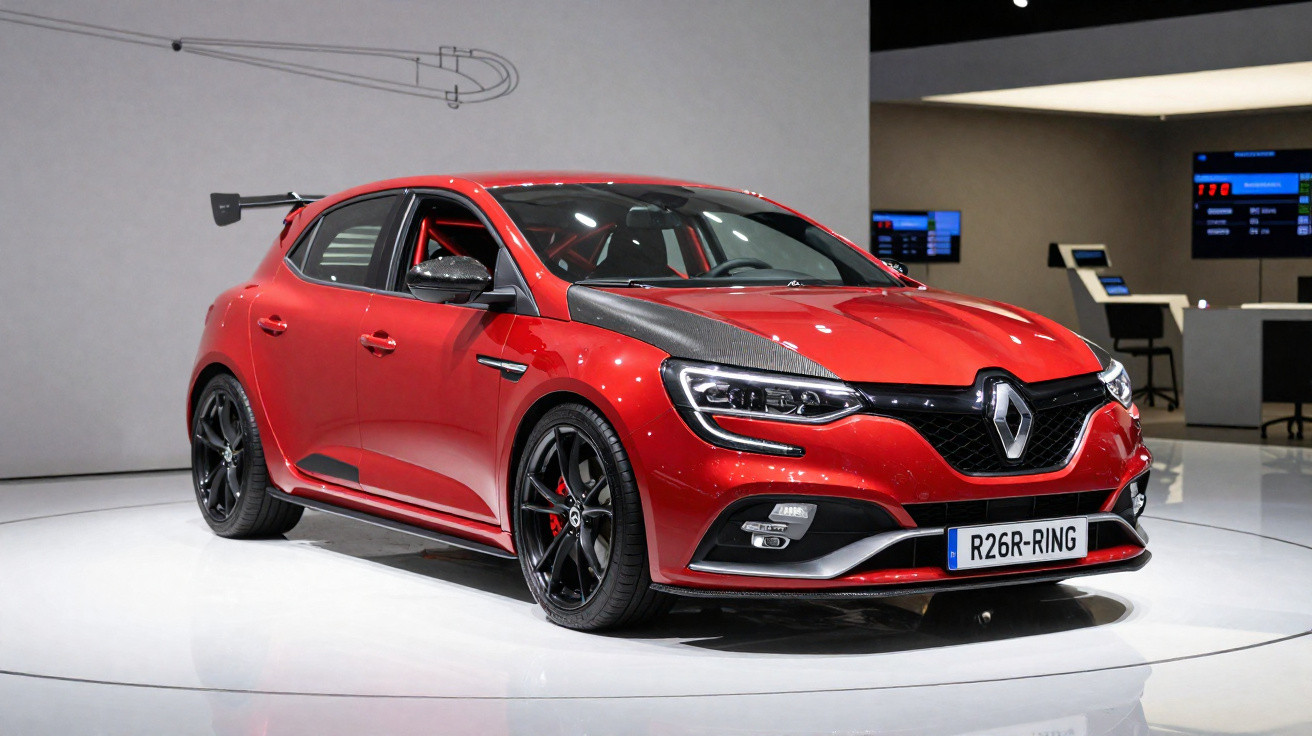
The second-generation Renault Mégane (released in 2002) marked the start of the journey of one of the greatest hot hatches ever made - the Renault Mégane R.S., a hot hatch that would go on to become the benchmark and the car everyone else chased for around a dozen years.
Introduced in 2004, the Mégane R.S. was not instantly regarded as the dominant force in its class. Instead, the formula was refined year after year - dampers, springs, steering, brakes and even the wheels were continuously and carefully “tuned” until it became the reference point it is today.
The F4RT 2.0 turbo: power, torque and performance figures
The engine, however, remained fundamentally the same - though it certainly wasn’t left entirely untouched. The F4RT unit - a 2.0-litre, turbocharged, inline four-cylinder - started out with 225 hp at 5500 rpm and 300 Nm at 3000 rpm. In this early period it would later rise to 230 hp and 310 Nm.
Always paired with a six-speed manual gearbox, it had enough punch to launch its 1375 kg (DIN) to 100 km/h in just 6.5s and run on to a top speed of 236 km/h.
The Porsche 911 GT3 RS of hot hatches
If there’s a reason to admire Renault Sport, it’s that it’s packed with enthusiasts just like us. Even after a long line of improvements - culminating in the R.S. 230 Renault F1 Team R26, 22 kg lighter than the regular R.S. and with an upgraded Cup chassis - they set rationality aside entirely and, in 2008, created the extreme Renault Mégane R.S. R26.R.
Why call it extreme? Because, in essence, they built the Porsche 911 GT3 RS of hot hatches. Everything that was done served a single goal: extracting every last drop of performance to find that extra hundredth of a second on any circuit - and, interestingly, the engine was left unchanged.
Radical diet: what was removed and what was replaced
Anything deemed unnecessary was deleted - because weight is performance’s enemy. Out went the rear seat and rear seatbelts - with the option of fitting a roll cage in their place - along with the airbags (except the driver’s), automatic air conditioning, the rear window wiper and washer, the front fog lamps, the headlamp washers, and most of the sound insulation.
And that still wasn’t the end of it. The bonnet switched to carbon (−7.5 kg), the rear side windows and rear screen became polycarbonate (−5.7 kg), and the seats used carbon-fibre backs with an aluminium structure (−25 kg). A few more kilograms could be shed again by choosing the titanium exhaust.
The outcome: 123 kg less (!), bringing it down to a mere 1230 kg. Acceleration improved slightly (−0.5s to 100 km/h), but it was the lower mass - and the corresponding chassis revisions - that turned the Renault Mégane R.S. R26.R into a corner-carving machine like few others.
Nürburgring time and limited production
That dynamic advantage was proven in the very same year, when it became the fastest front-wheel-drive car around the Nürburgring, setting a time of 8min17s.
It’s worth celebrating the R26.R’s 10 years of life (Editor’s note: at the time the original article was published), with production restricted to just 450 units. Its uncompromising pursuit of more performance - without simply adding more horsepower - is precisely what makes it a genuine performance icon.
About “Glories of the Past”. This is Razão Automóvel’s series dedicated to models and versions that stood out in one way or another. We like revisiting the machines that once made us dream. Join us on this journey back in time here at Razão Automóvel.
Comments
No comments yet. Be the first to comment!
Leave a Comment