
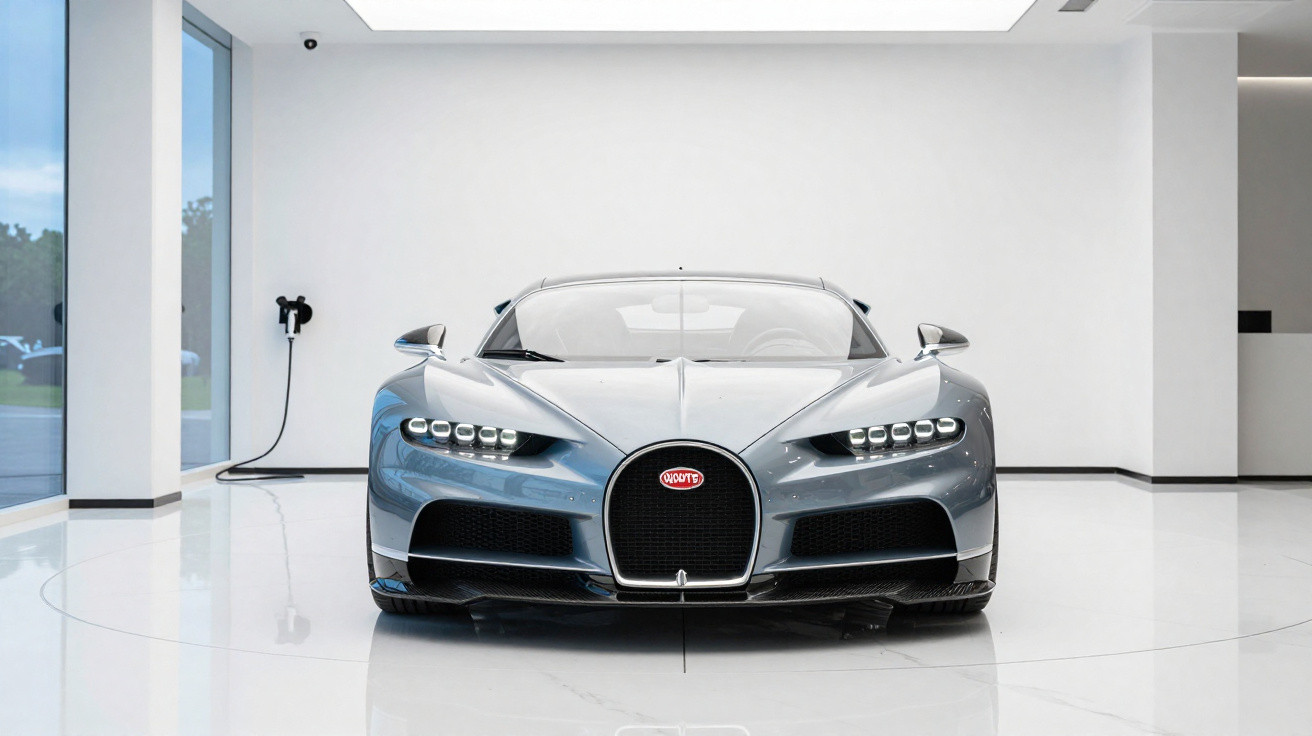
Bugatti’s Chiron successor and the return of the V16
Bugatti will stay loyal to a 16-cylinder engine when it unveils the Chiron successor next month. What changes is the way the cylinders are packaged: instead of a “W” layout, they will be arranged in a more conventional “V”.
While the W16 found in the Veyron and Chiron is unique to Bugatti, a V16 configuration has appeared before-just not very often. In fact, you have to go back to 1991 to find a production car fitted with one: the Cizeta Moroder V16T.
At a time when many had already written the internal combustion engine’s death certificate, who would have expected a mechanical giant like a V16 to return to a road car?
Until now, nothing concrete had been known about Bugatti’s new V16. However, Mate Rimac, Chief Executive Officer of Bugatti Rimac, shared the first details in an interview with the Financial Times during the Future of the Car conference held in London this week (it closes today).
What details were revealed?
A 1.0 m-long Bugatti V16-and naturally aspirated
To begin with, the new V16 will be notably long-after all, it uses two banks of eight cylinders each. Mate Rimac says the block will measure 1.0 m in length, which makes it 400 mm longer than the Chiron’s W16 block (which uses four cylinder banks).
The second point-and arguably the most important-is that this V16 will not use turbochargers: it will be naturally aspirated (!). By comparison, the Chiron’s W16 employs four turbochargers. The V16’s displacement is still unknown-rumours suggest 8.3 litres-but with natural aspiration, matching the Chiron’s 1500 hp would be an impossible task.
That is why this naturally aspirated V16 will be paired with electrical assistance. In fact, it has been known for some time that the Chiron successor would be a hybrid. Final power and torque figures are not yet confirmed, but they are not expected to come in below the Chiron’s 1500 hp and 1600 Nm.
Why a V16?
Rimac is widely recognised for the electric technology it develops-technology now found in Porsche EVs, Hyundai EVs, and even Koenigsegg hybrids. That is without forgetting that the company created the ballistic Nevera.
Even so, it was Mate Rimac himself who most strongly championed the decision to use a V16 for the Chiron successor. His reasoning, in his own words, was that it was the right call for a brand like Bugatti-and the best way to set it apart from Rimac and everyone else.
“You can reach the power numbers of this V16 from a highly turbocharged V8, but we wanted it to be more emotional. It has to feel special, because ‘if it’s comparable, it’s no longer a Bugatti’”.
Mate Rimac, CEO Bugatti Rimac
That final line is a direct nod to words attributed to Ettore Bugatti, the brand’s founder. Mate Rimac seems determined to take them literally-and that is good news.

Comments
No comments yet. Be the first to comment!
Leave a Comment