
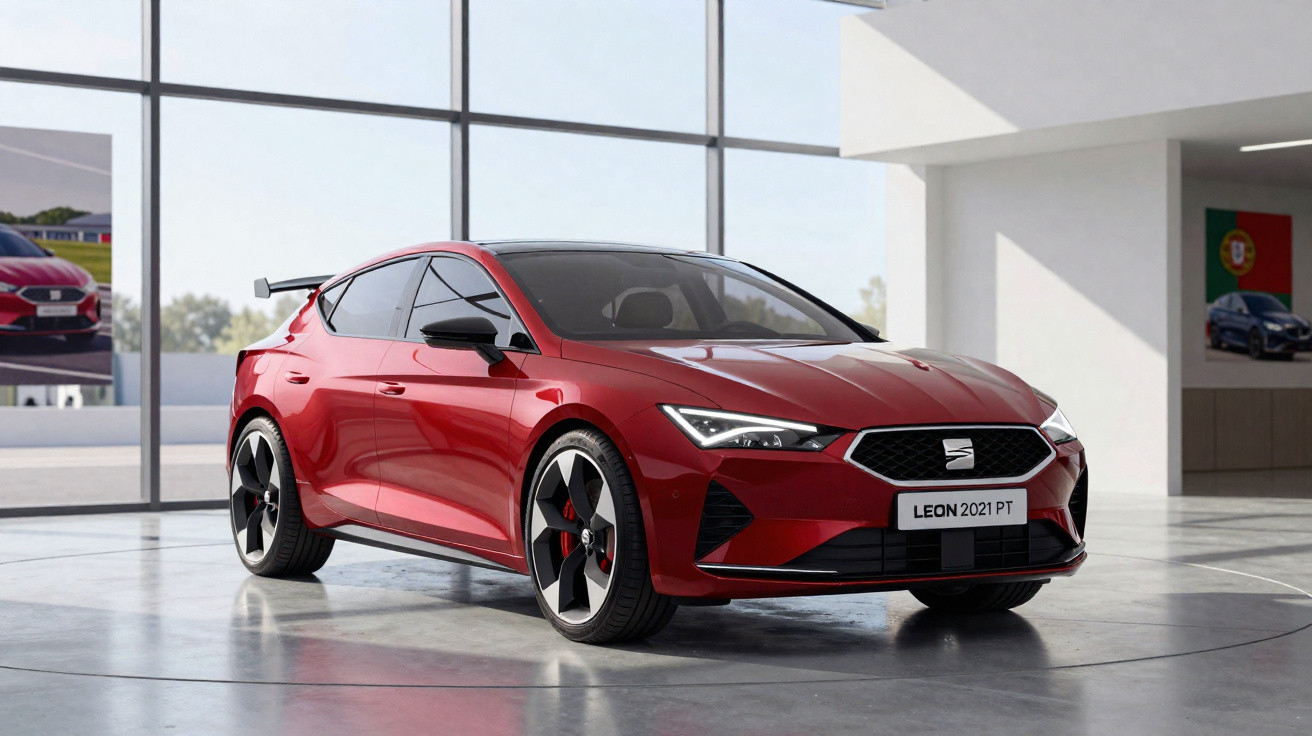
In 2021, the SEAT Leon claimed Portugal’s Car of the Year trophy, taking over the crown from the Toyota Corolla. It was not the first time the Spanish model had been honoured, either, as it had already won the same award in 2001 and again in 2014.
First launched in 1999, the Leon entered the market as a compact car offered exclusively with a five-door bodyshell. Underneath, it shared its platform with its Volkswagen Group “cousins” - the Volkswagen Golf, Audi A3 and Skoda Octavia - and it also had a great deal in common with its close “sibling”, the SEAT Toledo.
It did not take long for the Leon to establish itself across Europe, and Portugal’s 2001 Car of the Year prize reflected that momentum. Interestingly, it also marked SEAT’s second consecutive win, after the Spanish brand had lifted the same trophy the year before with the Toledo.
Penned by Giorgetto Giugiaro, the first-generation Leon represented SEAT’s debut in the compact segment and broke new ground for the company in several ways: it was the first SEAT to be built at the same time in two factories (Brussels and Martorell), the first to offer four-wheel drive paired with a six-speed gearbox, and the first to push beyond 150 hp.
With a distinctive look that helped set trends, the Leon also stood out for the way it was made. It featured a fully galvanised body to guard against corrosion - something that was not typical of SEAT cars at the time. It also offered sophisticated extras - at least by the standards of the era - such as automatic opening of the fuel flap.
As a result, the first-generation Leon had plenty going for it. Production continued until May 2004, and it went on to sell more than 500 000 units.
The SEAT Leon the brand needed
Ever since the Toledo was unveiled at the Barcelona Motor Show in 1991, there had been speculation about potential offshoots, including a coupé and a five-door hatchback.
With the arrival of the Leon, SEAT not only filled one of those gaps, it also strengthened its range with a model that had a much more sporting character than the Toledo. The Toledo carried family duties that the Leon did not need to take on.
Even so, the two cars shared many similarities, starting with the platform mentioned earlier and extending to the cabin, where the standout feature was a dashboard derived from the first-generation Audi A3.
The most powerful Leon had 225 hp
On the petrol side, the Leon line-up began with a 1.4 producing 75 hp, a 1.6 with 100 hp, and a 1.8 that made 125 hp in naturally aspirated form - before reaching 225 hp with a turbocharger in the Cupra R version introduced in 2003.
Added to that was the 2.8 VR6 (Cupra 4), which arrived in 2002 and gave the Leon a naturally aspirated V6 - with 24 valves - delivering 204 hp and 270 Nm of peak torque.
Paired with a six-speed manual gearbox and an all-wheel-drive system, this version ran on to 235 km/h and needed just 7.3s to reach 100 km/h.
As for diesel power, there was a single 1.9 inline four-cylinder. It was offered as a naturally aspirated 68 hp variant and in turbocharged versions with 90, 100, 110, 130 and 150 hp. All of them used direct injection and were always matched to five- or six-speed manual gearboxes.
Sportier versions: FR and Cupra
The FR variant set itself apart with a chromed exhaust, unique bumpers and grey mirror caps. In 2004, to mark the first generation’s farewell, the Spanish brand launched the Leon FR Special Edition, fitted with 17" Cupra wheels plus FR and red badging.
However, the most performance-focused Leon versions took their cue from the 1999 Toledo Concept Cupra and carried the [Cupra] name - a name that would later become, in 2018, an independent brand within the SEAT Group.
That brings us, naturally, to the Cupra models themselves, which featured sportier bumpers, a huge oval chromed exhaust outlet and additional equipment.
At the very top sat the Cupra R versions. They offered up to 225 hp and stood out with an even more aggressive appearance, highlighted by 18" wheels and Brembo brake calipers with drilled discs. On top of that, they placed the “Leon” badge in the centre of the tailgate rather than on the left, as on the more “conventional” versions.
And in motorsport?
The first-generation SEAT Leon Cupra R formed the basis of a one-make trophy contested in seven countries (Spain, United Kingdom, Germany, France, Italy, Hungary and Turkey). The series began in 2003 and became known as the SEAT Leon Supercopa.
Developed by SEAT Sport itself, the car used a 1.8 turbo engine producing 25 hp more than the road-going versions, for a total of 250 hp.
SEAT’s entry into the World Touring Car Championship (WTCC) and the British Touring Car Championship (BTCC) only followed in 2005, by which time the second-generation SEAT Leon had arrived - a model that would go on to enjoy an even more impressive commercial run, with more than 600 000 units sold.
Comments
No comments yet. Be the first to comment!
Leave a Comment